

Daily Devotional
Monday, December 28, 2026 (NS), December 15, 2026 (OS)
Fast Day. No Meat, Fish, Dairy, Eggs, Alcohol or Olive Oil Allowed.
Monday of the Thirty-First Week
The commemoration of Hieromartyr Eleftherios, our venerable Father Paul of Mount Latros, our venerable Father Tryphon of Pechenga, and the holy Hierarch Stephen the Confessor, Archbishop of Sougdaia.
Scripture Readings
Paschalion — Movable Calendar
Monday of the Thirty-First Week
Epistle
The Reading is from the Epistle of Saint Paul to the Hebrews [§ 329]. Brethren:
For Gk. usage, see Heb. 11:17-31; for Sl. usage, see Heb. 11:17-23, 27-31.
11 17By faith Abraham, when he was put to the test, offered up Isaac, and he who received the promises offered up his only-begotten son, 18as to whom it was said “for in Isaac thy seed shall be called [Gen. 21:12],” 19reckoning that God was able to raise even from the dead; from which also he received him for himself in a type. 20By faith Isaac blessed Jacob and Esau concerning coming things. 21By faith Jacob, when he was dying, blessed each of the sons of Joseph, and “did reverence upon the top of his staff [Gen. 47:31].” 22By faith Joseph, when he was dying, made mention concerning the exodus of the sons of Israel, and gave command concerning his bones. 23By faith Moses, after he was born, was hid three months by his parents, because “they saw the little child was fair [cf. Ex. 2:2],” and they were not afraid of the edict of the king. 24By faith Moses, “having become full-grown [Ex. 2:11],” refused to be called the son of pharaoh’s daughter, 25having chosen rather to suffer affliction with the people of God, than to have the temporary enjoyment of sin, 26since he deemed the reproach of Christ greater wealth than the treasures in Egypt; for he kept on looking away from the treasures to the recompense. 27By faith he forsook Egypt, not fearing the anger of the king; for he persevered, as seeing the invisible One. 28By faith he hath celebrated the passover and the pouring upon of the blood, lest the one who destroyeth the firstborn should touch them. 29By faith they passed through the Red Sea as through dry land, where the Egyptians, having made an attempt, were swallowed up. 30By faith the walls of Jericho fell, after they were encircled for seven days. 31By faith Rahab the harlot, having received the spies with peace, did not perish with those who disobeyed.
Gospel
The Reading is from the Holy Gospel according to Saint Mark [§ 33]. At that time:
8 11The Pharisees came to Jesus and began to dispute with Him, seeking from Him a sign from the heaven, putting Him to the test. 12And having groaned in His spirit, He saith, “Why doth this generation seek after a sign? Verily I say to you, there shall be no sign given to this generation.” 13And having left them, He embarked into the ship again and went away to the other side. 14And they forgot to take loaves. And except for one loaf, they did not have any with them in the ship. 15And He repeatedly gave them express orders, saying, “Be taking heed and be wary of the leaven of the Pharisees and the leaven of Herod.” 16And they were reasoning with one another, saying, “It is because we have no loaves.” 17But Jesus, having known it, saith to them, “Why reason ye, because ye have no loaves? Do ye not yet perceive nor comprehend? Have ye still hardened your heart? 18“Having eyes, see ye not? And having ears, hear ye not? And do ye not remember? 19“When I broke the five loaves for the five thousand, how many baskets full of fragments took ye up?” They say to Him, “Twelve.” 20“And when I broke the seven for the four thousand, how many large provision baskets full of fragments took ye up?” And they said, “Seven.” 21And He was saying to them, “Do ye not yet comprehend?”
Menaion — Fixed Calendar
The commemoration of Hieromartyr Eleftherios, our venerable Father Paul of Mount Latros, our venerable Father Tryphon of Pechenga, and the holy Hierarch Stephen the Confessor, Archbishop of Sougdaia.
Epistle
For the Hieromartyr:
The Reading is from the Second Epistle of Saint Paul to Saint Timothy [§ 291]. Child Timothy:
1 8Do thou not become ashamed of the testimony of our Lord, nor me His prisoner, but suffer hardship with the Gospel, according to God’s power, 9Who saved us and called us with a holy calling, not according to our works, but according to His own purpose and grace which was given to us in Christ Jesus before the ages of time, 10but now hath been made manifest by the appearance of our Savior Jesus Christ, Who brought death to nought indeed and brought to light life and incorruption through the Gospel, 11to which I was appointed a herald and apostle and teacher of nations. 12For which cause I also suffer these things, but I am not ashamed; for I know Whom I have believed, and have been persuaded that He is able to guard the deposit entrusted to me until that day. 13Keep on holding fast an outline of sound words which thou heardest from me, in faith and love which are in Christ Jesus. 14Guard thou the good deposit entrusted to thee through the Holy Spirit indwelling in us.
15This thou knowest, that all they who are in Asia were turned away from me, of whom are Phygellos and Hermogenes. 16May the Lord grant mercy to the house of Onesiphoros, for many times he refreshed me, and was not ashamed of my chain; 17but having been in Rome, he sought me out most diligently and found me— 18may the Lord grant him to find mercy from the Lord in that day—and in how many things he ministered in Ephesus thou knowest better than I need say.
For the venerable Fathers:
The Reading is from the Epistle of Saint Paul to the Galatians [§ 213]. Brethren:
5 22The fruit of the Spirit is love, joy, peace, long-suffering, kindness, goodness, faith, 23meekness, self-control; against such things there is no law. 24But they who are of the Christ crucified the flesh with the passions and the lusts. 25If we live by the Spirit, let us also be walking by the Spirit. 26Let us not become vainglorious, provoking one another, envying one another.
6 1Brethren, even if a man should be overtaken in some transgression, ye, the spiritual ones, be restoring such a one in the spirit of meekness, looking out for thyself, lest thou also be tempted. 2Keep on bearing one another’s burdens, and thus fill up the law of the Christ.
For the Hierarch and Confessor:
The Reading is from the Epistle of Saint Paul to the Hebrews [§ 318]. Brethren:
7 26Such a High Priest was fitting for us: holy, guileless, undefiled, Who hath been separated from the sinners and hath become higher than the heavens, 27Who hath no need daily, even as the high priests, to offer up sacrifices, first for his own sins, then for those of the people; for this He did once for all after He offered up Himself. 28For the law appointeth men high priests who have weakness; but the word of the oath, which is after the law, appointeth the Son, Who hath been perfected forever.
8 1Now in reference to the things being spoken of, the chief point is: We have such a High Priest, Who sat down on the right of the throne of the majesty in the heavens, 2a Liturgist of the holies and of the tabernacle, the true one, which the Lord pitched, and not man.
Gospel
For the Hieromartyr:
The Reading is from the Holy Gospel according to Saint Mark [§ 10]. At that time:
2 23During the sabbath days Jesus was going along through the sown fields; and His disciples began to make their way plucking the ears of grain. 24And the Pharisees were saying to Him, “Behold, why do they that which is not lawful on the sabbath days?” 25And He was saying to them, “Did ye not ever read what David did when he had need and hungered, he and those with him: 26“how he entered into the house of God in the time of Abiathar the high priest, and ate the loaves set forth before the presence of God, which it is not lawful to eat, except for the priests, and gave also to those who were with him?” 27And He was saying to them, “The sabbath was made for man, not man for the sabbath. 28“Therefore the Son of Man is Lord also of the sabbath.”
3 1And He entered again into the synagogue; and a man was there whose hand had been withered. 2And they were watching Him closely, whether He would cure him on the sabbath, in order that they might accuse Him. 3And He saith to the man who had the withered hand, “Arise and stand in the midst.” 4And He saith to them, “Is it lawful on the sabbath days to do good or to do evil, to save life or to kill?” But they were silent. 5And having looked round about on them with wrath, being grieved for the hardness of their heart, He saith to the man, “Stretch forth thy hand.” And he stretched it forth, and his hand was restored sound as the other.
For the venerable Fathers:
The Reading is from the Holy Gospel according to Saint Luke [§ 24]. At that time:
6 17Jesus stood upon a level place. And there was a crowd of
His disciples, and a great multitude of the people from all of Judæa and Jerusalem and the
seacoast of Tyre and Sidon, who came to hear Him, and to be healed of their diseases—
18even those who were troubled by unclean spirits; and they were cured.
19And all the crowd was seeking to touch Him, for power was coming forth from Him and
healing all. 20And He lifted up His eyes to His disciples, and began to say:
“Blessed are the poor, for yours is the kingdom of God.
21“Blessed are ye who hunger now, for ye shall be
filled.
Blessed are ye who weep now, for ye shall laugh.
22“Blessed are ye whenever men hate you, and whenever they
separate you, and reproach you, and cast out your name as evil, on account of the Son of
Man.
23“Rejoice in that day and leap for joy, for behold, your
reward is great in the heavens.”
For the Confessor:
The Reading is from the Holy Gospel according to Saint Matthew [§ 11]. The Lord said to His disciples:
5 14“Ye are the light of the world. A city situated on the top of a mountain cannot be hid. 15“Nor do they light a lamp and put it under the bushel, but upon the lampstand, and it giveth light to all those in the house. 16“Thus, let your light shine before men, that they might see your good works, and might glorify your Father Who is in the heavens.
17“Do not begin to think that I came to abolish the law or the prophets; I came not to abolish, but to fulfill. 18“For verily I say to you, until the heaven and the earth shall have passed away, one iota or one tittle in no wise shall pass away from the law, until all shall have taken place. 19“Whosoever then shall break one of the least of these commandments, and shall teach men so, he shall be called least in the kingdom of the heavens; but whosoever shall do and teach them, this one shall be called great in the kingdom of the heavens.”
Lives of the Saints (Prologue)
December 28th – Civil Calendar
December 15th – Church Calendar
1. The Hieromartyr Eleutherius.
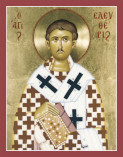 A good fruit of a good tree, this wonderful saint had noble
and eminent parents. He was born in Rome, where his father was in imperial service. His mother,
Anthea, heard the Gospel from the great Apostle Paul himself, and was baptized by him. Being
early left a widow, she entrusted her only son to the education and service of the Bishop of
Rome, Anacletus. Seeing how greatly Eleutherius was gifted and illumined by the grace of God, the
bishop ordained him deacon at the age of fifteen, priest at eighteen and bishop at twenty.
Endowed by God with wisdom, he made up for what he lacked in years. This godly man was made
bishop in Illyria, with his seat at Valona in Albania. He kept his flock like a good shepherd,
adding to their number from day to day. The Emperor Hadrian, a persecutor of Christians, sent a
commander, Felix, with soldiers, to seize Eleutherius and take him to Rome. When the furious
Felix arrived in Valona and went into the church, and heard and saw God’s holy hierarch,
his heart was suddenly changed and he became a Christian. Eleutherius baptized him and set off
with him for Rome, as merrily as though he were going to a feast, not to trial and torture. The
emperor put the gently-born Eleutherius to harsh torture, flogging him, burning him on an iron
grid, boiling him in pitch and burning him in a fiery furnace. But, by God’s power,
Eleutherius was delivered from all these deadly torments. Seeing all this, Choribus the governor
proclaimed that he himself was a Christian. Choribus was tortured and then beheaded, and so also
blessed Felix. Finally, the imperial executioners cut off the honored head of St. Eleutherius.
When his mother, holy Anthea, came and stood over the dead body of her son, she was also
beheaded. Their bodies were taken to Valona, where St. Eleutherius glorifies the name of Christ
to this day by many wonders. He suffered in the time of Hadrian, in the year 120.
A good fruit of a good tree, this wonderful saint had noble
and eminent parents. He was born in Rome, where his father was in imperial service. His mother,
Anthea, heard the Gospel from the great Apostle Paul himself, and was baptized by him. Being
early left a widow, she entrusted her only son to the education and service of the Bishop of
Rome, Anacletus. Seeing how greatly Eleutherius was gifted and illumined by the grace of God, the
bishop ordained him deacon at the age of fifteen, priest at eighteen and bishop at twenty.
Endowed by God with wisdom, he made up for what he lacked in years. This godly man was made
bishop in Illyria, with his seat at Valona in Albania. He kept his flock like a good shepherd,
adding to their number from day to day. The Emperor Hadrian, a persecutor of Christians, sent a
commander, Felix, with soldiers, to seize Eleutherius and take him to Rome. When the furious
Felix arrived in Valona and went into the church, and heard and saw God’s holy hierarch,
his heart was suddenly changed and he became a Christian. Eleutherius baptized him and set off
with him for Rome, as merrily as though he were going to a feast, not to trial and torture. The
emperor put the gently-born Eleutherius to harsh torture, flogging him, burning him on an iron
grid, boiling him in pitch and burning him in a fiery furnace. But, by God’s power,
Eleutherius was delivered from all these deadly torments. Seeing all this, Choribus the governor
proclaimed that he himself was a Christian. Choribus was tortured and then beheaded, and so also
blessed Felix. Finally, the imperial executioners cut off the honored head of St. Eleutherius.
When his mother, holy Anthea, came and stood over the dead body of her son, she was also
beheaded. Their bodies were taken to Valona, where St. Eleutherius glorifies the name of Christ
to this day by many wonders. He suffered in the time of Hadrian, in the year 120.
2. St. Stephen the Confessor of Sourozh.
Born in Cappadocia and educated under the care of the patriarch, St. Germanos, he went off into solitude and lived hidden from the world. An angel appeared to St. Germanos and told him to make Stephen bishop of the town of Sourozh (now Sudak in the Crimea), and this the patriarch did. Stephen brought many to the Christian Faith by his zeal, and suffered much at the hands of the Emperor Leo the Isaurian because of his, Stephen’s, struggle against the iconoclasts, prophesying to the emperor his imminent decease. After the evil death of this evil ruler, Stephen returned to his diocese and was pastor to his flock as a true man of God, departing this life peacefully at the end of the eighth century.
3. Our Holy Father Paul of Latros.
Born in Pergamum (Pergamos), he lived in asceticism on a mountain called Latros in Asia Minor. He was glorified by his asceticism and his many miracles, and entered peacefully into rest in old age, going to the Lord in the year 950.
4. Our Holy Father Pardus the Solitary.
In his youth, he was a wagoneer, but because of an unintentional sin, he left the world and withdrew to the desert to live in asceticism. He lived in Palestine in the sixth century.
FOR CONSIDERATION
For unintentional murder, earthly law frees the murderer. The Church lays penance on the unintentional murderer, a penance much lighter than that for a willful murderer, but does not leave him without a penance. If a priest kills unintentionally, for instance, the Church forbids him to serve as a priest for the rest of his life. Christians with sensitive souls and sharpened consciences take on themselves a harsher penance than the Church lays down. St. Pardus, as a wagoneer, once arrived in Jericho. Leaving his ass in front of an inn, he went in. At that moment, a child fell in front of the ass, and the animal trampled on it and killed it. When Pardus saw the dead and trampled child, killed by his ass, his heart was so burdened that he felt as though he were himself guilty of the child’s death. This conscience-stricken man laid on himself the harshest penance: he abandoned his trade, forsook the world although he was very young, and went off into the arid desert for strict bodily asceticism and spiritual toil and repentance. With many tears, he offered God his repentance for the murder of the child. He desired to give his life for that of the child, and prayed to God that He would somehow bring this about. He searched out a lion, hoping that it would eat him, but the lion fled from him. He lay in the narrow track that the lion had taken, hoping the beast would kill him, but the lion leapt over him and would not touch him. Seeing, therefore, that it was God’s will that he live and not perish, he calmed down, but remained to his death a lowly penitent. Is this not a sensitive, loving and God-fearing soul? Is not this the refined and sharpened conscience of a true Christian?
Daily Scripture Readings taken from The Orthodox New Testament, translated and published by Holy Apostles Convent, Buena Vista, Colorado, copyright © 2000, used with permission, all rights reserved.
Daily Prologue Readings taken from The Prologue of Ochrid, by Bishop Nikolai Velimirovic, translated by Mother Maria, published by Lazarica Press, Birmingham, England, copyright © 1985, all rights reserved. Edited by Dormition Skete.