

Daily Devotional
Thursday, December 24, 2026 (NS), December 11, 2026 (OS)
Fast Day, but Fish, Wine and Olive Oil Allowed.
Thursday of the Thirtieth Week
The commemoration of our venerable father among the saints, Daniel the Stylite, the holy Martyr Myrax of Egypt, and St. Nicon the Dry of the Kiev Caves.
Scripture Readings
Paschalion — Movable Calendar
Thursday of the Thirtieth Week
Epistle
The Reading is from the Epistle of Saint Paul to the Hebrews [§ 326]. Brethren:
10 35Do not begin to cast away your boldness which hath great recompense. 36For ye have need of patience, that, after ye do the will of God, ye might receive for yourselves the promise. 37“For yet a very little while, the One Who cometh will come, and will not delay [cf. Hab. 2:3]. 38“Now the just shall live by faith; and if one should draw himself back, My soul hath no pleasure in him [cf. Hab. 2:4].” 39But we are not of those who draw back to destruction, but of those who are of faith to the saving of the soul.
11 1Now faith is the subsistence of things hoped for, a proof of things not seen. 2For by this the elders were approved by testimony. 3By faith we perceive with the mind the ages to have been put in order by a word of God, so that the things which are seen have not come into being out of things which appear. 4By faith Abel offered to God a sacrifice greater in quality than Cain, by which he was borne witness to as being righteous, God bearing witness upon his gifts; and by it he being dead, yet speaketh. 5By faith Enoch was translated, so as not to see death, “and was not found, because God translated him [Gen. 5:24]”; for before his translation he hath been borne witness to have well pleased God. 6But without faith it is impossible to please Him, for it is needful for him who draweth near to God to have believed that He is, and that He becometh a rewarder to those who seek Him out. 7By faith Noah, after he was divinely warned concerning the things not yet seen, was moved to be wary and prepared an ark to the salvation of his house, by which he condemned the world, and became heir of the righteousness according to faith.
Gospel
The Reading is from the Holy Gospel according to Saint Luke [§ 107]. The Lord said to His disciples:
21 28“Rise up and lift up your heads, because your redemption draweth near.” 29And He spoke a parable to them: “Behold the fig tree and all the trees. 30“Whenever they at once put forth leaves, ye see and know for yourselves that already the summer is near. 31“So also ye, whenever ye see these things coming to pass, know ye that the kingdom of God is near. 32“Verily I say to you, that in no wise shall this generation pass away, until all shall have taken place. 33“The heaven and the earth shall pass away, but My words in no wise shall pass away.”
Menaion — Fixed Calendar
The commemoration of our venerable father among the saints, Daniel the Stylite, the holy Martyr Myrax of Egypt, and St. Nicon the Dry of the Kiev Caves.
Epistle
The Reading is from the First Epistle of Saint Paul to the Thessalonians [§ 270].
4 13Brethren, we do not wish you to be ignorant concerning those who have fallen asleep, that ye may not be grieving, even as the rest who have no hope. 14For if we believe that Jesus died and is risen, so also those who fell asleep through Jesus will God bring with Him. 15For we say this to you by the word of the Lord, that we the living, the ones remaining over until the coming of the Lord, in no wise shall precede those who fell asleep. 16For the Lord Himself shall descend from heaven with a shout of command, with a voice of an archangel, and with a trumpet of God; and the dead in Christ shall rise first. 17Then we the living, the ones remaining over, shall be carried off together with them in clouds to a meeting of the Lord in the air, and so shall we always be with the Lord.
Gospel
The Reading is from the Holy Gospel according to Saint John [§ 16]. The Lord said to the Jews who had come to Him:
5 24“Verily, verily, I say to you, that the one who heareth My word and believeth the One Who sent Me hath everlasting life, and cometh not into judgment, but hath passed over out of death into life. 25“Verily, verily, I say to you, that an hour cometh, and now is, when the dead shall hear the voice of the Son of God, and they who hear shall live. 26“For even as the Father hath life in Himself, so He also gave to the Son to have life in Himself, 27“and He also gave to Him authority to execute judgment. That He is Son of Man, 28“cease marvelling at this; for an hour is coming in which all those in the graves shall hear His voice, 29“and shall go forth—they who did good things to a resurrection of life, but they who practised bad things to a resurrection of condemnation. 30“I am not able to do anything of Myself. Even as I hear, I judge; and My judgment is just, because I seek not Mine own will, but the will of the One Who sent Me, the Father.”
Lives of the Saints (Prologue)
December 24th – Civil Calendar
December 11th – Church Calendar
1. Our Holy Father Daniel the Stylite.
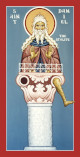 Born in the village of Maroutha, near the city of
Samosata in Mesopotamia, of Christian parents, Elias and Martha, he was a gift of God through the
tearful prayers of his mother, who was barren, and was dedicated to God in his youth. He embraced
the monastic state at the age of twelve and visited St. Simeon the Stylite, receiving his
blessing. Desirous of solitude, Daniel left his monastery and withdrew to an abandoned pagan
temple on the shore of the Black Sea. He endured many assaults from demons, but overcame them all
by prayer, endurance and the sign of the Cross. After that, he climbed up onto a pillar, where he
remained till his death, enduring with equanimity both heat and cold, and attacks from both men
and demons. Many disciples gathered around his pillar, and he led them towards eternal life by
his example and his words. God rewarded His devoted servant with great grace in this life, and he
worked many miracles of help to men, and foretold future events. People came to his pillar from
all parts, seeking help and advice from the saint of God. Kings and patriarchs came to him, as
well as simple folk. The Emperor Leo the Great used to bring his foreign guests, princes and
nobles, and show them Daniel on his pillar, saying: ‘Here is the wonder of my
empire!’ Daniel foretold the day of his own death, taught his disciples as a father would
his children, and took leave of them. At the time of his death, his disciples saw angels,
prophets, apostles and martyrs around the pillar. Having lived in asceticism for eighty years,
this angelic man entered into rest, and into the kingdom of Christ, in 489.
Born in the village of Maroutha, near the city of
Samosata in Mesopotamia, of Christian parents, Elias and Martha, he was a gift of God through the
tearful prayers of his mother, who was barren, and was dedicated to God in his youth. He embraced
the monastic state at the age of twelve and visited St. Simeon the Stylite, receiving his
blessing. Desirous of solitude, Daniel left his monastery and withdrew to an abandoned pagan
temple on the shore of the Black Sea. He endured many assaults from demons, but overcame them all
by prayer, endurance and the sign of the Cross. After that, he climbed up onto a pillar, where he
remained till his death, enduring with equanimity both heat and cold, and attacks from both men
and demons. Many disciples gathered around his pillar, and he led them towards eternal life by
his example and his words. God rewarded His devoted servant with great grace in this life, and he
worked many miracles of help to men, and foretold future events. People came to his pillar from
all parts, seeking help and advice from the saint of God. Kings and patriarchs came to him, as
well as simple folk. The Emperor Leo the Great used to bring his foreign guests, princes and
nobles, and show them Daniel on his pillar, saying: ‘Here is the wonder of my
empire!’ Daniel foretold the day of his own death, taught his disciples as a father would
his children, and took leave of them. At the time of his death, his disciples saw angels,
prophets, apostles and martyrs around the pillar. Having lived in asceticism for eighty years,
this angelic man entered into rest, and into the kingdom of Christ, in 489.
2. Our Holy Father Luke the Stylite.
Luke lived in Constantinople during the reign of the Emperor Constantine Porphyrogenitus. He fought as a soldier in the war against the Bulgars and witnessed the slaughter of many thousands, but he himself emerged from the war alive and unharmed. Seeing the finger of God in his deliverance, he scorned all the vanity of this world, took himself off to a pillar near Chalcedon and there spent forty-five years in asceticism, cleansing his soul from every sinful thought and desire. He entered into rest after a life pleasing to God, some time between 970 and 980, and went to the better life.
3. Our Holy Father Nikon the Dry.
He was enslaved by the Tartars as a monk of the Kiev Caves, and spent three years in captivity, fettered, tortured and abused. When his kinsmen brought the money to ransom him from his owner, he refused, saying: ‘If the Lord had wanted me to be free, He would not have given me into the hands of these lawless men.’ Once he told his owner that Christ would free him in three days. The Tartar thought that this meant that his slave was going to run away, so he cut his tendons below the knee. On the third day, though, Nikon was indeed carried by invisible hands to Kiev. After a time, the Tartar came to Kiev and recognized his former slave. He repented and was baptized, and the former owner became the servant and disciple of his erstwhile slave. Nikon, called ‘the Dry’ because of the great emaciation of his body, was a great visionary and wonder-worker. He entered peacefully into rest in the Lord on December 11th, 1101.
4. The Holy Martyr Meirax.
An Egyptian, he was tricked by the Mohammedan emir into accepting Islam. He later repented, went into a mosque bearing a cross, declared himself a Christian and called upon the Moslems to forsake their errors and turn to the Truth. He was tortured and martyred in about 640.
FOR CONSIDERATION
‘The Lord preserveth all them that love Him’ (Ps. 144:21). The lives of the saints affirm this with sun-like clarity. Certain envious priests complained to Patriarch Anatolios about St. Daniel, slandering him and saying that he was a magician. This sprang from their jealousy of the young ascetic, who had outstripped them in every virtue and had drawn many to himself by his manner of life. The patriarch summoned Daniel, and examined him in his faith and his way of life. Daniel having laid all before him, the patriarch rose from his seat and embraced him, speaking highly of him and sending him away in peace. Several days later, Patriarch Anatolios fell ill, and he called Daniel and asked him to pray to God for his recovery. Daniel prayed, and the patriarch was instantly restored to health. When the patriarch sought to reward Daniel in some way, the young saint asked, as his reward, that his slanderers be pardoned. The patriarch said: ‘How could I not forgive them when they are the means of such a great blessing—that I should come to know you and obtain healing through you?’ Indeed, ‘the Lord preserveth all them that love Him,’ and turns to good the evil that men devise.
While St. Nikon the Dry was a slave among the Tartars, his master became sick and was at the point of death. Realizing that he was in this state, he ordered his sons to crucify Nikon on his grave. St. Nikon foresaw the future Baptism of his cruel master, and prayed to God for his recovery. Against all expectation, the Tartar recovered. Thus, through prayer, Nikon saved himself from physical death and his master from the death of his soul.
Daily Scripture Readings taken from The Orthodox New Testament, translated and published by Holy Apostles Convent, Buena Vista, Colorado, copyright © 2000, used with permission, all rights reserved.
Daily Prologue Readings taken from The Prologue of Ochrid, by Bishop Nikolai Velimirovic, translated by Mother Maria, published by Lazarica Press, Birmingham, England, copyright © 1985, all rights reserved. Edited by Dormition Skete.