

Daily Devotional
Wednesday, December 2, 2026 (NS), November 19, 2026 (OS)
Fast Day. No Meat, Fish, Dairy, Eggs, Alcohol or Olive Oil Allowed.
Wednesday of the Twenty-Seventh Week
The commemoration of the holy Prophet Obadios (Obadiah), and the holy Martyr Barlaam of Cæsarea in Cappadocia, and our fathers among the saints, Barlaam and Ioasaph the Prince of India.
Scripture Readings
Paschalion — Movable Calendar
Wednesday of the Twenty-Seventh Week
Epistle
The Reading is from the First Epistle of Saint Paul to Saint Timothy [§ 287]. Child Timothy:
5 22Do not be laying hands quickly on anyone, nor taking part in the sins of others; be keeping thyself pure. 23Be drinking water no longer, but be using a little wine for thy stomach and thy frequent infirmities. 24The sins of some men are manifest beforehand, going before to judgment, but some men they also follow after. 25In like manner also the good works of some are manifest beforehand, and those that are otherwise cannot be hid.
6 1Let as many as are under a yoke as slaves be deeming their own masters worthy of all honor, in order that the name of God and the teaching may not be blasphemed. 2And they that have believing masters, cease despising them, because they are brethren; but rather be rendering them service, because they are faithful and beloved who are themselves conferring benefits in return.
These things be teaching and exhorting. 3If anyone teach differently and draw not near to sound words—those of our Lord Jesus Christ, and the teaching according to piety— 4he hath been puffed up with pride, knowing nothing, but is sick concerning questions and disputes about words, out of which cometh envy, strife, blasphemies, evil suspicions, 5wasting time with wearing disputations of people who have been corrupted in mind and deprived of the truth, supposing piety to be a means of gain. Be withdrawing from such. 6But piety with sufficiency is a great means of gain. 7For we brought nothing into the world, and it is manifest that neither are we able to carry anything out; 8but having sustenance and coverings, we shall be satisfied with these. 9Now they who wish to be rich fall into temptation and a snare and many foolish and harmful desires, which sink men into destruction and perdition. 10For the love of money is a root of all evils, by which some, reaching out for themselves, were led astray from the faith and pierced themselves with many griefs.
11But thou, O man of God, be fleeing these things; and be pursuing righteousness, piety, faith, love, patience, meekness.
Gospel
The Reading is from the Holy Gospel according to Saint Luke [§ 78]. At that time:
15 1All the tax collectors and the sinners were drawing near to hear Jesus. 2And the Pharisees and the scribes were murmuring, saying, “This One receiveth sinners and eateth with them.” 3And He spoke this parable to them, saying, 4“What man among you, having a hundred sheep and having lost one of them, doth not leave the ninety-nine in the wilderness and go after the lost one until he should find it? 5“And having found it, he layeth it upon his own shoulders, rejoicing. 6“And after he cometh to the house, he calleth together his friends and the neighbors, saying to them, ‘Rejoice with me, for I found my sheep which hath been lost.’ 7“I say to you that thus there shall be more joy in the heavens over one sinner who repenteth than over ninety-nine righteous ones who have no need of repentance. 8“Or what woman having ten drachmas, if she should lose one drachma, doth not light a lamp, and sweep the house, and seek diligently until she should find it? 9“And having found it, she calleth together her friends and neighbors, saying, ‘Rejoice with me, for I found the drachma which I lost.’ 10“Thus, I say to you, joy ariseth in the presence of the angels of God over one sinner who repenteth.”
Menaion — Fixed Calendar
The commemoration of the holy Prophet Obadios (Obadiah), and the holy Martyr Barlaam of Cæsarea in Cappadocia, and our fathers among the saints, Barlaam and Ioasaph the Prince of India.
Epistle
The Reading is from the Epistle of Saint Paul to the Colossians [§ 250]. Brethren:
1 12Give thanks to the God and Father Who rendereth us sufficient for the portion of the lot of the saints in the light, 13Who delivered us from the power of the darkness and translated us into the kingdom of the Son of His love, 14in Whom we have the redemption through His blood, the forgiveness of sins, 15Who is the image of the invisible God, the firstborn of all creation. 16For in Him were all things created, the things in the heavens and the things upon the earth, the visible and the invisible, whether thrones, or dominions, or principalities, or authorities. All things through Him and to Him have been created. 17And He is before all things, and in Him all things have come into existence. 18And He is the head of the body, the Church, Who is the beginning, the firstborn from the dead, that in all things He might come to hold first place.
Gospel
No reading given.
Lives of the Saints (Prologue)
December 2nd – Civil Calendar
November 19th – Church Calendar
1. The Holy Prophet Obadiah.
Obadiah (Obdios) lived at the court of King Ahab, but when the king turned away from true worship and bowed down to idols, Obadiah did not follow the king’s example, but continued to serve the one, true God. When the wicked Queen Jezebel, because of her feud with Elias, hunted down all the prophets of God, Obadiah took a hundred of them and hid them in two caves, feeding them till the persecution was over (III Kings 18:4). A contemporary of the great Prophet Elias, Obadiah revered him greatly and hearkened to him in all things, being a follower and pupil of his. He lived nine hundred years before Christ, and entered peacefully into rest.
2. The Holy Martyr Barlaam.
He was born in Antioch, and was harshly tortured by the dishonorable judge for his faith in Christ the Lord. The judge decided to use ridicule, and to put such pressure on him that he would offer sacrifice to idols. He accordingly took him to the temple and applied fire to his palm, putting incense on the fire with the thought that the martyr would be forced by the pain to throw the fire and incense from his hand in front of the idols, and thus involuntarily offer them incense. But this heroic soldier of Christ held the fire on his palm, and would not cast it before the idols, until his fingers were burned and fell off, and his palm was burned through and fell to the ground with the fire. ‘He had a right hand stronger than fire,’ said St. Basil the Great, ‘for, though the flames consumed it, still the hand held the fire as ash.’ St. Chrysostom writes: ‘The angels looked from the heights; the archangels beheld, for the scene was majestic, surpassing in truth all human nature. Lo, who would not wish to see a man who made such an ascetic endeavor and did not feel that which it is common to man to feel; a man who was himself the altar of sacrifice, and the sacrifice, and the priest?’ When his hand had burned off, his body fell dead to the ground and his soul went to the eternal rest of his Lord and Savior. This glorious and heroic elder suffered in the year 304.
3. Our Holy Fathers Barlaam and Ioasaph the Heir.
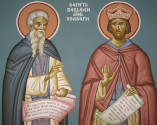 They were Indian
ascetics. Ioasaph was son and heir to King Abenner. By God’s providence he was visited by
the elder Barlaam, who taught him the Christian Faith and baptized him. After that, the elder
went off into the mountains to live in asceticism, and Ioasaph remained to wrestle with many
temptations in the world and to overcome them by the grace of God. Ioasaph finally succeeded in
bringing his father to Christ. When he had been baptized, King Abenner lived a further four years
in deep repentance (for he had committed grave sins in his persecution of Christians) and then
finished his earthly course and went to the better life. The young Ioasaph entrusted the kingdom
to his friend Barachias, and himself went off into the desert to live in asceticism for the sake
of Christ. His one desire on earth was to see his spiritual father, Barlaam, once more. God, in
His mercy, fulfilled his desire, and one day, Ioasaph stood before Barlaam’s cave, and
called: ‘Bless me, father!’ The elder Barlaam lived in asceticism in the desert for
seventy years, living a hundred years in all. St. Ioasaph handed over his kingdom at the age of
twenty-five and went into the desert, where he lived a further thirty-five years. They both had
great love for the Lord Jesus, brought many to the true Faith and entered into the eternal joy of
their Lord.
They were Indian
ascetics. Ioasaph was son and heir to King Abenner. By God’s providence he was visited by
the elder Barlaam, who taught him the Christian Faith and baptized him. After that, the elder
went off into the mountains to live in asceticism, and Ioasaph remained to wrestle with many
temptations in the world and to overcome them by the grace of God. Ioasaph finally succeeded in
bringing his father to Christ. When he had been baptized, King Abenner lived a further four years
in deep repentance (for he had committed grave sins in his persecution of Christians) and then
finished his earthly course and went to the better life. The young Ioasaph entrusted the kingdom
to his friend Barachias, and himself went off into the desert to live in asceticism for the sake
of Christ. His one desire on earth was to see his spiritual father, Barlaam, once more. God, in
His mercy, fulfilled his desire, and one day, Ioasaph stood before Barlaam’s cave, and
called: ‘Bless me, father!’ The elder Barlaam lived in asceticism in the desert for
seventy years, living a hundred years in all. St. Ioasaph handed over his kingdom at the age of
twenty-five and went into the desert, where he lived a further thirty-five years. They both had
great love for the Lord Jesus, brought many to the true Faith and entered into the eternal joy of
their Lord.
4. The Holy Martyr Heliodoros.
He was from the town of Magidos in Pamphylia, and was tortured for the Christian Faith in the time of the Emperor Aurelian (270-275). While undergoing harsh torture, he heard a voice from heaven: ‘Fear not; I am with thee!’ Thrown into a white-hot copper ox, he prayed fervently to God, and God saved him. The white-hot ox was suddenly cooled, and Heliodoros emerged alive. The judge cried to him that some sort of magic had done that, but to this the martyr replied: ‘My magic is Christ!’ He was then beheaded and went to the Lord.
FOR CONSIDERATION
A tale by the elder Barlaam to Ioasaph: A man was fleeing from a unicorn. Fleeing thus, he fell into a pit and grabbed hold of a tree. Thinking he was out of danger, he looked down and saw two bears, one black and one white, gnawing alternately and with great persistence at the roots of the tree in an attempt to gnaw them through and bring the tree crashing down. Looking even further down, he saw a huge and deadly snake, which, with jaws wide open, was waiting to devour him when the tree had been felled. He then saw four smaller, poisonous snakes around his feet. Looking upwards through the tree, he saw a small honeycomb in the branches, and forgetting all the danger that encompassed him, stretched out his hand to reach that small sweetness in the tree. The interpretation is this: the unicorn represents death, which from Adam till now pursues a man to kill him; the pit filled with all sorts of dangers is this world; the tree is the path of our life; the white and black bears are day and night, which alternate in order to shorten our days; the huge and terrible snake is hell; the four poisonous snakes are the four elements of which our bodies are composed; the small honeycomb in the tree is that small sweetness that life offers to man. Oh, when will men learn not to be enraptured by this empty sweetness, and forgetful of the terrible dangers that surround them and draw them down to eternal ruin?
Daily Scripture Readings taken from The Orthodox New Testament, translated and published by Holy Apostles Convent, Buena Vista, Colorado, copyright © 2000, used with permission, all rights reserved.
Daily Prologue Readings taken from The Prologue of Ochrid, by Bishop Nikolai Velimirovic, translated by Mother Maria, published by Lazarica Press, Birmingham, England, copyright © 1985, all rights reserved. Edited by Dormition Skete.