

Daily Devotional
Sunday, November 29, 2026 (NS), November 16, 2026 (OS)
Fast Day, but Fish, Wine and Olive Oil Allowed.
Fourth Period
Sunday of the Twenty-Sixth Week
Mode One — Fourth Eothinon
The commemoration of the holy Apostle and Evangelist Matthew.
Scripture Readings
Paschalion — Movable Calendar
Fourth Period
Sunday of the Twenty-Sixth Week
Mode One — Fourth Eothinon
Epistle
The Reading is from the Epistle of Saint Paul to the Ephesians [§ 229]. Brethren:
5 8Be walking as children of light— 9for the fruit of the Spirit is in all goodness and righteousness and truth— 10proving what is well-pleasing to the Lord. 11And cease having fellowship with the unfruitful works of darkness, but rather even reprove them. 12For it is shameful even to speak of the things which are done by them in secret. 13But all things which are reproved are made manifest by the light; for all which is made manifest is light. 14Wherefore, He saith, “Rouse thyself, thou who sleepest, and arise from the dead, and the Christ shall shine on thee [cf. Is. 9:2, 26:19, 52:1, 60:1, 2].”
15Be taking heed then how exactly ye walk, not as unwise ones, but as wise ones, 16redeeming the time, because the days are evil. 17On this account cease becoming foolish, but become as ones understanding what the will of the Lord is. 18And cease being drunk with wine, in which is prodigality, but keep on being filled with the Spirit, 19speaking to one another in psalms and hymns and spiritual songs, singing and chanting in your heart to the Lord.
Gospel
The Reading is from the Holy Gospel according to Saint Luke [§ 53]. At that time:
10 25A certain doctor of the law came to Jesus, tempting Him, and saying, “Teacher, by having done what shall I inherit eternal life?” 26And He said to him, “In the law what hath been written? How readest thou?” 27And he answered and said, “Thou shalt love the Lord thy God with all thy heart, and with all thy soul, and with all thy strength, and with all thy mind [cf. Deut. 6:5; 11:13]; and thy neighbor as thyself [cf. Lev. 19:18].” 28And He said to him, “Thou didst answer rightly; be doing this, and thou shalt live.” 29But he, wishing to justify himself, said to Jesus, “And who is my neighbor?” 30And taking it up, Jesus said, “A certain man was going down from Jerusalem to Jericho, and fell among robbers, who both stripped him and laid blows upon him, and went away, leaving him, as it happened, half-dead. 31“Now, by a coincidence, a certain priest was going down on that road. And having seen him, he passed by on the opposite side. 32“And in like manner also a Levite, having come to be by the place, came and saw him, and passed by on the opposite side. 33“But a certain Samaritan, as he journeyed, came down to him; and having seen him, he was moved with compassion. 34“And he drew near and bound up his wounds, pouring over oil and wine; and he put him upon his own beast, and brought him to an inn, and took care of him. 35“And on the morrow, after he came forth, he took out two denarii, and gave them to the innkeeper, and said to him, ‘Take care of him; and whatsoever thou shalt spend besides, on my coming back, I will repay thee.’ 36“Which then of these three seemeth to thee to have proved to be a neighbor of the one who fell among the robbers?” 37And he said, “The one who rendered mercy in dealing with him.” Then Jesus said to him, “Go on thy way, and be thou doing in like manner.”
Menaion — Fixed Calendar
The commemoration of the holy Apostle and Evangelist Matthew.
Epistle
The Reading is from the First Epistle of Saint Paul to the Corinthians [§ 131]. Brethren:
4 9I think that God showed forth us the apostles last, as condemned to death; for we became a spectacle to the world, both to angels and to men. 10We are fools for Christ’s sake, but ye are wise in Christ. We are weak, but ye are strong. Ye are held in honor, but we are dishonored. 11Until the present hour, we both hunger and thirst, and are naked, and are being buffeted, and never at rest. 12And we toil working with our own hands. Being reviled, we bless; being persecuted, we bear up; 13being evilly spoken of, we beseech. We became as the filth of the world, the off-scouring of all until now. 14I do not write these things shaming you, but admonishing you as my beloved children. 15For if ye have myriads of tutors in Christ, yet ye have not many fathers; for in Christ Jesus I begot you through the Gospel. 16Therefore, I beseech you, keep on becoming imitators of me.
Gospel
The Reading is from the Holy Gospel according to Saint Matthew [§ 30]. At that time:
9 9As Jesus passed by from that place, He saw a man called Matthew sitting at the custom-house. And He saith to him, “Follow thou Me.” And he rose up and followed Him. 10And it came to pass, as He reclined at table in the house, also behold, many tax collectors and sinners came and were reclining at table with Jesus and His disciples. 11And after the Pharisees saw Him, they said to His disciples, “Why eateth your Teacher with the tax collectors and sinners?” 12And Jesus, having heard it, said to them, “They who are strong have no need of a physician, but they who are ill. 13“But go and learn what this is, ‘I wish mercy, and not sacrifice [cf. Hos. 6:6]’: For I came not to call the righteous, but sinners to repentance.”
Lives of the Saints (Prologue)
November 29th – Civil Calendar
November 16th – Church Calendar
1. The Holy Apostle Matthew the Evangelist.
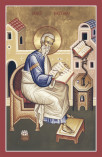 Matthew the son of Alphaeus was at first a
tax-collector, and it was as such that the Lord saw him in Capernaum and said to him:
‘Follow Me!’ Leaving everything, he followed Him (Matt. 9:9). After that, Matthew
prepared a feast in his house, and there provided an opportunity for the Lord to voice some great
truths about His coming to earth. After receiving the Holy Spirit, Matthew preached the Gospel
among the Parthians and Medes and in Ethiopia, the land of the negroes. In Ethiopia, he
consecrated as bishop one Platon, a follower of his, and himself withdrew to prayerful solitude
on a mountain, where the Lord appeared to him. Matthew baptized the wife and son of the prince of
that land, at which the prince was greatly enraged and sent a guard to bring Matthew before him
for trial. The soldiers went off, but returned to the prince, saying that they had heard
Matthew’s voice, but had been unable to set eyes on him. The prince then sent a second
guard. When this guard drew near to the apostle, he shone with a heavenly radiance so brilliant
that the soldiers were unable to look at him, but threw down their weapons in terror and returned
home. The prince then went himself. When he approached Matthew, such radiance shone forth from
the saint that the prince was blinded on the instant. But the apostle had a kind heart: he prayed
to God and the prince’s sight was restored—unfortunately, only on the physical plane, his
spiritual eyes remaining closed. He seized St. Matthew and put him to harsh torture, twice
lighting a fire on his chest, but the power of God kept him alive and unharmed. Then the apostle
prayed to God, and gave his spirit into His hands. The prince commanded that the martyr’s
body be put into a leaden coffin and cast into the sea. The saint appeared to Bishop Platon and
told him where to find his body in its coffin, and the bishop went and brought them back. Seeing
this new marvel, the prince was baptized and received the name Matthew. He then set aside all
earthly vanity and became a priest, serving the Church in a manner pleasing to God. When Platon
died, the Apostle Matthew appeared to this Matthew and counseled him to accept the episcopate. So
he became a bishop, and was a good shepherd for many years, until God took him to His immortal
kingdom. St. Matthew the Apostle wrote his Gospel in Aramaic, and it was very soon translated
into Greek. It has come down to us in Greek, the Aramaic original being lost. Of this evangelist,
it is said that he never ate meat, but fed only on vegetables and fruit.
Matthew the son of Alphaeus was at first a
tax-collector, and it was as such that the Lord saw him in Capernaum and said to him:
‘Follow Me!’ Leaving everything, he followed Him (Matt. 9:9). After that, Matthew
prepared a feast in his house, and there provided an opportunity for the Lord to voice some great
truths about His coming to earth. After receiving the Holy Spirit, Matthew preached the Gospel
among the Parthians and Medes and in Ethiopia, the land of the negroes. In Ethiopia, he
consecrated as bishop one Platon, a follower of his, and himself withdrew to prayerful solitude
on a mountain, where the Lord appeared to him. Matthew baptized the wife and son of the prince of
that land, at which the prince was greatly enraged and sent a guard to bring Matthew before him
for trial. The soldiers went off, but returned to the prince, saying that they had heard
Matthew’s voice, but had been unable to set eyes on him. The prince then sent a second
guard. When this guard drew near to the apostle, he shone with a heavenly radiance so brilliant
that the soldiers were unable to look at him, but threw down their weapons in terror and returned
home. The prince then went himself. When he approached Matthew, such radiance shone forth from
the saint that the prince was blinded on the instant. But the apostle had a kind heart: he prayed
to God and the prince’s sight was restored—unfortunately, only on the physical plane, his
spiritual eyes remaining closed. He seized St. Matthew and put him to harsh torture, twice
lighting a fire on his chest, but the power of God kept him alive and unharmed. Then the apostle
prayed to God, and gave his spirit into His hands. The prince commanded that the martyr’s
body be put into a leaden coffin and cast into the sea. The saint appeared to Bishop Platon and
told him where to find his body in its coffin, and the bishop went and brought them back. Seeing
this new marvel, the prince was baptized and received the name Matthew. He then set aside all
earthly vanity and became a priest, serving the Church in a manner pleasing to God. When Platon
died, the Apostle Matthew appeared to this Matthew and counseled him to accept the episcopate. So
he became a bishop, and was a good shepherd for many years, until God took him to His immortal
kingdom. St. Matthew the Apostle wrote his Gospel in Aramaic, and it was very soon translated
into Greek. It has come down to us in Greek, the Aramaic original being lost. Of this evangelist,
it is said that he never ate meat, but fed only on vegetables and fruit.
2. Our Holy Father Sergius of Malopinega.
He was a Russian parish priest. As a priest, he lived a godly life and served for twenty-two years in the Vologda region. He entered peacefully into rest on November 16th, 1585, at the age of ninety-two.
FOR CONSIDERATION
Does the Lord’s commandment about unceasing prayer (Lk. 18:1) apply only to monks, or to all Christians? If it applied only to monks, the apostle would not have written to the Christians in Thessalonica: ‘Pray without ceasing’ (I Thess. 5:17). The apostle, then, reiterates the Lord’s command word for word, and gives it to all Christians without distinction of monk or layman. St. Gregory Palamas lived for some time as a young man in a monastery in Beroea. There lived in those parts a well-known ascetic, the elder Job, who was venerated by all. It happened at one time that St. Gregory, in the elder’s presence, quoted the apostle’s words, asserting that unceasing prayer was a necessity for all Christians, not only for monks. The elder Job replied to these words, saying that the Jesus Prayer is a necessity only for monks, and not for all Christians. Gregory, being a young man, ceded the argument, not wishing to quarrel, and withdrew in silence. When Job had returned to his cell and was standing in prayer, an angel of God appeared to him in great heavenly glory, and said to him: ‘Elder, don’t doubt the truth of Gregory’s words; he spoke truly. So, hold your peace and advise others to do the same.’ Thus, then, both the apostle and the angel underlined the commandment that all Christians must pray to God without ceasing. If not unceasingly in church, then unceasingly in every place and at every time, in the depths of your heart. If God does not for a moment tire of giving us good things, how can we tire of thanking Him for these good things? If He is constantly thinking of us, why do we not think constantly of Him?
Daily Scripture Readings taken from The Orthodox New Testament, translated and published by Holy Apostles Convent, Buena Vista, Colorado, copyright © 2000, used with permission, all rights reserved.
Daily Prologue Readings taken from The Prologue of Ochrid, by Bishop Nikolai Velimirovic, translated by Mother Maria, published by Lazarica Press, Birmingham, England, copyright © 1985, all rights reserved. Edited by Dormition Skete.