

Daily Devotional
Saturday, November 14, 2026 (NS), November 1, 2026 (OS)
No Fasting.
Saturday of the Twenty-Fourth Week
The commemoration of the holy Wonder-workers and Unmercenaries Kosmas and Damian.
Scripture Readings
Paschalion — Movable Calendar
Saturday of the Twenty-Fourth Week
Epistle
The Reading is from the Second Epistle of Saint Paul to the Corinthians [§ 191]. Brethren:
11 1Would that ye were bearing with me in a little foolishness! But indeed ye do bear with me. 2For I am jealous over you with a jealousy of God; for I myself betrothed you to one Husband, in order to present you as a pure virgin to the Christ; 3but I fear, lest in any way, as the serpent deceived Eve by his craftiness, your thoughts in this manner should be corrupted from the simplicity which is toward the Christ. 4For if indeed the one who cometh proclaimeth another Jesus whom we did not proclaim, or if ye receive another spirit which ye did not receive, or another gospel which ye did not accept, well were ye bearing with him. 5For I reckon to have come behind in nothing of the exceedingly super apostles. 6But even if I am unskilled in speech, yet not in knowledge; but in every way we have been made manifest to you in all things.
Gospel
The Reading is from the Holy Gospel according to Saint Luke [§ 36]. The Lord said:
8 16“No one, having lit a lamp, covereth it with a vessel or putteth it underneath a bed, but placeth it upon a lampstand, that they who enter in may see the light. 17“For nothing is secret which shall not become manifest, nor hidden that shall not be known and come to light. 18“Be taking heed then how ye hear: for whosoever hath, it shall be given to him; and whosoever hath not, even what he seemeth to have shall be taken away from him.”
19And His Mother and brethren came to Him, and were not able to meet with Him on account of the crowd. 20And it was reported to Him by some who said, “Thy Mother and Thy brethren are standing outside, wishing to see Thee.” 21And He answered and said to them, “My mother and My brethren are these who hear the word of God and do it.”
Menaion — Fixed Calendar
The commemoration of the holy Wonder-workers and Unmercenaries Kosmas and Damian.
Epistle
The Reading is from the First Epistle of Saint Paul to the Corinthians [§ 153]. Brethren:
12 27Ye are the body of Christ, and members severally.
28And God set for Himself some in the Church: first apostles, second prophets, third teachers, then works of power, then free gifts of healings, helps, governments, kinds of tongues. 29All are not apostles, are they? All are not prophets, are they? All are not teachers, are they? All do not have works of power, do they? 30All do not have free gifts of healings, do they? All do not speak with tongues, do they? 31All do not interpret, do they? But keep on desiring earnestly the better gifts of grace. And yet I show you a more surpassing way.
13 1If I speak with the tongues of men and of angels, but I have not love, I have become as sounding brass or a clanging cymbal. 2And if I have prophecy, and know all the mysteries and all the knowledge, and if I have all the faith, so as to remove mountains from one place to another, but I have not love, I am nothing. 3And if I dole out all of my goods, and if I deliver up my body that I may be burned, but I have not love, I am being profited nothing. 4Love is long-suffering, is kind; love is not jealous; love vaunteth not itself, is not puffed up; 5doth not behave unseemly, seeketh not its own, is not provoked, thinketh no evil; 6rejoiceth not in unrighteousness, but rejoiceth with the truth; 7covereth all things, believeth all things, hopeth all things, endureth all things. 8Love never falleth away.
Gospel
The Reading is from the Holy Gospel according to Saint Matthew [§ mid 34]. At that time:
10 1After Jesus called to Himself His twelve disciples, He gave to them authority over unclean spirits, so as to cast them out, and to cure every disease and every weakness.... 5These twelve Jesus sent forth, and commanded them, saying, “Do not begin to go into the way of the nations, and do not begin to enter into a city of the Samaritans. 6“But go rather to the sheep, the lost of the house of Israel. 7“And as ye go, be preaching, saying, ‘The kingdom of the heavens hath drawn near.’ 8“Be healing the sick, cleansing lepers, raising the dead, casting out demons; freely ye received, freely give.”
Lives of the Saints (Prologue)
November 14th – Civil Calendar
November 1st – Church Calendar
1. Ss. Kosmas and Damian.
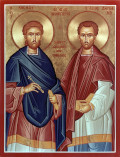 Unmercenaries and wonder-workers, they were brothers in the flesh
and in the spirit, born somewhere in Asia of a pagan father and a Christian mother. After their
father’s death, their mother, Theodota, devoted all her time and energy to the bringing-up
of her sons as true Christians. God helped her, and her sons grew as two choice fruits and as two
holy lamps. They were skilled in medicine and ministered to the sick without payment, and so
fulfilled Christ’s command: ‘Freely have ye received; freely give’ (Matt. 10:
8). They were so strict in their unpaid ministry to men that Kosmas became greatly enraged with
his brother Damian when he took three eggs from a woman, Palladia, and gave orders that, after
his death, he should not be buried with his brother. In fact, holy Damian had not taken those
eggs as a reward for healing Palladia’s sickness, but because she had sworn by the Most
Holy Trinity that he should have them. However, after their death in Fereman, they were buried
together in obedience to a revelation from God. These two holy brothers were great wonder-workers
both during their lifetime and after their death. A farm laborer, on lying down to sleep at one
time, was attacked by a snake, which entwined itself around his mouth and stomach. This poor man
would have breathed his last in the greatest torment had he not at the last moment invoked the
help of Saints Kosmas and Damian. Thus the Lord glorified forever by miracles those who glorified
Him here on earth by their faith, purity and mercy.
Unmercenaries and wonder-workers, they were brothers in the flesh
and in the spirit, born somewhere in Asia of a pagan father and a Christian mother. After their
father’s death, their mother, Theodota, devoted all her time and energy to the bringing-up
of her sons as true Christians. God helped her, and her sons grew as two choice fruits and as two
holy lamps. They were skilled in medicine and ministered to the sick without payment, and so
fulfilled Christ’s command: ‘Freely have ye received; freely give’ (Matt. 10:
8). They were so strict in their unpaid ministry to men that Kosmas became greatly enraged with
his brother Damian when he took three eggs from a woman, Palladia, and gave orders that, after
his death, he should not be buried with his brother. In fact, holy Damian had not taken those
eggs as a reward for healing Palladia’s sickness, but because she had sworn by the Most
Holy Trinity that he should have them. However, after their death in Fereman, they were buried
together in obedience to a revelation from God. These two holy brothers were great wonder-workers
both during their lifetime and after their death. A farm laborer, on lying down to sleep at one
time, was attacked by a snake, which entwined itself around his mouth and stomach. This poor man
would have breathed his last in the greatest torment had he not at the last moment invoked the
help of Saints Kosmas and Damian. Thus the Lord glorified forever by miracles those who glorified
Him here on earth by their faith, purity and mercy.
2. The Holy Martyr Hermenegild the Heir.
He was the son of the Gothic King Luvigeld, who held the Arian heresy. Hermenegild, however, did not turn from Orthodoxy, in spite of the flattery and threats of his brutal, heretic father. His father threw him into prison, and on Pascha, sent a heretic bishop early in the morning to give him Communion. This man of God would not receive Communion at the hands of a heretic; a fact that the bishop passed on to the king. The king was furious, and ordered the executioners to cut off Hermenegild’s head, which came to pass in 586. Luvigeld later repented of having killed his son and recognized his heresy, but he never officially returned to Orthodoxy before his death.
3. Our Holy Father, the Martyr Iakovos, with his disciples Iakovos and Dionysius.
He was born in the diocese of Kastoria, of parents called Martin and Paraskeve. Working as a shepherd, Iakovos became rich and thus incurred the envy of his brother, who reported him to the Turks as having found some money in the ground. Iakovos fled to Constantinople, where he became poor. He was once the guest of a Turkish bey. The Turks were eating meat, but Iakovos was fasting. The bey said: ‘Your Christian Faith is indeed great!’ and he related how his wife had been sick in mind and how, after trying all doctors and medicines, he had taken her to the patriarch for prayers to be read over her. As soon as the patriarch opened the book to read, a heavenly light filled the church. When the prayer was ended, his wife was made whole. Iakovos, hearing how the bey extolled the Christian Faith, gave away all that he had and went to the Holy Mountain, where he became a monk in the monastery of Iviron. He lived in asceticism on the Holy Mountain, and suffered for the Faith at the hands of the Turks in Jedrene on November 1st, 1520. His wonder-working relics and those of his disciples are preserved in the monastery of St. Anastasia near Thessalonica.
FOR CONSIDERATION
St. Hilarion of Meglin waged a fierce battle against the Bogomils. At one time, the leaders of the Bogomils came to Hilarion and began to dispute with him about faith. The Bogomils taught that God created the spiritual world, but that the material world was the work of the devil. Hilarion replied to this that it is written in the Scriptures: ‘God is the King of all the earth’ (Ps. 46:7), and also: ‘The earth is the Lord’s, and the fullness thereof’ (Ps. 23:1). The Bogomils asserted that the Old Testament was of the devil. To this the saint replied: ‘If the Old Testament indeed came from the devil, could Christ have said: “Search the Scriptures: they testify of Me” (John 5:39), and could He have stated that the greatest commandments are those on love of God and one’s neighbor that were aforetime given by Moses?’ The Bogomils also asserted that Christ brought His body with Him from heaven. To this St. Hilarion replied that, had it been thus, then the body of Christ would not have felt hunger or thirst, nor weariness and suffering, nor would it have undergone death. The Bogomils then showed their disapprobation of the sign of the Cross that Orthodox Christians make. To this, the saint replied: ‘And what will you do when the sign of the Son of Man, the Cross, appears in the heavens, and when all the nations of the world who did not believe in the Cross will lament?’ And he added: ‘How can you say that all evil is material evil, and will not do reverence to that Wood by which the whole material world was sanctified?’
Daily Scripture Readings taken from The Orthodox New Testament, translated and published by Holy Apostles Convent, Buena Vista, Colorado, copyright © 2000, used with permission, all rights reserved.
Daily Prologue Readings taken from The Prologue of Ochrid, by Bishop Nikolai Velimirovic, translated by Mother Maria, published by Lazarica Press, Birmingham, England, copyright © 1985, all rights reserved. Edited by Dormition Skete.