

Daily Devotional
Friday, November 6, 2026 (NS), October 24, 2026 (OS)
Fast Day, but Wine and Olive Oil Allowed.
Friday of the Twenty-Third Week
The commemoration of the Icon of the Mother of the Most Holy Theotokos, the Joy of All Who Sorrow, and the holy Martyr Arethas and those with him.
Scripture Readings
Paschalion — Movable Calendar
Friday of the Twenty-Third Week
Epistle
The Reading is from the First Epistle of Saint Paul to the Thessalonians [§ 266].
For Gk. usage, see 1 Thess. 2:14-20; for Sl. usage, see 1 Thess. 2:14-19.
2 14Brethren, ye became imitators of the churches of God which are in Judæa in Christ Jesus. For ye also suffered the same things by your own countrymen, even as they have by the Jews, 15who both killed the Lord Jesus and their own prophets, and persecuted us; and they please not God, and are contrary to all men, 16forbidding us to speak to the nations that they might be saved, to the end that they fill up their sins always. But the wrath came upon them to the uttermost.
17But we, brethren, having been made orphans from you for an hour’s time—in person, not in heart—endeavored more abundantly to see your face with great desire. 18Wherefore we wished to come to you, indeed I Paul, both once and twice, and yet Satan hindered us. 19For what is our hope, or joy, or crown of boasting? Are not also ye before our Lord Jesus Christ at His coming? 20For ye are our glory and joy.
Gospel
The Reading is from the Holy Gospel according to Saint Luke [§ 50]. At that time:
10 1The Lord appointed seventy others also, and sent them forth two by two before His face into every city and place where He Himself was about to go. 2Therefore He was saying to them, “The harvest indeed is great, but the workers are few. Entreat therefore the Lord of the harvest that He would send out workers into His harvest. 3“Go; behold, I send you forth as lambs in the midst of wolves. 4“Cease carrying a purse, neither a leathern pouch, nor sandals; and do not begin to greet anyone along the way. 5“And into whatsoever house ye enter, first say, ‘Peace be to this house.’ 6“And if, indeed, there be there a son of peace, your peace shall come to rest upon it; but if not so, it shall return to you. 7“And in that very house keep on remaining, eating and drinking the things given by them, for the worker is worthy of his hire. Do not have the habit of moving from house to house. 8“And into whatsoever city ye enter, and they receive you, go on eating the things which are set before you; 9“and keep on curing the sick in it, and saying to them, ‘The kingdom of God hath drawn near to you.’ 10“But into whatsoever city ye enter, and they receive you not, go out into its broad streets, and say, 11“‘Even the dust of your city, which cleaveth to us, we wipe off ourselves against you; but know this, that the kingdom of God hath drawn near to you.’ 12“But I say to you that it shall be more tolerable in that day for Sodom than for that city. 13“Woe to thee, Chorazin! Woe to thee, Bethsaida! For if the works of power which took place in you took place in Tyre and Sidon, they would have repented long ago, sitting in sackcloth and ashes. 14“But it shall be more tolerable for Tyre and Sidon in the judgment than for you. 15“And thou, Capernaum, which hath been lifted high unto the heaven, shall be brought down as far as Hades.”
Menaion — Fixed Calendar
The commemoration of the Icon of the Mother of the Most Holy Theotokos, the Joy of All Who Sorrow, and the holy Martyr Arethas and those with him.
Epistle
For the Icon:
The Reading is from the Epistle of Saint Paul to the Hebrews [§ 320]. Brethren:
9 1The first tabernacle also used to have both ordinances of worship and the sanctuary of this world. 2For a tabernacle was furnished: the first in which were both the lampstand and the table, and the laying forth of the loaves, which is called Holy; 3and after the second veil, a tabernacle which is called Holy of Holies, 4which hath a golden censer, and the ark of the covenant which hath been covered all around from every side with gold, in which was the golden jar having the manna, and the rod of Aaron that budded, and the tablets of the covenant; 5and above it were the cherubim of glory overshadowing the mercy seat, concerning which now is not the time to speak severally. 6Now after these things were thus furnished, the priests, on the one hand, enter into the first tabernacle, performing worship services; 7on the other hand, into the second, the high priest entereth alone once for all every year, not without blood, which he offereth on behalf of himself and the faults of ignorance of the people.
For the Martyr:
For Gk. usage, see [Heb. 11:33-12:2]. For Sl. usage, see [Heb. 11:33-40].
The Reading is from the Epistle of Saint Paul to the Hebrews [§§ 330, 331]. Brethren:
11 33All the saints through faith struggled against kingdoms, wrought righteousness, attained to promises, stopped mouths of lions, 34quenched the power of fire, escaped the edges of the sword, were empowered out of weakness, became strong in battle, turned back encampments of aliens. 35Women received their dead by resurrection. And others were tortured, not accepting release, that they might attain a better resurrection. 36And others received trial of mockings and of scourgings, and, moreover, of bonds and of imprisonment. 37They were stoned, they were sawn asunder, were tempted; they died, murdered by the sword. They went about in sheepskins, in goatskins, being in need, afflicted, ill-treated— 38of whom the world was not worthy. They were made to wander in deserts, and in mountains, and in caves, and in the holes of the earth. 39And these all, having been approved by testimony through faith, received not for themselves the promise, 40God having foreseen some better thing concerning us, that they should not be made perfect without us.
12 1Therefore we also, having so great a cloud of witnesses which is set around us, and having laid aside every weight and sin that is easily circumvented, let us by means of patience be running the course which is set before us, 2looking to Jesus, the originator and accomplisher of our faith, Who, in exchange for the joy set before Him, endured a cross, having despised the shame, and hath sat down on the right of the throne of God.
Gospel
For the Icon:
The Reading is from the Holy Gospel according to Saint Luke [§ 54]. At that time:
10 38 Jesus entered into a certain village. And a certain woman, by name Martha, received Him into her house. 39And she had a sister called Mary, who also sat down beside the feet of Jesus, and was listening to His word. 40But Martha was distracted about much serving, and she came up to Him and said, “Lord, is it no concern to Thee that my sister left me to serve alone? Speak to her therefore that she should help me.” 41And Jesus answered and said to her, “Martha, Martha, thou art anxious and troubled about many things. 42“But there is need of one thing, and Mary chose the good part, which shall not be taken away from her.”...
11 27And it came to pass, as He was speaking these things, a certain woman out of the crowd lifted up her voice and said to Him, “Blessed is the womb that bore Thee, and the breasts which Thou didst suck.” 28But He said, “Yea rather, blessed are they who hear the word of God and keep it.”
For the Martyr:
The Reading is from the Holy Gospel according to Saint Luke [§ 67]. The Lord said:
12 32“Cease being afraid, little flock, for your Father is well pleased to give you the kingdom. 33“Sell your possessions and give alms. Make for yourselves purses which do not become old, an unfailing treasure in the heavens, where no thief draweth near nor moth destroyeth; 34“for where your treasure is, there your heart will be also. 35“Let your loins be girded about and the lamps be kept burning; 36“and be ye like to men waiting for their own lord—whenever he should depart from the wedding festivities—that when he cometh and knocketh, straightway, they might open to him. 37“Happy are those slaves whom the lord, after he cometh, shall find watching. Verily I say to you that he shall gird himself about and shall have them recline at table, and will come forth and minister to them. 38“And if he should come in the second watch, and in the third watch should he come, and find them thus, happy are those slaves. 39“But know ye this, that if the master of the house had known in what hour the thief was coming, he would have watched and not let his house be broken into. 40“Ye therefore also keep on becoming ready, for in the hour ye think not, the Son of Man cometh.”
for Sl. usage, see [Mt. 10:32, 33, 37, 38; 19:27-30].
Lives of the Saints (Prologue)
November 6th – Civil Calendar
October 24th – Church Calendar
1. The Holy Martyr Arethas.
This holy martyr suffered for the Christian Faith with more than four thousand other Christians: priests, monks and nuns, townsmen and women and children. Arethas was the local governor of the town of Negran, in the land of Omir in southern Arabia, and was ninety-five years old when he suffered. The land of Omir was governed by a Jew called Dunaan, a vicious persecutor of Christians. Resolving to exterminate Christianity completely in his land, he laid siege to the Christian town of Negran and told the citizens that if they did not deny Christ, he would put them all to death. The citizens closed the gates, and Dunaan attacked the city wall for a long time without success. Then the iniquitous governor swore to the citizens that he would do nothing to them if they opened the gate for him to enter and take the tribute owing to him, saying that he would then go away at once. The Christians believed him, and opened the gates. Then the bloodthirsty Jew summoned the aged Arethas to him, along with his clergy and other eminent citizens, and slew them all with the sword, and then indulged in a riot of butchery through the town. Hearing of this, the Byzantine emperor, Justin, was greatly distressed and wrote a letter to the Ethiopian Emperor Elesbaan, urging him to set out with an army against Dunaan and avenge the Christian blood that had been spilled. Elesbaan obeyed Justin, attacked the governor of Omir, overcame him, slaughtered his entire army and put him to the sword. A devout man called Abramius was installed as ruler of Omir by God’s revelation; and as archbishop, also by God’s revelation, St. Gregory (see Dec. 19th). In Negran, the Christians rebuilt the Church of the Holy Trinity that Dunaan had burned, and built a church to the holy Martyr Arethas and the other martyrs of that city. They suffered and received wreaths of martyrdom from the Lord in 523.
2. St. Elesbaan, Emperor of Ethiopia.
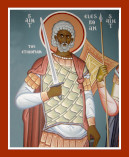 Inflamed with love for
Christ, this devout emperor raised an army against Dunaan, the wicked persecutor of
Christians in the land of Omir, but he was unsuccessful in the early stages of the battle
and many of his soldiers perished in the arid desert. He then lamented bitterly to God, and
promised to become a monk if God would help him overcome the shedder of Christian blood.
Defeating Dunaan, Elesbaan returned to Ethiopia and immediately left the imperial court and
went to a monastery, where he lived in strict asceticism as a true monk for a whole fifteen
years, God giving him wonder-working gifts both before and after his death. He entered into
rest in 555. Inflamed with love for
Christ, this devout emperor raised an army against Dunaan, the wicked persecutor of
Christians in the land of Omir, but he was unsuccessful in the early stages of the battle
and many of his soldiers perished in the arid desert. He then lamented bitterly to God, and
promised to become a monk if God would help him overcome the shedder of Christian blood.
Defeating Dunaan, Elesbaan returned to Ethiopia and immediately left the imperial court and
went to a monastery, where he lived in strict asceticism as a true monk for a whole fifteen
years, God giving him wonder-working gifts both before and after his death. He entered into
rest in 555.
|
3. The Icon: ‘Joy of all who Sorrow’.
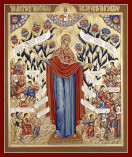 This is the name given to one of the wonder-working icons of
the most holy Mother of God, and today is especially the commemoration of the miraculous
healing of Ephemia, sister of Patriarch Joachim, in Moscow in 1688. Ephemia had a dangerous
wound in the side, and when the doctors were unsuccessful in their treatment of it, she
fell down in prayer before the most holy Mother of God. She then heard a voice:
‘Ephemia, go to the Church of the Transfiguration of my Son; there you will find the
icon “Joy of all who Sorrow”. Ask the priest to pray before that icon, and you
will be healed.’ Ephemia did this, and was immediately completely healed. This is the name given to one of the wonder-working icons of
the most holy Mother of God, and today is especially the commemoration of the miraculous
healing of Ephemia, sister of Patriarch Joachim, in Moscow in 1688. Ephemia had a dangerous
wound in the side, and when the doctors were unsuccessful in their treatment of it, she
fell down in prayer before the most holy Mother of God. She then heard a voice:
‘Ephemia, go to the Church of the Transfiguration of my Son; there you will find the
icon “Joy of all who Sorrow”. Ask the priest to pray before that icon, and you
will be healed.’ Ephemia did this, and was immediately completely healed.
|
4. Our Holy Father Arethas of the Kiev Caves.
He went to the Lord in 1190 (see the passage for consideration below).
Author’s note: In the Greek Synaxarion, the Holy Martyr Sebastiana, a disciple of the Apostle Paul, who suffered for the Faith in the year 82, in the time of the Emperor Domitian, is also commemorated. She was first tortured in the city of Marcianopolis, where the Apostle Paul appeared to her and said: ‘Rejoice, and do not be sad, for you will go from here to your own town to confess your faith in Christ.’ And so it came to pass: the judge sent her to her birthplace, Herakleia, where she was tortured and finally beheaded. Her remains were put in a sack and thrown into the sea, but an angel of God took them to a place called Risiston, where Ammia, the wife of a senator, found them and gave them burial. Her relics had healing power and gave off myrrh.
FOR CONSIDERATION
When a holy man commits a transgression, a greater punishment descends on him than would on an ordinary man, who is less dedicated to the hidden will of God, when he does the same thing. St. Arethas was a monk in the monastery of the Caves in Kiev, and was very avaricious. Heaps of possessions stood in his cell, of which he would give away not one scrap to anyone. But he once fell very seriously ill and saw, as if in a vision, how the devils snatched his soul from the angel, saying: ‘It’s ours! It’s ours!’ and presenting Arethas’ avarice and commercial bent as proof of this. Recovering from his illness, Arethas changed his way of life, and from that time counted earthly goods as nothing. God, in His love, forgave him and later gave him great grace.
Another monk, in the monastery to which the blessed Emperor Elesbaan went, liked to go often to the tavern, where he got drunk and even had immoral relations with women. One day, returning from the tavern, enormous snakes fell on him and took turns in chasing him. In great pain and anguish, the monk cried out: ‘As you would flee from holy and righteous Elesbaan, go away from me’; and the snakes suddenly stopped. Then the monk heard what seemed to be a human voice coming from the snakes: ‘An angel of God commanded me to bite you because of your impurity and foulness, for you have promised to serve God with purity, but now you foul your body and anger the Holy Spirit.’ The monk swore to sin no more, returned to the monastery and did not sin again right up to his death. Thus God chides and has mercy at the prayers of the holy Emperor Elesbaan.
Daily Scripture Readings taken from The Orthodox New Testament, translated and published by Holy Apostles Convent, Buena Vista, Colorado, copyright © 2000, used with permission, all rights reserved.
Daily Prologue Readings taken from The Prologue of Ochrid, by Bishop Nikolai Velimirovic, translated by Mother Maria, published by Lazarica Press, Birmingham, England, copyright © 1985, all rights reserved. Edited by Dormition Skete.