

Daily Devotional
Monday, October 19, 2026 (NS), October 6, 2026 (OS)
No Fasting.
Monday of the Twenty-First Week
The commemoration of the holy Apostle Thomas.
Scripture Readings
Paschalion — Movable Calendar
Monday of the Twenty-First Week
Epistle
The Reading is from the Epistle of Saint Paul to the Philippians [§ 248]. Brethren:
4 10I rejoiced in the Lord greatly that now at length your thinking concerning me sprouted afresh, upon which ye indeed were thinking, but ye were lacking opportunity. 11Not that I speak as to lack; for I learned in whatever state I am to be self-sufficient. 12I know both how to be humbled, and I know how to abound; in everything and in all things I have been initiated both to be full and to hunger, both to abound and to lack. 13I can do all things in Christ, the One Who empowereth me. 14Yet ye did well sharing in mine affliction. 15But ye Philippians know also that in the beginning of the Gospel, when I departed from Macedonia, not one church took part with me in regard to an account of giving and receiving, except ye only. 16For even in Thessalonica ye sent in regard to my necessity both once and twice. 17Not that I am seeking after the gift, but I am seeking after the fruit that is abounding to your account. 18But I have received in full all things, and abound; I have been made full, having received from Epaphroditos the things from you, an odor of a sweet smelling fragrance, an acceptable sacrifice, well-pleasing to God. 19But my God shall fill to the full your every need according to His wealth in glory, in Christ Jesus. 20Now to the God and Father of us be glory to the ages of the ages. Amen.
21Greet every saint in Christ Jesus. The brethren with me greet you. 22All the saints greet you, but most of all those of Cæsar’s house.
23The grace of our Lord Jesus Christ be with you all. Amen.
Gospel
The Reading is from the Holy Gospel according to Saint Luke [§ 25]. The Lord said to those Jews who had come to him:
6 24“Woe to you, the rich! For ye are receiving in full your consolation.
25“Woe to you who have been filled, for ye shall hunger.
Woe to you who laugh now, for ye shall mourn and weep.
26“Woe to you, whenever all men shall speak well of you, for according to these things their fathers were doing to the false prophets.
27“But I say to you who hear, keep on loving your enemies, doing well to those who hate you, 28“blessing those who curse you, and praying for those who act despitefully toward you. 29“To him who smiteth thee on the cheek, be offering also the other; and from him who taketh away thine outer garment, do not even withhold thy tunic. 30“And to everyone who asketh thee, be giving; and from him who taketh away your things, cease demanding them back.”
Menaion — Fixed Calendar
The commemoration of the holy Apostle Thomas.
Epistle
The Reading is from the First Epistle of Saint Paul to the Corinthians [§ 131]. Brethren:
4 9I think that God showed forth us the apostles last, as condemned to death; for we became a spectacle to the world, both to angels and to men. 10We are fools for Christ’s sake, but ye are wise in Christ. We are weak, but ye are strong. Ye are held in honor, but we are dishonored. 11Until the present hour, we both hunger and thirst, and are naked, and are being buffeted, and never at rest. 12And we toil working with our own hands. Being reviled, we bless; being persecuted, we bear up; 13being evilly spoken of, we beseech. We became as the filth of the world, the off-scouring of all until now. 14I do not write these things shaming you, but admonishing you as my beloved children. 15For if ye have myriads of tutors in Christ, yet ye have not many fathers; for in Christ Jesus I begot you through the Gospel. 16Therefore, I beseech you, keep on becoming imitators of me.
Gospel
The Reading is from the Holy Gospel according to Saint John [ § 65].
20 19When it was evening on that day, the first of the week—and the doors were closed where the disciples were gathered together for fear of the Jews—Jesus came and stood in the midst, and saith to them, “Peace be to you.” 20And after He said this, He showed them His hands and His side. Then were the disciples glad, after they saw the Lord. 21Then Jesus said to them again, “Peace be to you; even as the Father hath sent Me forth, I also send you.” 22And after He said this, He breathed on them, and saith to them, “Receive ye the Holy Spirit: 23“if ye forgive the sins of any, they are forgiven to them; if ye retain the sins of any, they are retained.” 24But Thomas, one of the twelve, who is called Didymos, was not with them when Jesus came. 25The other disciples therefore were saying to him, “We have seen the Lord.” But he said to them, “Unless I should see in His hands the mark of the nails, and put my finger into the mark of the nails, and put my hand into His side, in no wise will I believe.” 26And after eight days His disciples were again inside, and Thomas with them. Then cometh Jesus, the doors having been shut, and He stood in the midst, and said, “Peace be to you.” 27Then He saith to Thomas, “Bring thy finger here, and behold My hands; and bring thy hand, and put it into My side. And cease being unbelieving, but believing.” 28And Thomas answered and said to Him, “My Lord and my God.” 29Jesus said to him, “Because thou hast seen Me, thou hast believed; blessed are they who did not see, and yet believed.”
30Then indeed Jesus also did many other signs in the presence of His disciples, which are not written in this book; 31but these things have been written that ye might believe that Jesus is the Christ, the Son of God, and that believing ye may have life in His name.
Lives of the Saints (Prologue)
October 19th – Civil Calendar
October 6th – Church Calendar
1. The Holy Apostle Thomas.
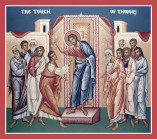 He was one of the twelve great apostles. Through his doubt of the
Resurrection of the Lord Christ, a new confirmation was given of that wonderful and saving event,
for the risen Lord appeared again to His disciples, to convince Thomas. The Lord said to Thomas:
‘Reach hither thy hand, and thrust it into My side; and be not faithless, but
believing,’ and Thomas cried: ‘My Lord and my God!’ (John 20). After the
descent of the Holy Spirit, when the apostles cast lots to see who would go where to preach the
Gospel, it fell to Thomas to go to India. He was somewhat saddened at having to go so far away,
but the Lord appeared to him and comforted him. In India, St. Thomas converted many, both rich
and poor, to the Christian Faith, and founded a Church there, making priests and bishops. Among
others, St. Thomas converted two sisters, Tertiana and Mygdonia, wives of Indian princes. Both
sisters were ill-treated for their faith by their husbands, who would not live with them after
their Baptism, and divorced them. Being freed from their marriages, they lived godly lives till
their deaths. Dionysius and Pelagia, a couple at first betrothed to each other, heard the
apostle’s teaching and did not live together, but devoted themselves to the ascetic life.
Pelagia died a martyr for the Faith and Dionysius was made bishop by the apostle. Prince
Misdaeus, the husband of Tertiana, whose wife and son Iuzanes Thomas baptized, condemned the
apostle to death, and sent five soldiers, who ran him through with their lances, and thus the
holy Apostle Thomas gave his soul into the hands of his Christ. Before his death, he, with the
other apostles, was miraculously borne to Jerusalem for the funeral of the most holy Mother of
God. Arriving late, he grieved bitterly, and at his request, the tomb of the most pure one was
opened, but the body was not there: the Lord had taken His Mother to His heavenly home. Thus St.
Thomas first, by his unbelief, confirmed the faith in the Resurrection of the Lord and then, by
his late arrival, revealed to us the wondrous glorification of the Mother of God.
He was one of the twelve great apostles. Through his doubt of the
Resurrection of the Lord Christ, a new confirmation was given of that wonderful and saving event,
for the risen Lord appeared again to His disciples, to convince Thomas. The Lord said to Thomas:
‘Reach hither thy hand, and thrust it into My side; and be not faithless, but
believing,’ and Thomas cried: ‘My Lord and my God!’ (John 20). After the
descent of the Holy Spirit, when the apostles cast lots to see who would go where to preach the
Gospel, it fell to Thomas to go to India. He was somewhat saddened at having to go so far away,
but the Lord appeared to him and comforted him. In India, St. Thomas converted many, both rich
and poor, to the Christian Faith, and founded a Church there, making priests and bishops. Among
others, St. Thomas converted two sisters, Tertiana and Mygdonia, wives of Indian princes. Both
sisters were ill-treated for their faith by their husbands, who would not live with them after
their Baptism, and divorced them. Being freed from their marriages, they lived godly lives till
their deaths. Dionysius and Pelagia, a couple at first betrothed to each other, heard the
apostle’s teaching and did not live together, but devoted themselves to the ascetic life.
Pelagia died a martyr for the Faith and Dionysius was made bishop by the apostle. Prince
Misdaeus, the husband of Tertiana, whose wife and son Iuzanes Thomas baptized, condemned the
apostle to death, and sent five soldiers, who ran him through with their lances, and thus the
holy Apostle Thomas gave his soul into the hands of his Christ. Before his death, he, with the
other apostles, was miraculously borne to Jerusalem for the funeral of the most holy Mother of
God. Arriving late, he grieved bitterly, and at his request, the tomb of the most pure one was
opened, but the body was not there: the Lord had taken His Mother to His heavenly home. Thus St.
Thomas first, by his unbelief, confirmed the faith in the Resurrection of the Lord and then, by
his late arrival, revealed to us the wondrous glorification of the Mother of God.
2. Our Holy Father, the New-Martyr Makarios.
Born in Kion in Bithynia, of Christian parents Peter and Anthusa, he was baptized with the name Manuel. His parents had him taught tailoring as a trade, then his father embraced Islam and moved to Prousa. Once, when Manuel went to Prousa in the course of his work, his father found him and put great pressure on him to follow his example. Manuel refused, but in vain: the Turks circumcised him by force. Then Manuel fled to the Holy Mountain and became a monk in the skete of St. Anne, receiving the name Makarios. He was a model monk for twelve years, but his soul could find no peace. ‘Whosoever shall deny Me before men, him will I also deny before My Father’ (Matt. 10:33)—these words of Christ’s were constantly ringing in Makarios’ ears. He therefore resolved, with his elder’s blessing, to go to Prousa and openly confess his faith in Christ before the Turks, calling Mohammed a false prophet. After being flogged for a hundred and thirty days and enduring even harsher tortures, he was beheaded with the sword in Prousa on October 6th, 1590. A part of his wonder-working relics is preserved in the skete of St. Anne on Mount Athos.
FOR CONSIDERATION
‘We have a building of God, a house not made with hands, eternal in the heavens’ (II Cor. 5:1), says the discerning Apostle Paul. All our labor on earth for God has this one aim: to strive with all our strength to attain to that eternal home not made with hands in the heavens. An Indian king, Gundafor, decided to build himself a magnificent palace, the like of which had never been seen on earth. When his envoy, Havan, sought skilled workers capable of building such a palace for the king, they came, by God’s providence, to meet the Apostle Thomas, who told them that he was skilled in such work and that no one could build the king what he wanted without his, Thomas,’ help. Thomas therefore received a great sum of gold from the king to build this palace. As soon as he left the king’s presence, he gave all the gold away to the poor. After two years, the king sent servants to ask Thomas if the palace was ready, as it was being built at some distance from the capital. Thomas replied: ‘All is ready except for the roof,’ and he asked for more money from the king and was given it. Thomas again gave it all away to the poor and went around the kingdom doing his own work, which was the preaching of the Gospel. The king discovered that Thomas had not even begun to build the palace, so he seized him and threw him into prison. That night, the king’s brother died, and the king was grief-stricken. An angel took the dead man’s soul and carried it to Paradise, and showed him a wonderful palace such as the mind of man could not imagine. The soul of the dead man wanted to go into that palace, but the angel told him that he could not, as it was the palace that the Apostle Thomas had built for his brother with the alms he had given. Then the angel returned the man’s soul to his body. When the man came to himself, he said to the king, his brother: ‘Swear that you will give me anything I ask of you.’ And the king swore that he would. His brother then said: ‘Give me the palace you have in heaven.’ The king was amazed, and doubted greatly that there could be any such palace in heaven, but when his brother explained it all to him, he was convinced and immediately released Thomas from prison. When they heard from the apostle’s lips the words of salvation and eternal life, the king and his brother were both baptized. The king gave himself to further almsgiving, that he might build himself a yet more wonderful palace in heaven.
Daily Scripture Readings taken from The Orthodox New Testament, translated and published by Holy Apostles Convent, Buena Vista, Colorado, copyright © 2000, used with permission, all rights reserved.
Daily Prologue Readings taken from The Prologue of Ochrid, by Bishop Nikolai Velimirovic, translated by Mother Maria, published by Lazarica Press, Birmingham, England, copyright © 1985, all rights reserved. Edited by Dormition Skete.