

Daily Devotional
Friday, October 16, 2026 (NS), October 3, 2026 (OS)
Fast Day. No Meat, Fish, Dairy, Eggs, Alcohol or Olive Oil Allowed.
Friday of the Twentieth Week
The commemoration of Hieromartyr Dionysios the Areopagite.
Scripture Readings
Paschalion — Movable Calendar
Friday of the Twentieth Week
Epistle
The Reading is from the Epistle of Saint Paul to the Philippians [§ 245]. Brethren:
3 8I suffered the loss of all things, and deem them to be dung, that I might win Christ, 9and might be found in Him, not having a righteousness of mine own, which is of the law, but that which is through faith in Christ, the righteousness of God on the basis of faith, 10to come to know Him, and the power of His resurrection, and the partaking of His sufferings, being conformed to His death, 11if by any means I might attain to the resurrection of the dead. 12Not that I already received, or already have been perfected; but I pursue, if I might also apprehend that for which I also was apprehended by the Christ, Jesus. 13Brethren, I count not myself to have apprehended; but one thing I do, forgetting the things which are behind, and stretching forth to those things which are before, 14I pursue toward the mark for the prize of the high calling of God in Christ Jesus. 15Let us therefore, as many as are perfect, be of this mind; and if ye are otherwise minded in anything, God shall reveal even this to you. 16Only to what we attained, let us walk by the same rule, let us mind the same thing.
17Brethren, keep on becoming imitators together of me and look to those who so walk, as ye have us for an example. 18For many walk about, of whom I was telling you often, and now tell even weeping, that they are the enemies of the Cross of Christ: 19whose end is destruction, whose god is the belly, and who glory in their shame—they who mind earthly things!
Gospel
The Reading is from the Holy Gospel according to Saint Luke [§ 24]. At that time:
6 17Jesus stood upon a level place. And there was a crowd of
His disciples, and a great multitude of the people from all of Judæa and Jerusalem and the
seacoast of Tyre and Sidon, who came to hear Him, and to be healed of their diseases—
18even those who were troubled by unclean spirits; and they were cured.
19And all the crowd was seeking to touch Him, for power was coming forth from Him and
healing all. 20And He lifted up His eyes to His disciples, and began to say:
“Blessed are the poor, for yours is the kingdom of God.
21“Blessed are ye who hunger now, for ye shall be
filled.
Blessed are ye who weep now, for ye shall laugh.
22“Blessed are ye whenever men hate you, and whenever they
separate you, and reproach you, and cast out your name as evil, on account of the Son of
Man.
23“Rejoice in that day and leap for joy, for behold, your
reward is great in the heavens.”
Menaion — Fixed Calendar
The commemoration of Hieromartyr Dionysios the Areopagite.
Epistle
The Reading is from the Acts of the Apostles [§ 40]. In those days:
17 16While Paul awaited Silas and Timothy in Athens, his spirit was provoked in him when he beheld that the city was full of idols. 17Therefore he was discoursing indeed in the synagogue with the Jews and those who were devout, and in the market every day with those who happened to be present. 18But certain philosophers of the Epicureans and of the Stoics were conversing with him, and some were saying, “What would this picker up of seeds of news wish to say?” And some said, “He seemeth to be a proclaimer of foreign deities,” because he was preaching to them Jesus and the resurrection. 19And having taken hold of him, they led him to the Areopagos, saying, “May we come to know what this new teaching is which is spoken by thee? 20“For thou bringest in certain surprising things to our ears. We wish therefore to know what these things may mean.” 21Now all Athenians and the strangers living there have leisure for nothing else other than to say something and to hear newer things. 22And Paul stood in the midst of the Areopagos, and said, “Men, Athenians, I perceive how in all things ye are most religious. 23“For passing through and carefully observing the objects of your veneration, I also found an altar on which it had been written: ‘To an unknown God.’ Therefore since ye know not Whom ye reverence, I proclaim this One to you. 24“The God Who made the world and all things in it, this same One, being Lord of heaven and of earth, dwelleth not in temples made by hand; 25“neither is He being serviced to by the hands of men, as though in need of anything, because He Himself giveth to all life, and breath, in all respects. 26“And He made of one blood every nation of mankind, to dwell on all the face of the earth, having determined preappointed seasons and the boundaries of their dwelling, 27“to seek the Lord, if perhaps they might feel about for Him and find Him, though indeed He is not far from each one of us. 28“For in Him we live, and move, and exist, as also some among your poets have said, ‘For we are also His offspring.’ 29“Being then offspring of God, we ought not to think that which is divine is like gold or silver or stone, graven by art and man’s conception. 30“Therefore God, having overlooked indeed the times of ignorance, now commandeth all men everywhere to repent, 31“because He set up a day in which He is going to judge the inhabited world in righteousness by a Man Whom He ordained, after He gave assurance to all and raised Him from the dead.” 32But after they heard “a resurrection of the dead,” some indeed began to mock, but others said, “We will hear thee again concerning this matter.” 33And thus Paul went out from their midst. 34But certain men, having joined themselves together to him, believed, among whom were Dionysios the Areopagite and a woman, by name Damaris, and others with them.”
Gospel
The Reading is from the Holy Gospel according to Saint Matthew [§ 55]. The Lord said this parable:
13 44“The kingdom of the heavens is like treasure which hath been hidden in the field, which, after a man found, he hid; and for the joy of it, he goeth and selleth all things, as much as he hath, and buyeth that field. 45“Again, the kingdom of the heavens is like a man, a merchant, seeking beautiful pearls, 46“who, after he found one very precious pearl, went away and sold all things, as much as he had, and bought it. 47“Again the kingdom of the heavens is like a dragnet which was cast into the sea and brought together of every kind, 48“which, when it was full, they drew up on the shore; and they sat down and gathered together the good into vessels, but the rotten they cast out. 49“Thus shall it be in the consummation of the age: the angels shall go forth, and shall separate the evil from the midst of the righteous, 50“and shall cast them into the furnace of the fire. There shall be there the weeping and the gnashing of the teeth.” 51Jesus saith to them, “Did ye understand all these things?” They say to Him, “Yes, Lord.” 52And He said to them, “On this account every scribe who was instructed into the kingdom of the heavens is like a man that is a master of a house, who putteth forth out of his treasure things new and old.”
53And it came to pass, when Jesus finished these parables, He departed from that place. 54And after He came into His own country, He was teaching them in their synagogue.
Lives of the Saints (Prologue)
October 16th – Civil Calendar
October 3rd – Church Calendar
1. The Hieromartyr Dionysius (Dionysios) the Areopagite.
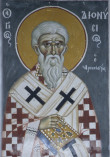 He is counted among the
seventy lesser apostles. This wonderful man was of a noble, pagan family in Athens. Finishing his
education in Athens, he went to Egypt to learn more. One day while he was there, the Lord Christ
breathed His last on the Cross, and the sun was darkened and it was dark in Egypt for the space
of three hours. Then Dionysius cried out: ‘Either God the Creator of the world is
suffering, or the world is ending.’ Returning to Athens, he married a woman called Damaris
and had sons by her. He was a member of the highest court in Greece, the Areopagus, and was
always thereafter known as the Areopagite. When the Apostle Paul preached the Gospel in Athens,
Dionysius was baptized with his whole household (Acts 17:34). Paul consecrated him bishop of
Athens (he having left his wife and children and status from love of Christ), and he travelled
widely with Paul, coming to know all the other apostles. He went especially to Jerusalem, to see
the most holy Mother of God, and wrote of his meeting with her in one of his works, being at the
burial of the most pure one along with the other apostles. When his teacher, St. Paul, suffered
martyrdom, Dionysius desired to die such a death himself, so he went off to Gaul to preach the
Gospel among the barbarians, accompanied by Rusticus, a priest, and a deacon called Eleutherius.
They endured much but met with great success. By their labors, many were turned to the Christian
Faith and Dionysius built a small chapel in Paris* where he celebrated divine service. When he
was ninety years old, he was seized and tortured for Christ, together with Rusticus and
Eleutherius, until they were all three beheaded with the sword. The severed head of St. Dionysius
jumped a long way and fell in front of a Christian woman, Catula, who buried it with his body. He
suffered in the time of Domitian, in the year 96. He wrote several famous works: on the names of
God, on the heavenly and ecclesiastical hierarchies, on mystical theology and on the most holy
Mother of God.
He is counted among the
seventy lesser apostles. This wonderful man was of a noble, pagan family in Athens. Finishing his
education in Athens, he went to Egypt to learn more. One day while he was there, the Lord Christ
breathed His last on the Cross, and the sun was darkened and it was dark in Egypt for the space
of three hours. Then Dionysius cried out: ‘Either God the Creator of the world is
suffering, or the world is ending.’ Returning to Athens, he married a woman called Damaris
and had sons by her. He was a member of the highest court in Greece, the Areopagus, and was
always thereafter known as the Areopagite. When the Apostle Paul preached the Gospel in Athens,
Dionysius was baptized with his whole household (Acts 17:34). Paul consecrated him bishop of
Athens (he having left his wife and children and status from love of Christ), and he travelled
widely with Paul, coming to know all the other apostles. He went especially to Jerusalem, to see
the most holy Mother of God, and wrote of his meeting with her in one of his works, being at the
burial of the most pure one along with the other apostles. When his teacher, St. Paul, suffered
martyrdom, Dionysius desired to die such a death himself, so he went off to Gaul to preach the
Gospel among the barbarians, accompanied by Rusticus, a priest, and a deacon called Eleutherius.
They endured much but met with great success. By their labors, many were turned to the Christian
Faith and Dionysius built a small chapel in Paris* where he celebrated divine service. When he
was ninety years old, he was seized and tortured for Christ, together with Rusticus and
Eleutherius, until they were all three beheaded with the sword. The severed head of St. Dionysius
jumped a long way and fell in front of a Christian woman, Catula, who buried it with his body. He
suffered in the time of Domitian, in the year 96. He wrote several famous works: on the names of
God, on the heavenly and ecclesiastical hierarchies, on mystical theology and on the most holy
Mother of God.
* Author’s note: Some historians think that Dionysius of Paris was other than St. Dionysius the Areopagite.
2. Our Holy Father John the Chozebite, the Egyptian.
He lived in asceticism in the community of Chozeba in the time of the Emperor Justinian. Whenever he served the Liturgy, he saw a heavenly light in the altar. Ananias, an elder, lived the ascetic life not far from him, and the humility of these two saints was wonderful. A man brought his mad son to Ananias to be healed by his prayers. Ananias sent him to St. John, as being greater than he. John could not disobey the elder, but cried out: ‘In the name of Jesus Christ, it is Ananias, not I, who commands you to come out of this boy!’ And the boy was healed immediately.
3. Our Holy Father Dionysius (Dionisy) of the Kiev Caves.
He was a hieromonk and an anchorite. The following occurred on Pascha in 1463: he was going round the graves with Cross and censer to cense the relics and graves of the saints buried there. With overflowing joy in the Resurrection, he cried out on going into the caves: ‘My holy fathers and brethren, Christ is risen!’ At that, a voice like thunder rose from the tombs: ‘Truly He is risen!’
4. St. Hesychius the Chorebite.
He was at first careless for his soul’s salvation, but he became seriously ill and died, and came back from the dead and was healed. This wrought a profound change in him. He shut himself in a cell on the Holy Mountain and spoke not a single word to anyone for twelve years. Before his death, the monks opened his cell and begged him to give them some instruction. He only said: ‘He who ponders on death cannot sin.’ From him descended those known as the ‘hesychasts,’ who held silence, pondering on God and mental prayer to be the chief works of the true monk. They had a skete, known as the Hesychast or Silent, on the Holy Mountain. It is said of Gregory the Theologian that he was a hesychast during the Great Fast. St. Hesychius lived in the sixth century.
FOR CONSIDERATION
A vision of St. Andrew the Fool for Christ: Holy Andrew, walking one day along the streets of Constantinople, saw a great and splendid funeral. A rich man had died, and his cortege was magnificent. But when he looked more closely, Andrew saw a host of little black men capering merrily around the corpse, one grinning like a prostitute, another barking like a dog, a third grunting like a pig, a fourth pouring something filthy over the body. And they were mocking the chanters and saying: ‘You’re singing over a dog!’ Andrew, marveling, wondered what this man had done. Turning round, he saw a handsome youth standing weeping behind a wall. ‘For the sake of the God of heaven and earth, tell me the reason for your tears,’ said Andrew. The young man then told him that he had been the dead man’s guardian angel, but that the man had, by his sins, greatly offended God, casting his angel’s counsel from him and giving himself over utterly to the black demons. And the angel said that this man was a great and unrepentant sinner: a liar, a hater of men, a miser, a shedder of blood and a dissolute man who had turned three hundred souls to immorality. In vain was he honored by the emperor and respected by the people. In vain was this great funeral. Death had caught him unrepentant, and the harvest had come without warning.
Daily Scripture Readings taken from The Orthodox New Testament, translated and published by Holy Apostles Convent, Buena Vista, Colorado, copyright © 2000, used with permission, all rights reserved.
Daily Prologue Readings taken from The Prologue of Ochrid, by Bishop Nikolai Velimirovic, translated by Mother Maria, published by Lazarica Press, Birmingham, England, copyright © 1985, all rights reserved. Edited by Dormition Skete.