

Daily Devotional
Tuesday, October 13, 2026 (NS), September 30, 2026 (OS)
No Fasting.
Tuesday of the Twentieth Week
The commemoration of Hieromartyr Gregory, Bishop of Greater Armenia, and our father among the saints, Michael, the first Metropolitan of Kiev, and Wonder-worker of all Russia.
Scripture Readings
Paschalion — Movable Calendar
Tuesday of the Twentieth Week
Epistle
The Reading is from the Epistle of Saint Paul to the Philippians [§ 242]. Brethren:
2 16I ran not in vain, nor labored in vain. 17But if also I am being poured out as a libation upon the sacrifice and service of your faith, I rejoice, and rejoice with you all; 18and ye also be rejoicing in the same and be rejoicing with me.
19But I hope in the Lord Jesus to send Timothy quickly to you, that I also may be of good courage, after I come to know the things concerning you. 20For I have no one like-minded, who genuinely will care for the things concerning you. 21For all seek their own things, not the things of Christ Jesus. 22But ye know the proof of him, that, as a child to a father, he served with me in regard to the Gospel. 23This one indeed therefore I hope to send at once, whensoever I shall have in view the things concerning me.
Gospel
The Reading is from the Holy Gospel according to Saint Luke [§ 18]. At that time:
5 12As Jesus was in one of the cities, behold, a man full of leprosy; and after he saw Jesus, he fell on his face and entreated Him, saying, “Lord, if Thou art willing, Thou art able to cleanse me.” 13And He stretched forth His hand and touched him, saying, “I am willing; be cleansed.” And straightway the leprosy departed from him. 14And He ordered him to tell no one, “But go and show thyself to the priest, and make an offering for thy cleansing, even as Moses commanded, for a testimony to them.” 15But the report concerning Him kept on going abroad much more; and many crowds were coming together to hear, and to be cured from their infirmities by Him. 16But He Himself was withdrawing into the wildernesses and was praying.
Menaion — Fixed Calendar
The commemoration of Hieromartyr Gregory, Bishop of Greater Armenia, and our father among the saints, Michael, the first Metropolitan of Kiev, and Wonder-worker of all Russia.
Epistle
For the Hieromartyr:
The Reading is from the First Epistle of Saint Paul to the Corinthians [§ 166]. Brethren:
16 13Keep on watching, standing fast in the faith, conducting yourselves in a courageous way, and being strong. 14Let all your things be done in love.
15But, I beseech you, brethren—ye know the house of Stephanas, that it is the firstfruits of Achaia, and that they set themselves to ministering to the saints— 16that ye also be submitting to such, and to everyone who is helping in the work and toiling. 17And I rejoice at the coming of Stephanas, and of Fortunatos, and of Achaikos; for that which ye lacked, these supplied. 18For they refreshed my spirit and yours. Therefore be acknowledging such ones as these.
19The churches of Asia greet you. Aquila and Priscilla greet you much in the Lord, with the church in their house. 20All the brethren greet you. Greet one another with a holy kiss.
21The greeting of me Paul with mine own hand. 22If anyone love not the Lord Jesus Christ, let him be anathema. The Lord hath come. 23The grace of the Lord Jesus Christ be with you. 24My love be with you all in Christ Jesus. Amen.
For the Hierarch:
The Reading is from the Epistle of Saint Paul to the Hebrews [§ 335]. Brethren:
13 17Be obedient to those who lead you, and keep on submitting, for they are watchful for your souls, as those about to render an account, that they may do this with joy, and not groaning; for this would be unprofitable for you. 18Keep on praying for us; for we trust that we have a good conscience, in all things wishing to conduct ourselves well. 19But I beseech you more abundantly to do this, that I might be restored more quickly to you.
20Now the God of peace Who brought up from the dead our Lord Jesus, the Shepherd of the sheep, the great One, in the blood of an everlasting covenant, 21may He render you perfect in every good work, in order to do His will, doing in you that which is well-pleasing before His face, through Jesus Christ, to Whom be glory to the ages of the ages. Amen.
Gospel
For the Hieromartyr:
The Reading is from the Holy Gospel according to Saint Matthew [§ 103]. The Lord said to His disciples:
24 42“Be watching then, for ye know not in what hour your Lord cometh. 43“But know ye this, that if the master of the house had known in what watch the thief was coming, he would have watched and not let his house be broken into. 44“On this account, ye also keep on becoming ready, for in what hour ye think not, the Son of Man cometh. 45“Who then is the faithful and prudent slave, whom his lord appointeth over his household, to give them food in due season? 46“Happy is that slave whom his lord, after he cometh, shall find so doing. 47“Verily I say to you, that he shall appoint him over all his possessions.”
For the Hierarch:
The Reading is from the Holy Gospel according to Saint John [§ 36]. The Lord said to the Jews who had come to Him:
10 9“I am the door; by Me if anyone should enter, he shall be saved, and shall go in and go out and find pasture. 10“The thief cometh not, except that he might steal, and slay, and destroy. I came that they may have life, and may have it abundantly. 11“I am the good shepherd. The good shepherd layeth down his life for the sheep. 12“But the hireling, who indeed is not a shepherd, whose own the sheep are not, seeth the wolf coming, and leaveth the sheep and fleeth; and the wolf seizeth them and scattereth the sheep. 13“Now the hireling fleeth, because he is a hireling and careth not about the sheep. 14“I am the good shepherd; and I know those that are Mine, and am known of those that are Mine. 15“Even as the Father knoweth Me, I also know the Father; and I lay down My life for the sheep. 16“And I have other sheep which are not of this fold; them also it is needful for Me to bring, and they shall hear My voice; and there shall be one flock and one Shepherd.”
Lives of the Saints (Prologue)
October 13th – Civil Calendar
September 30th – Church Calendar
1. St. Gregory the Enlightener, Bishop of Armenia.
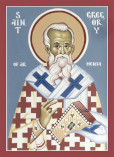 Gregory was of a noble family, kin to the
imperial house of Persia (to King Artaban) and Armenia (King Khosrov). When these two houses made
war between themselves, Gregory withdrew to Caesarea in Cappadocia, where he first came into
contact with the Christian Faith, received Baptism and married. He had two sons of this marriage,
Rostanes and Aristanes, and dedicated them both to the service of the Church. After his
wife’s death, he returned to Armenia and entered the service of King Tiridates. Gregory
served his king faithfully, and the king loved him, but when he discovered that Gregory was a
Christian, he was greatly enraged and put pressure on him to reject the Christian Faith and
worship idols. Having no success whatever in this, Tiridates put Gregory to harsh torture, and
after cruel torment, threw him into a deep pit filled with every kind of poisonous reptile,
meaning thus to kill him. But God, Who is all-seeing, preserved Gregory alive in that pit for
fourteen whole years. Tiridates continued the persecution of Christians in his kingdom, and
attacked a women’s monastery of thirty-seven nuns with their abbess, Gaïane. When he
had slain them with terrible tortures, Tiridates went mad and was like a monstrous wild boar. A
man appeared to the king’s sister in a dream and told her that her mad brother would not be
restored to sanity until Gregory was taken out of the pit. This being done, Gregory healed and
baptized Tiridates. Then Gregory, at the king’s desire, became Bishop of Armenia and with
the king’s help, and above all, God’s help, enlightened the whole of Armenia and the
surrounding area with the Christian Faith. St. Gregory finished his life of great toil in old
age, in about 335. In his place, his son Aristanes was consecrated bishop, and he continued his
father’s work. Aristanes was one of the 318 fathers at the First Ecumenical Council.
Gregory was of a noble family, kin to the
imperial house of Persia (to King Artaban) and Armenia (King Khosrov). When these two houses made
war between themselves, Gregory withdrew to Caesarea in Cappadocia, where he first came into
contact with the Christian Faith, received Baptism and married. He had two sons of this marriage,
Rostanes and Aristanes, and dedicated them both to the service of the Church. After his
wife’s death, he returned to Armenia and entered the service of King Tiridates. Gregory
served his king faithfully, and the king loved him, but when he discovered that Gregory was a
Christian, he was greatly enraged and put pressure on him to reject the Christian Faith and
worship idols. Having no success whatever in this, Tiridates put Gregory to harsh torture, and
after cruel torment, threw him into a deep pit filled with every kind of poisonous reptile,
meaning thus to kill him. But God, Who is all-seeing, preserved Gregory alive in that pit for
fourteen whole years. Tiridates continued the persecution of Christians in his kingdom, and
attacked a women’s monastery of thirty-seven nuns with their abbess, Gaïane. When he
had slain them with terrible tortures, Tiridates went mad and was like a monstrous wild boar. A
man appeared to the king’s sister in a dream and told her that her mad brother would not be
restored to sanity until Gregory was taken out of the pit. This being done, Gregory healed and
baptized Tiridates. Then Gregory, at the king’s desire, became Bishop of Armenia and with
the king’s help, and above all, God’s help, enlightened the whole of Armenia and the
surrounding area with the Christian Faith. St. Gregory finished his life of great toil in old
age, in about 335. In his place, his son Aristanes was consecrated bishop, and he continued his
father’s work. Aristanes was one of the 318 fathers at the First Ecumenical Council.
2. The Holy Martyrs Gaïane, Rhipsimia and 35 other nuns.
They were all slain by Tiridates for their faith in Christ. Holy Rhipsimia was of rare beauty, and the Emperor Diocletian therefore wanted her for his wife. This was the cause of the suffering of all thirty-seven of them. Rhipsimia refused to go to the emperor, because she was already consecrated to Christ her Bridegroom. Then Tiridates began to urge her to go with him, for the king was as though intoxicated by her beauty, but Rhipsimia resisted the pagan king with all her strength, ‘and he who was victorious over the princes of the Goths and routed the Persians could not overcome one virgin of Christ’. The furious king put her to harsh torture (her tongue was cut out, her stomach cut open and her entrails spilled out), during which Rhipsimia gave her soul into God’s hands. After that, the other nuns were seized and beheaded with the sword. The famous monastery of Echmiazdin, near Erivan, was built over their relics, and became the chief spiritual center of Armenia for many centuries.
3. St. Michael (Mikhail), First Metropolitan of Kiev.
He was sent by the Patriarch of Constantinople to Russia at the request of the great Prince Vladimir, to baptize the pagan people and to establish and organize the Church. St. Michael baptized the people in Kiev, Novgorod, Rostov and many other towns and villages, set the Church in order, establishing the episcopate and priesthood, laid the foundations of the monastery of St. Michael in Kiev, and sent missionaries to the Bulgars and Tartars, bringing many of them to Christ. This saint accomplished all this and much else in a mere four years. He entered peacefully into rest in 992, and his relics are preserved in the Monastery of the Caves.
FOR CONSIDERATION
Strange changes take place in the destinies of men, today as in former times. Those who have abased themselves for the sake of God’s righteousness are raised up to great heights, and scoffers at the Faith of God turn into servants of that same Faith. King Tiridates threw St. Gregory into a deep pit, where he spent fourteen years, forgotten by the entire world but not forgotten by God. Who among men could imagine that the greatest light of the Armenian people was to be found in the darkness of a pit? And who could ever imagine the powerful and tyrannical King Tiridates one day saving the life of this Gregory, whom he had condemned to death, and giving him more help than the whole world could give him? After fourteen years, Gregory was shown by God to be alive, and miraculously healed the mad king. King Tiridates, an unrestrained persecutor of Christians, was baptized and became the greatest zealot for the Christian Faith. One could say that, by God’s help, both Gregory and Tiridates were brought out of a deep pit: Gregory a physical one and Tiridates a spiritual. Oh, the infinite wisdom of God in the directing of the destinies of men! The sometime bestial and passionate Tiridates became so softened by repentance that he became in character more like Gregory than like himself before his Baptism.
Daily Scripture Readings taken from The Orthodox New Testament, translated and published by Holy Apostles Convent, Buena Vista, Colorado, copyright © 2000, used with permission, all rights reserved.
Daily Prologue Readings taken from The Prologue of Ochrid, by Bishop Nikolai Velimirovic, translated by Mother Maria, published by Lazarica Press, Birmingham, England, copyright © 1985, all rights reserved. Edited by Dormition Skete.