

Daily Devotional
Thursday, September 24, 2026 (NS), September 11, 2026 (OS)
No Fasting.
Thursday of the Seventeenth Week
The commemoration of the Afterfeast of the Nativity, and our venerable Mother Theodora of Alexandria, of our venerable Fathers Sergius and Herman, Wonder-workers of Valaam, and Fool for Christ St. Xenia of St. Petersburg.
Scripture Readings
Paschalion — Movable Calendar
Thursday of the Seventeenth Week
Epistle
The Reading is from the Epistle of Saint Paul to the Ephesians [§ 225]. Brethren:
For Gk. usage, see Eph. 4:14-17; for Sl. usage, see Eph. 4:14-19.
4 14We may no longer be infants, tossed to and fro by waves, and carried about with every wind of teaching, by the sleight of men, in craftiness toward the systematizing of error; 15but speaking the truth in love, we might grow up into Him in all things Who is the head—the Christ, 16from Whom all the body, being joined and knit together by what every juncture supplieth, according to the energy of every single part in measure, maketh for itself the increase of the body, to the building up of itself in love.
17This I say, therefore, and testify in the Lord: ye are no longer to walk even as also the rest of the nations walk, in the vanity of their mind, 18who have been darkened in thought and alienated from the life of God, because of the ignorance which is in them, because of the hardness of their heart; 19who, having become insensible, gave themselves up to licentiousness, for the working of all uncleanness with greediness.
Gospel
The Reading is from the Holy Gospel according to Saint Mark [§ 52]. At that time:
11 27Jesus came again to Jerusalem. And as He was walking about in the temple, the chief priests, and the scribes, and the elders come to Him, 28and say to Him, “By what authority doest Thou these things? And who gave Thee this authority that Thou mayest be doing these things?” 29And Jesus answered and said to them, “I also will question you for one word; and answer Me, and I will tell you by what authority I am doing these things: 30“The baptism of John, was it from heaven or from men? Answer Me.” 31And they were reasoning with themselves, saying, “If we should say, ‘From heaven,’ He will say, ‘Why then did ye not believe him?’ 32“But if we should say, ‘From men’?”—they were fearing the people; for all held that John was a prophet. 33And answering, they say to Jesus, “We know not.” And Jesus answered, saying to them, “Neither do I tell you by what authority I am doing these things.”
Menaion — Fixed Calendar
The commemoration of the Afterfeast of the Nativity, and our venerable Mother Theodora of Alexandria, of our venerable Fathers Sergius and Herman, Wonder-workers of Valaam, and Fool for Christ St. Xenia of St. Petersburg.
Epistle
For the venerable Mother and Fool for Christ:
The Reading is from the Epistle of Saint Paul to the Galatians [§ 208]. Brethren:
3 23Before faith came, we were being guarded under the law, having been closed up to the faith about to be revealed. 24Therefore the law hath become our tutor until Christ, in order that we might be justified by faith. 25But faith having come, we are no longer under a tutor. 26For all are sons of God through faith in Christ Jesus. 27For as many as were baptized into Christ, ye put on Christ. 28There is neither Jew nor Greek, there is neither slave nor free, there is neither male and female; for ye are all one in Christ Jesus. 29And if ye are Christ’s, then are ye Abraham’s seed, and heirs according to promise.
For the venerable Fathers:
The Reading is from the Epistle of Saint Paul to the Galatians [§ 213]. Brethren:
5 22The fruit of the Spirit is love, joy, peace, long-suffering, kindness, goodness, faith, 23meekness, self-control; against such things there is no law. 24But they who are of the Christ crucified the flesh with the passions and the lusts. 25If we live by the Spirit, let us also be walking by the Spirit. 26Let us not become vainglorious, provoking one another, envying one another.
6 1Brethren, even if a man should be overtaken in some transgression, ye, the spiritual ones, be restoring such a one in the spirit of meekness, looking out for thyself, lest thou also be tempted. 2Keep on bearing one another’s burdens, and thus fill up the law of the Christ.
Gospel
For the venerable Mother:
The Reading is from the Holy Gospel according to Saint John [§ 28]. At that time:
8 3The scribes and the Pharisees brought to Jesus a woman who had been caught in adultery. And after they made her stand in the midst, 4they say to Him, “Teacher, this woman was caught committing adultery, in the very act. 5“Now Moses, in the law, commanded us to stone such women. Thou therefore, what sayest Thou?” 6But this they were saying, putting Him to the test, in order that they may have an accusation against Him. But Jesus, having stooped down, was writing with His finger on the ground. 7And as they continued questioning Him, He lifted up Himself and said to them, “The one who is without sin among you, let him first cast the stone at her.” 8And again He stooped down and was writing on the ground. 9But after they heard and were convicted by their own conscience, they were going out one by one, beginning from the eldest. And Jesus was left alone, and the woman being in the midst. 10And after Jesus lifted up Himself, He said to her, “Woman, where are those accusers of thine? Did no one condemn thee?” 11And she said, “No one, Sir.” And Jesus said, “Neither do I condemn thee; go, and henceforth no longer go on sinning.”
For the venerable Fathers:
The Reading is from the Holy Gospel according to Saint Luke [§ 24]. At that time:
6 17 Jesus stood upon a level place. And there was a crowd of His disciples, and a great multitude of the people from all of Judæa and Jerusalem and the seacoast of Tyre and Sidon, who came to hear Him, and to be healed of their diseases— 18even those who were troubled by unclean spirits; and they were cured. 19And all the crowd was seeking to touch Him, for power was coming forth from Him and healing all. 20And He lifted up His eyes to His disciples, and began to say:
“Blessed are the poor, for yours is the kingdom of God.
21“Blessed are ye who hunger now, for ye shall be filled.
Blessed are ye who weep now, for ye shall laugh.
22“Blessed are ye whenever men hate you, and whenever they separate you, and reproach you, and cast out your name as evil, on account of the Son of Man.
23“Rejoice in that day and leap for joy, for behold, your reward is great in the heavens.”
For the venerable Fool for Christ:
The Reading is from the Holy Gospel according to Saint Matthew [§ 104]. The Lord said this parable:
25 1“The kingdom of the heavens shall be likened to ten virgins, who took their lamps and went forth to meet the bridegroom. 2“And five of them were prudent, and five were foolish. 3“Those who were foolish took lamps for themselves and took no oil with them; 4“but the prudent took oil in their vessels with their lamps. 5“But while the bridegroom tarried, they all dozed and went on sleeping. 6“But in the middle of the night, there came to pass a cry, ‘Behold, the bridegroom cometh; go ye out to meet him!’ 7“Then all those virgins were wakened and trimmed their lamps. 8“And the foolish said to the prudent, ‘Give us of your oil, for our lamps are going out.’ 9“But the prudent answered, saying, ‘Peradventure there might not be enough for us and you, but go rather to those who sell, and buy for yourselves.’ 10“But while they went away to buy, the bridegroom came, and they who were ready went in with him to the wedding festivities; and the door was shut. 11“And afterwards the remaining virgins came also, saying, ‘Lord, lord, open to us.’ 12“But he answered and said, ‘Verily I say to you, I know ye not.’ 13“Be watching then, for ye know not the day nor the hour in which the Son of Man cometh.”
Lives of the Saints (Prologue)
September 24th – Civil Calendar
September 11th – Church Calendar
1. Our Holy Mother Theodora.
From Alexandria, she was the wife of a young man. Urged on by a fortune-teller, she committed adultery with another man. Her conscience immediately began to trouble her, and she cut off her hair and dressed in men’s garb, then went off to the men’s monastery of Octodecatos under the man’s name of Theodore. Her labors, fasts, vigils, meekness and tearful repentance were a source of wonder to all the brethren. Slandered by some harlot, who said that Theodora had lain with her, she would not let the truth be known, regarding it as a punishment from God for her former sin. Driven out of the monastery, she spent seven years outside the monastery gates, caring for the harlot’s child. She overcame all the enemy’s assaults, refusing to worship Satan, to take food from the hand of a soldier or to heed her husband’s demand that she return to him—for all that was simply devilish illusion, and when Theodora made the sign of the Cross, it all vanished away like smoke. After seven years, the abbot of the monastery received her back, and she lived there in asceticism a further two years and then entered into rest in the Lord. Only then did the monks learn that she was a woman; an angel appeared to the abbot and explained everything to him. Her husband came to her funeral, and remained till his death in the cell of his former wife. St. Theodora had very great grace from God: she tamed wild beasts, healed sicknesses and brought water to a dry well. Thus God glorified this true penitent, who, with heroic endurance, spent nine years repenting of one sin. She entered into rest in the year 490.
2. St. Paphnutios the Confessor.
A bishop in the Egyptian Thebaid, he suffered greatly for the Orthodox Faith: heretics put out one of his eyes and broke his left leg. He took part in the First Ecumenical Council, refuting the Arian heresy with great power. The Emperor Constantine valued him greatly, and often kissed him on the missing eye, lost for the truth of Orthodoxy. At the council, he stood in opposition to the western representatives, who proposed that secular priests be completely forbidden to marry. He was chaste throughout the whole of his life.
3. Our Holy Father Ephrosynus the Cook.
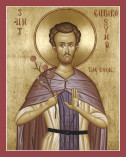 A simple man and a man of God, he served as
cook in a certain monastery in the ninth century. The spiritual father of this monastery
dreamed one night that he was in Paradise, and there saw Ephrosynus, who chose for him
three apples of Paradise. When he awoke, he saw these three lovely and fragrant apples on
his pillow. He quickly found Ephrosynus and asked him: ‘Where were you last night,
brother?’ ‘Where you were, father,’ the blessed man of God replied. The
spiritual father then revealed the whole affair to the monks, and all knew of the holiness
and godliness of Ephrosynus. But he, fearing the praise of men, immediately fled from the
monastery and hid himself in the desert, where he spent the rest of his life. A simple man and a man of God, he served as
cook in a certain monastery in the ninth century. The spiritual father of this monastery
dreamed one night that he was in Paradise, and there saw Ephrosynus, who chose for him
three apples of Paradise. When he awoke, he saw these three lovely and fragrant apples on
his pillow. He quickly found Ephrosynus and asked him: ‘Where were you last night,
brother?’ ‘Where you were, father,’ the blessed man of God replied. The
spiritual father then revealed the whole affair to the monks, and all knew of the holiness
and godliness of Ephrosynus. But he, fearing the praise of men, immediately fled from the
monastery and hid himself in the desert, where he spent the rest of his life.
|
4. The Holy Martyr Ia.
Denounced by an idolatrous priest, she suffered for the Lord in Persia in the time of Sapor II, in 363. According to tradition, the sun was darkened at the time of her death, and the whole air was filled with a wonderful fragrance. She is glorified forever by the Lord.
5. The Holy Martyrs Diodore, Didymus and Diomedes.
They were flogged for Christ’s sake in Laodicea, and gave their souls into the hands of their Lord.
FOR CONSIDERATION
One must not hinder any man on the path of perfect self-giving and service of God. Many holy women, who determined to flee wedlock and consecrate themselves to God, were followed and hindered by their husbands. These women have usually escaped in the end, remaining steadfast in their intention, and have often, by their example, wakened their husbands’ consciences and set them on the way of salvation. St. Theodora had to conceal herself from her husband with the greatest caution, and she therefore dressed herself in men’s clothing and hid in a men’s monastery. But there have also been husbands with godly wisdom, who, with their wives, fulfilled their desire to withdraw from the world and consecrate themselves entirely to God. The Emperor Frederick was betrothed to a maiden, Agnes Cheshka, but she would not agree to enter into wedlock, and breaking off the betrothal, went into a monastery. Then the wise emperor said: ‘If she had left me for some mortal man, I would have had my revenge; but I dare not consider myself affronted that, in my place, she has chosen the King of heaven.’
Daily Scripture Readings taken from The Orthodox New Testament, translated and published by Holy Apostles Convent, Buena Vista, Colorado, copyright © 2000, used with permission, all rights reserved.
Daily Prologue Readings taken from The Prologue of Ochrid, by Bishop Nikolai Velimirovic, translated by Mother Maria, published by Lazarica Press, Birmingham, England, copyright © 1985, all rights reserved. Edited by Dormition Skete.