

Daily Devotional
Friday, July 24, 2026 (NS), July 11, 2026 (OS)
Fast Day, but Wine and Olive Oil Allowed.
Friday of the Eighth Week
The commemoration of the Martyr Ephemia the All-praised, the standard of the Fathers when she ratified the definition of the Faith, and the repose of the Equal-to-the-apostles Olga, Princess of Russia, in Baptism called Helen.
Scripture Readings
Paschalion — Movable Calendar
Friday of the Eighth Week
Epistle
The Reading is from the First Epistle of Saint Paul to the Corinthians [§ 148]. Brethren:
11 8Man is not of woman, but woman of man. 9For also man was not created on account of the woman, but woman on account of the man. 10For this cause ought the woman to have authority on the head on account of the angels. 11However neither is man without woman, nor woman without man in the Lord. 12For as the woman is of the man, so also the man is by the woman; but all things of God. 13Judge in yourselves: Is it becoming for a woman to be praying to God uncovered? 14Or doth not nature herself teach you that on the one hand if a man should have long hair, it is a dishonor to him, 15but on the other hand if a woman should have long hair, it is to her glory? For the long hair hath been given to her for a covering. 16But if anyone think to be contentious, we have no such custom, nor the churches of God.
17Now giving this order, I praise ye not, that ye come together not for the better, but for the worse. 18For indeed, first, when ye come together in the church, I hear that there be schisms among you, and in part I believe it. 19For there must be also heresies among you, that the approved might become manifest among you. 20When ye come together therefore in one place, it is not to eat a Lord’s Supper. 21For in eating each one taketh before others his own supper; and one is hungry, and another is drunk. 22Have ye not houses in order to eat and to drink? Or do ye despise the Church of God, and put to shame those who have not? What shall I say to you? Shall I praise you in this? I praise you not. 23For I received from the Lord that which I also delivered to you.
Gospel
The Reading is from the Holy Gospel according to Saint Matthew [§ 71]. At that time:
17 10The disciples of Jesus asked Him, saying, “Why then do the scribes say that it is necessary for Elias to come first?” 11And Jesus answered and said to them, “Elias indeed cometh first and shall restore all things. 12“But I say to you that Elias already came, and they did not recognize him, but did to him as much as they wished. Thus also the Son of Man is about to suffer under them.” 13Then the disciples comprehended that He spoke to them concerning John the Baptist.
14And after they came to the crowd, there came to Him a man, kneeling down to Him and saying, 15“Lord, have mercy on my son, for he is a lunatic, and suffereth badly; for often he falleth into the fire, and often into the water. 16“And I brought him to Thy disciples, and they were not able to cure him.” 17And Jesus answered and said, “O unbelieving and wayward generation, until when shall I be with you? Until when shall I bear with you? Bring him here to Me.” 18And Jesus rebuked it, and the demon came out from him; and the boy was cured from that hour.
Menaion — Fixed Calendar
The commemoration of the Martyr Ephemia the All-praised, the standard of the Fathers when she ratified the definition of the Faith, and the repose of the Equal-to-the-apostles Olga, Princess of Russia, in Baptism called Helen.
Epistle
The Reading is from the Second Epistle of Saint Paul to the Corinthians [§ 181]. Brethren:
6 1We, working together, beseech you also not to receive the grace of God in vain— 2for He saith, “In an acceptable time I heard thee, and in a day of salvation I helped thee [Is. 49:8]”; behold, now is an acceptable time; behold, now is a day of salvation— 3by not giving even one cause of stumbling in anything, that the ministry might not be blamed. 4But in all things commending ourselves as ministers of God, in much patience, in afflictions, in necessities, in straits, 5in blows, in imprisonments, in instabilities, in toils, in vigils, in fastings, 6in pureness, in knowledge, in long-suffering, in kindness, in the Holy Spirit, in love unfeigned, 7in the word of truth, in the power of God, by the weapons of righteousness of the right hand and of the left, 8by glory and dishonor, by ill-fame and good fame; as deceivers and yet true; 9as unknown and well-known; as dying, and, behold, we live; as chastened, and not put to death; 10as ones sorrowful, but always rejoicing; as poor, but enriching many; as having nothing, and yet possessing all things.
Gospel
The Reading is from the Holy Gospel according to Saint Luke [§ 33]. At that time:
7 36A certain one of the Pharisees was asking Jesus that He would eat with him. And He entered into the house of the Pharisee, and reclined at table. 37And behold, a woman in the city who was a sinner, when she found out that He was reclining at table in the house of the Pharisee, brought an alabaster flask of perfumed ointment, 38and she stood beside His feet behind Him, weeping; and she began to wet His feet with tears, and was wiping them off with the hairs of her head; and she was kissing His feet ardently and anointing them with the perfumed ointment. 39Now when the Pharisee who invited Him saw it, he spoke within himself, saying, “This One, if He were a prophet, would know who and of what sort the woman is who toucheth Him, for she is a sinner.” 40And Jesus answered and said to him, “Simon, I have something to say to thee.” And he saith, “Teacher, say it.” 41“There were two debtors to a certain creditor: the one was owing five hundred denarii, and the other fifty. 42“But when they had nothing to pay back the debt, he showed himself gracious to both. Say which of them then will love him more?” 43Simon answered and said, “I suppose that he, to whom he showed himself the more gracious.” And He said to him, “Rightly thou didst judge.” 44And He turned to the woman, and said to Simon, “Seest thou this woman? I entered into thy house; water thou gavest Me not for My feet, but she with tears did wet My feet, and with the hairs of her head wiped them off. 45“A kiss thou gavest Me not, but she from the time that I entered did not cease from ardently kissing My feet. 46“With oil thou didst not anoint My head, but she anointed My feet with perfumed ointment. 47“For which reason I say to thee, her sins, which are many, have been forgiven, for she loved much. But to whom little is forgiven, the same loveth little.” 48And He said to her, “Thy sins have been forgiven.” 49And those reclining at table with Him began to say among themselves, “Who is this Who even forgiveth sins?” 50And He said to the woman, “Thy faith hath saved thee; go thy way in peace.”
Lives of the Saints (Prologue)
July 24th – Civil Calendar
July 11th – Church Calendar
1. The Holy and Great Martyr Ephemia.
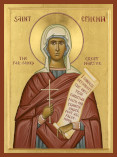 This saint is commemorated on September 16th,
the day on which she suffered. On this day is commemorated the miracle wrought by her precious
relics, revealed at the time of the Fourth Ecumenical Council in Chalcedon. This council was
called together in the reign of the Emperor Marcian and the Empress Pulcheria, in 451, after the
death of the Emperor Theodosios the Younger, and was summoned because of the heresy of Dioscoros,
Patriarch of Alexandria, and Eftyches, an archimandrite in Constantinople, who had disseminated
the false teaching that there were in Christ not two natures, divine and human, but only one, a
divine nature. At this council, the chief role was played by Anatolios, Patriarch of
Constantinople, and Juvenal, Patriarch of Jerusalem. Because, through the quarrels and evidence
on both sides, no decision could be reached, Patriarch Anatolios suggested that the Orthodox and
the heretics each write down their confession of faith, and that they be put into the reliquary
that contained the relics of St. Ephemia. All agreed to this. Two confessions of faith, then,
were written and placed in the hands of the great martyr. The reliquary was closed and sealed
with the imperial seal, a watch then being set over it. They then all spent three days in fasting
and prayer. On the fourth day, when the tomb was opened, they saw the Orthodox confession of
faith above the saint’s head and the heretical one beneath her feet. Thus was the conflict
resolved by God’s power, on the side of Orthodoxy. In the time of the Emperor Herakleios,
the relics of St. Ephemia were translated from Chalcedon to Constantinople, to the church
dedicated to her near the Hippodrome. The iconoclast Emperor Leo the Isaurian ordered that her
relics be thrown into the sea; but by a wonderful act, the reliquary was brought to the island of
Lemnos and placed in the church of the Holy Martyr Glykeria. Then, in the time of the Empress
Irene, the reliquary with its relics was again taken to Constantinople, to its former place.
Blood has flowed from these relics from time to time, to the succour of the sick and the
feeble.
This saint is commemorated on September 16th,
the day on which she suffered. On this day is commemorated the miracle wrought by her precious
relics, revealed at the time of the Fourth Ecumenical Council in Chalcedon. This council was
called together in the reign of the Emperor Marcian and the Empress Pulcheria, in 451, after the
death of the Emperor Theodosios the Younger, and was summoned because of the heresy of Dioscoros,
Patriarch of Alexandria, and Eftyches, an archimandrite in Constantinople, who had disseminated
the false teaching that there were in Christ not two natures, divine and human, but only one, a
divine nature. At this council, the chief role was played by Anatolios, Patriarch of
Constantinople, and Juvenal, Patriarch of Jerusalem. Because, through the quarrels and evidence
on both sides, no decision could be reached, Patriarch Anatolios suggested that the Orthodox and
the heretics each write down their confession of faith, and that they be put into the reliquary
that contained the relics of St. Ephemia. All agreed to this. Two confessions of faith, then,
were written and placed in the hands of the great martyr. The reliquary was closed and sealed
with the imperial seal, a watch then being set over it. They then all spent three days in fasting
and prayer. On the fourth day, when the tomb was opened, they saw the Orthodox confession of
faith above the saint’s head and the heretical one beneath her feet. Thus was the conflict
resolved by God’s power, on the side of Orthodoxy. In the time of the Emperor Herakleios,
the relics of St. Ephemia were translated from Chalcedon to Constantinople, to the church
dedicated to her near the Hippodrome. The iconoclast Emperor Leo the Isaurian ordered that her
relics be thrown into the sea; but by a wonderful act, the reliquary was brought to the island of
Lemnos and placed in the church of the Holy Martyr Glykeria. Then, in the time of the Empress
Irene, the reliquary with its relics was again taken to Constantinople, to its former place.
Blood has flowed from these relics from time to time, to the succour of the sick and the
feeble.
2. St. Elena (Olga).
A great Russian princess, the wife of Prince Igor, she was called Olga before her Baptism. She was baptized in Constantinople by Patriarch Polyefktos, and was greatly zealous for the Orthodox Faith in Russia. She entered into rest in 969.
3. Our Holy Father, the Martyr Nikodemos (Nicodemus).
Born in Elbasan, he was married and had children. Duped by the Turks, he embraced Islam and forced his children to do likewise, with the exception of one son who fled to the Holy Mountain and became a monk. Nikodemos went to Athos to take his son back, but the place made such an impression on him that he repented, returned to the Christian Faith and became a monk himself. He bewailed his apostasy for three years, then decided to return to Albania, to expiate his sin there where he had committed it. He therefore returned, informed the Turks that he was a Christian and was beheaded on July 11th, 1722. His wonder-working relics are preserved today whole and incorrupt.
4. Our Holy Father, the Martyr Nectarios.
Born in Vryoulla in Asia Minor, he was forced to accept Islam at the age of seventeen. His outcome was similar to that of St. Nikodemos. When he showed himself to his mother as a Turk, she cried at him: ‘Get away from me! I don’t know you. I bore you as a Christian, not as a Turk!’ He repented bitterly, went to the Holy Mountain and there, in the skete of St. Anne, became a monk. Having resolved to die for Christ and thus take away his sin, he went again to Vryoulla, where he suffered. He was beheaded for Christ by the Turks in his birthplace on July 11th, 1820, at the age of twenty-one.
FOR CONSIDERATION
A change of fortune hits hardest when it comes unexpectedly. But, to him who is prepared for the blow and is armed against it, can it be unexpected? The Emperor Charlemagne ensured that his sons learn some craft and his daughter to weave, so that they should have something to live on if their fortunes changed. The renowned Belissarios, a great general and conqueror, was slandered to the king by some malicious men, and on the foundation of this slander, was blinded and stripped of all his goods. The blind Bellisarios sat at the gate of Rome and begged for alms, saying to the passers-by: ‘Give to Bellisarios, whom fortune raised up but envy struck down and deprived of his sight!’ ‘Is not man as a soldier in arms on earth?’ says Righteous Job (7:1). One must be as a vigilant watch-man, ready for anything that may happen. What is there that cannot happen to a man? One must have hope in God in every suffering. Righteous Job, on his dung-heap, cried out from among the filth: ‘Though He slay me, yet will I trust Him!’ (13:15).
Daily Scripture Readings taken from The Orthodox New Testament, translated and published by Holy Apostles Convent, Buena Vista, Colorado, copyright © 2000, used with permission, all rights reserved.
Daily Prologue Readings taken from The Prologue of Ochrid, by Bishop Nikolai Velimirovic, translated by Mother Maria, published by Lazarica Press, Birmingham, England, copyright © 1985, all rights reserved. Edited by Dormition Skete.