

Daily Devotional
Sunday, May 3, 2026 (NS), April 20, 2026 (OS)
No Fasting.
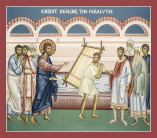
| The Fourth Sunday of Pascha, or the Sunday of the Paralytic Mode Three — Fifth Eothinon |
The commemoration of our venerable Father Theodore Trichinas ("the Hair-shirt Wearer"), hermit near Constantinople, and our venerable Father Anastasios of Sinai (commemorated on Gk. calendar on the 21st of April).
Scripture Readings
Paschalion — Movable Calendar
The Fourth Sunday of Pascha, or the Sunday of the Paralytic
Mode Three — Fifth Eothinon
Epistle
The Reading is from the Acts of the Apostles [§ 23]. In those days:
9 32It came to pass, as Peter passed through all quarters, he went down also to the saints that dwelt at Lydda. 33And there he found a certain man, by name Æneas, who kept his bed for eight years, and was paralyzed. 34And Peter said to him, “Æneas, Jesus the Christ healeth thee; rise up and make up thy bed for thyself.” And straightway he rose up. 35And all those inhabiting Lydda and the Sharon Plain, who saw him, turned to the Lord. 36Now there was in Joppa a certain disciple, by name Tabitha, which, being interpreted, is called Dorcas. She was full of good works and of alms which she used to do. 37And it came to pass in those days she fell sick and died. And after they washed her, they laid her in an upper room. 38And since Lydda was near to Joppa, and the disciples heard that Peter was in it, they sent forth two men to him, beseeching him not to delay to come over to them. 39And Peter, having risen up, went with them, whom after he came, they brought him into the upper room. And all the widows stood by him weeping, and showing howsoever many tunics and garments Dorcas used to make while she was with them. 40But Peter put them all forth, and kneeled down, and prayed. And turning to the body, he said, “Tabitha, rise up.” And she opened her eyes; and after she saw Peter she sat up. 41And he gave her his hand and raised her up; and after he called the saints and the widows, he presented her alive. 42And it became known throughout all of Joppa; and many believed on the Lord.
Gospel
The Reading is from the Holy Gospel according to Saint John [§ 14]. At that time:
5 1Jesus went up to Jerusalem. 2Now there is in Jerusalem by the gate a sheep pool, which is surnamed in Hebrew, Bethesda, having five porches. 3In these was lying a great multitude of the infirm, blind, lame, withered, awaiting the moving of the water. 4For an angel used to come down from time to time into the pool and trouble the water; then after the troubling of the water, the one who first entered became well of whatsoever disease he was held by. 5And a certain man was there, who had been thirty and eight years in his infirmity. 6Jesus saw this one lying there, and knew that he had already been much time in that condition, and He said to him, “Dost thou wish to become well?” 7The sick man answered Him, “Sir, I have no man in order that whenever the water is troubled he may put me into the pool; but while I am coming, another goeth down before me.” 8Jesus saith to him, “Rise, take up thy bed and be walking.” 9And straightway the man became well, and took up his bed, and went on walking. And on that day it was a sabbath. 10The Jews therefore were saying to him who had been healed, “It is a sabbath; it is not lawful for thee to take up the bed.” 11He answered them, “The One Who made me well, the same said to me, ‘Take up thy bed and be walking.’” 12Then they asked him, “Who is the Man Who said to thee, ‘Take up thy bed and be walking?’” 13But the one who was healed knew not Who it was, for Jesus turned aside, because a crowd was in the place. 14After these things Jesus findeth him in the temple, and said to him, “Behold, thou hast become well; no longer go on sinning, lest a worse thing should befall thee.” 15The man went away, and told the Jews that Jesus was the One Who made him well.
Menaion — Fixed Calendar
The commemoration of our venerable Father Theodore Trichinas ("the Hair-shirt Wearer"), hermit near Constantinople, and our venerable Father Anastasios of Sinai (commemorated on Gk. calendar on the 21st of April).
No readings given.
Lives of the Saints (Prologue)
May 3rd – Civil Calendar
April 20th – Church Calendar
1. Our Holy Father Theodore Trichinas.
He was a citizen of Constantinople, and the son of wealthy parents. He left parents, home and riches while still a young man and settled in a remote monastery in Thrace, where he undertook the most rigorous ascetic life. He slept on a stone so that he might have less sleep; he was always bareheaded and dressed in a hair-shirt, from which he was called ‘Trichinas’ or ‘hairy’. Because of his great and self-inflicted sufferings for the sake of his soul’s salvation, God granted him the gift of working miracles, both in his lifetime and after his death, and he died peacefully in about 400. Healing myrrh flowed from his relics.
2. Our Holy Father Anastasios of Mount Sinai.
He was abbot of Mount Sinai. He was for a long time a monk under the famous abbot, St. John of the Ladder, whom he succeeded on the latter’s death. He was also a great ascetic, and an eloquent narrator of the lives of the saints and the author of other instructive works. He fought an intensive battle against the heresy of the Akephalites, which was condemned by the Fourth Ecumenical Council at Chalcedon. He died in great old age in 685, and went to the Lord Whom he had served so faithfully.
3. Blessed Anastasios the Sinaite, Patriarch of Antioch.
He was chosen as Patriarch of Antioch in the reign of the Emperor Justinian while still a monk on Mount Sinai. His virtues, purity of life, great spiritual learning and staunch faith won him the patriarchal throne. But Justinian, according to one historical source, for a short time fell into the heresy of Aphthartodocetism. Eftychios, Patriarch of Constantinople, and Blessed Anastasios reacted sharply against this. The emperor exiled Eftychios and wanted to exile Anastasios also, but could find nothing in his life capable of criticism. When Justinian was dying, he repented and returned Eftychios to the patriarchal throne, but Justin, his successor, succeeded in exiling Anastasios on the basis of certain slanders. Anastasios spent twenty-three years in exile and was then returned to the throne of Antioch during the reign of the Emperor Maurice. He governed the Church of God for six further years and finished his earthly course in 599.
4. Blessed Gregory, Patriarch of Antioch.
An Armenian by birth, he was abbot first of the Pharanite monastery and then on Mount Sinai, and when Blessed Anastasios was driven from the patriarchal throne, he was, against his will, installed as Patriarch of Antioch. John Moschus writes about him in his ‘Meadow,’ praising him highly. Gregory was particularly distinguished by an outstanding compassion, most especially towards sinners. He entered into rest in the Lord in 593
5. The Holy Apostle Zaccheus.
He was at first a publican and a sinner, but when the Lord saw him in the tree in Jericho (Lk. 19), He immediately brought Zaccheus to repentance. Zaccheus later followed the Apostle Peter, who made him Bishop of Caesarea in Palestine, where he served the Gospel in faithfulness and died peacefully.
6. Our Holy Father Athanasius of Meteora.
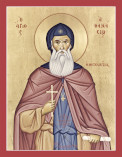 Born in 1310, he lived in asceticism on the Holy Mountain.
He founded a famous monastery in the Meteora in Thessaly. He had great gifts of discernment
and wonder-working. Born in 1310, he lived in asceticism on the Holy Mountain.
He founded a famous monastery in the Meteora in Thessaly. He had great gifts of discernment
and wonder-working.
|
Author’s note: Philaret also mentions Gabriel the Child-martyr in his ‘Lives of the Saints’. He was born in the village of Zvjerka, near the town of Zabludov and was only six years old when, in 1648, on the day when his parents were not at home, he was lured to a lonely place by a Jew named Schutko and crucified there. His body was found incorrupt thirty years later.
FOR CONSIDERATION
St. Anastasios of Mount Sinai teaches: ‘God gives to each Christian an angel to care for him through his whole life, unless he drives him away by his evil doings. But, as smoke drives away bees and an evil stench doves, so the guardian of our life, our angel, is driven away from us by our sins: drunkenness, debauchery, anger and the rest. An angel guides every faithful man in every good work, while the demons exert all their strength to disturb the faithful and deprive them of the heavenly kingdom.’ That angels are close to men and take care of them is testified to in the whole of holy Scripture and especially in the New Testament. Besides this, there are in the Orthodox Church innumerable testimonies of holy men and women who witnessed to that which Anastasios emphasises: that a gracious and powerful messenger of God, a soldier of the King of heaven, an angel of light, accompanies each one of us through this life. Who, other than the insane, would drive away such a good friend from himself? Indeed, only the insane and other ignoramuses drive away their greatest friends, their guardian angels.
Daily Scripture Readings taken from The Orthodox New Testament, translated and published by Holy Apostles Convent, Buena Vista, Colorado, copyright © 2000, used with permission, all rights reserved.
Daily Prologue Readings taken from The Prologue of Ochrid, by Bishop Nikolai Velimirovic, translated by Mother Maria, published by Lazarica Press, Birmingham, England, copyright © 1985, all rights reserved. Edited by Dormition Skete.