

Daily Devotional
Sunday, April 26, 2026 (NS), April 13, 2026 (OS)
No Fasting.
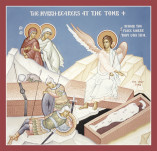
| Third Sunday of Pascha, Sunday of the Myrrh-Bearers Mode Two — Fourth Eothinon |
The commemoration of our holy father among the saints, Martin, Pope of Rome (commemorated on Sl. calendar on the 14th of April), and his fellow bishops, and Hieromartyr Artemon, presbyter of Laodicea.
Scripture Readings
Paschalion — Movable Calendar
Third Sunday of Pascha, Sunday of the Myrrh-Bearers
Mode Two — Fourth Eothinon
Epistle
The Reading is from the Acts of the Apostles [§ 16].
6 1In those days, when the disciples were multiplying, there arose a murmuring of the Hellenists against the Hebrews, because their widows were being overlooked in the daily ministration. 2And the twelve summoned the multitude of the disciples, and said, “It is not pleasing to us to leave behind the word of God to serve tables. 3“Therefore, brethren, look out for seven men from among yourselves, whose character is approved by testimony, full of the Holy Spirit and wisdom, whom we shall appoint over this business; 4“but we will persevere in prayer and the ministry of the word.” 5And the saying was pleasing before the whole multitude. And they chose for themselves Stephen (a man full of faith and of the Holy Spirit), and Philip, and Prochoros, and Nicanor, and Timon, and Parmenas, and Nicholas (a proselyte of Antioch), 6whom they set before the apostles; and having prayed, they laid their hands on them. 7And the word of God kept on increasing, and the number of the disciples was being multiplied in Jerusalem exceedingly, and great numbers of the priests were obedient to the faith.
Gospel
The Reading is from the Holy Gospel according to Saint Mark [§ 69]. At that time:
15 43Joseph, a noble counselor, who was from Arimathea, and who himself also was waiting for the kingdom of God, came; and having become bold, he went in to Pilate and asked for the body of Jesus for himself. 44And Pilate wondered if He were already dead; and having summoned the centurion, he questioned him if He died not long ago. 45And having come to know it from the centurion, he granted the body to Joseph. 46And he bought a linen cloth, and took Him down, and wrapped Him in the linen, and laid Him in a sepulcher which was hewn out of a rock, and rolled a stone against the door of the sepulcher. 47And Mary Magdalene and Mary the Mother of Joses were beholding where He was laid.
16 1And the sabbath having passed, Mary Magdalene, and Mary the Mother of Iakovos, and Salome bought aromatic spices, that they might come and anoint Him. 2And very early in the morning on the first day of the week they came to the sepulcher, after the sun rose. 3And they were saying among themselves, “Who shall roll away the stone from the door of the sepulcher for us?” 4And they looked up and saw that the stone had been rolled away, for it was exceedingly great. 5And after they entered into the sepulcher, they saw a young man sitting on the right, clothed in a white robe, and they were amazed. 6And he saith to them, “Cease being amazed. Ye are seeking Jesus the Nazarene Who hath been crucified. He was raised, He is not here. Behold the place where they laid Him. 7“But go and say to His disciples, and to Peter, that He goeth before you into Galilee; there shall ye see Him, even as He told you.” 8And they went out and fled from the sepulcher. And trembling and ecstasy held them fast, and to no one did they say anything, for they were afraid.
Menaion — Fixed Calendar
The commemoration of our holy father among the saints, Martin, Pope of Rome (commemorated on Sl. calendar on the 14th of April), and his fellow bishops, and Hieromartyr Artemon, presbyter of Laodicea.
No readings given.
Lives of the Saints (Prologue)
April 26th – Civil Calendar
April 13th – Church Calendar
1. The Hieromartyr Artemon.
He was a priest in Laodicea in the time of the Emperor Diocletian. He spoke thus of himself before the torturers’ tribunal: ‘I am called Artemon, a servant of Christ my God. Sixteen years I was a reader, and read the services in the Church of my God; twenty-eight years a deacon, and read the holy Gospel; and have now completed thirty years as a priest, teaching the people and setting them on the way of salvation with the help of Christ.’ The judge took him to the temple of Aesculapius, where the priests kept great snakes, regarding them as gods. They meant the snakes to bite Artemon, but he made the sign of the Cross, and by its power riveted the snakes to the ground so that they could not bite him. He then brought them out to the courtyard and breathed on them, and they died instantly. All who saw this were filled with amazement. But the chief of the pagan priests of that temple, Vitalis, seeing this marvel, fell to his knees before Artemon and cried: ‘Great is the Christian God!’ The martyr baptized him, along with several of his friends. But the evil judge stood firm in his wickedness and tortured the aged Artemon in various ways. He intended at one time to cast him into burning pitch, but fell off his horse into it himself and was burned. Two eagles were seen to descend on him, lift him from his horse and cast him into the pitch. St. Artemon remained free for a certain time and went about teaching the people, accompanied always by two tame deer. But he was arrested afresh and beheaded in the year 303. And his soul went to the kingdom of Christ our God, Whom he had served so faithfully.
2. The Holy Martyr Crescens.
From the city of Myra in Lycia, he was an honored and eminent citizen. He openly confessed his faith in Christ, and mocked at the lifeless idols. For this he was burned to death by the pagans.
3. The Holy Martyr Thomaïs.
Born in Alexandria of devout parents, she was instructed in piety from her youth and married to a devout man at the age of fifteen. But her father-in-law was a foul old man, and in the absence of his son, fell on his daughter-in-law with the intention of taking away her honor. Thomaïs was terrified, and in her terror, reminded her father-in-law of God’s law and slipped out of his hands. After a long struggle, the father-in-law took out a knife and slaughtered Thomaïs, cutting her into two pieces. At that moment the punishment of God fell upon him: he was instantly blinded and was unable to find the door to get out of the room. He was arrested right there and taken for trial, where he was condemned to death. Thus Thomaïs suffered for the commandments of God and for marital fidelity and purity. It happened after that, that those who were tormented by lustful passions lifted up their prayers to St. Thomaïs and received great help from her. The great ascetic Daniel translated her relics to Sketis and laid them in the priests’ cemetery. St. Thomaïs suffered in 476.
FOR CONSIDERATION
When the martyr Crescens, a nobleman of Myra in Lycia, was taken for trial, the judge put great pressure on him to worship idols. Being utterly unsuccessful in this, he finally said to Crescens: ‘Only let your body bow, but cleave in your soul to your God.’ To this the honest Crescens replied: ‘The body can do nothing independently of the soul, which gives it movement and guidance.’ Crescens was murdered for that clear teaching for Christians against two-facedness. And there is more to this. Christians have the responsibility of serving their Creator with their bodies, not just with their souls. By this is refuted the false position of some Christians who live in the flesh as pagans and meanwhile congratulate themselves on the belief in and love for God in their souls. They cut themselves in half and enter the service of two masters—although the holiest lips have stated the impossibility of that.
Daily Scripture Readings taken from The Orthodox New Testament, translated and published by Holy Apostles Convent, Buena Vista, Colorado, copyright © 2000, used with permission, all rights reserved.
Daily Prologue Readings taken from The Prologue of Ochrid, by Bishop Nikolai Velimirovic, translated by Mother Maria, published by Lazarica Press, Birmingham, England, copyright © 1985, all rights reserved. Edited by Dormition Skete.