

Daily Devotional
Sunday, April 12, 2026 (NS), March 30, 2026 (OS)
No Fasting.
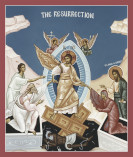
| The Holy and Great Sunday of Pascha |
The commemoration of our venerable Father John, the author of The Ladder, and the holy Apostles Sosthenes, Apollos, Kephas, Cæsar, and Epaphroditos of the Seventy, and our holy father among the saints, Sophronios the Wonder-worker, Bishop of Irkutsk.
Scripture Readings
Paschalion — Movable Calendar
The Holy and Great Sunday of Pascha
Epistle
The Reading is from the Acts of the Apostles [§ 1].
1 1The first account indeed I made for myself concerning all which, O Theophilos, Jesus began both to do and teach, 2until the day in which He was taken up, after He gave command to the apostles whom He chose for Himself through the Holy Spirit, 3to whom also He presented Himself alive after He had suffered by many proofs, being seen by them during forty days and speaking the things concerning the kingdom of God. 4And being assembled together with them, He ordered them not to depart from Jerusalem, but to wait for the promise of the Father, “which,” He said, “ye heard of Me; 5“for John indeed baptized with water, but ye shall be baptized in the Holy Spirit not many days after these.” 6Indeed therefore, after they came together, they kept on questioning, saying, “Lord, dost Thou at this time restore the kingdom to Israel?” 7And He said to them, “It is not yours to know times or seasons which the Father Himself put in His own authority. 8“But ye shall receive power, after the Holy Spirit is come upon you; and ye shall be witnesses to Me both in Jerusalem, and in all Judæa and Samaria, and unto the ends of the earth.”
Gospel
In the Liturgy
The Reading is from the Holy Gospel according to Saint John [§ 1].
1 1In the beginning was the Logos, and the Logos was with God, and the Logos was God. 2This One was in the beginning with God. 3All things came into being through Him, and without Him not even one thing came into being that hath come to be. 4In Him was life, and the Life was the light of men. 5And the light shineth in the darkness, and the darkness overcame it not.
6There came to be a man who was sent forth from God, whose name was John. 7This same came for a witness, in order that he might bear witness concerning the Light, that all might believe through Him. 8He was not that One, the Light, but was sent that he might bear witness concerning the Light. 9That was the true Light, which giveth light to every man coming into the world. 10He was in the world, and the world came into being through Him, and the world knew Him not. 11He came to His own, and His own received Him not. 12But as many as received Him, to them He gave power to become children of God, to those who believe in His name: 13who were begotten not of blood, nor of the will of the flesh, nor of the will of man, but of God. 14And the Logos became flesh and tabernacled among us, and we beheld His glory, the glory as of an only-begotten from the Father, full of grace and truth. 15John beareth witness concerning Him, and hath cried out, saying, “This One was He of Whom I said, ‘The One Who cometh after me hath come to be before me, for He was before me.’” 16And of His fullness we all received, and grace for grace; 17for the law was given through Moses, but the grace and the truth came to be by Jesus Christ.
In Vespers
The Reading is from the Holy Gospel according to Saint John [§ 65].
20 19When it was evening on that day, the first of the week—and the doors were closed where the disciples were gathered together for fear of the Jews—Jesus came and stood in the midst, and saith to them, “Peace be to you.” 20And after He said this, He showed them His hands and His side. Then were the disciples glad, after they saw the Lord. 21Then Jesus said to them again, “Peace be to you; even as the Father hath sent Me forth, I also send you.” 22And after He said this, He breathed on them, and saith to them, “Receive ye the Holy Spirit: 23“if ye forgive the sins of any, they are forgiven to them; if ye retain the sins of any, they are retained.” 24But Thomas, one of the twelve, who is called Didymos, was not with them when Jesus came. 25The other disciples therefore were saying to him, “We have seen the Lord.” But he said to them, “Unless I should see in His hands the mark of the nails, and put my finger into the mark of the nails, and put my hand into His side, in no wise will I believe.”
Menaion — Fixed Calendar
The commemoration of our venerable Father John, the author of The Ladder, and the holy Apostles Sosthenes, Apollos, Kephas, Cæsar, and Epaphroditos of the Seventy, and our holy father among the saints, Sophronios the Wonder-worker, Bishop of Irkutsk.
Epistle
For the venerable Father:
The Reading is from the Epistle of Saint Paul to the Galatians [§ 213]. Brethren:
5 22The fruit of the Spirit is love, joy, peace, long-suffering, kindness, goodness, faith, 23meekness, self-control; against such things there is no law. 24But they who are of the Christ crucified the flesh with the passions and the lusts. 25If we live by the Spirit, let us also be walking by the Spirit. 26Let us not become vainglorious, provoking one another, envying one another.
6 1Brethren, even if a man should be overtaken in some transgression, ye, the spiritual ones, be restoring such a one in the spirit of meekness, looking out for thyself, lest thou also be tempted. 2Keep on bearing one another’s burdens, and thus fill up the law of the Christ.
For the Hierarch:
The Reading is from the Epistle of Saint Paul to the Hebrews [§ 318]. Brethren:
7 26Such a High Priest was fitting for us: holy, guileless, undefiled, Who hath been separated from the sinners and hath become higher than the heavens, 27Who hath no need daily, even as the high priests, to offer up sacrifices, first for his own sins, then for those of the people; for this He did once for all after He offered up Himself. 28For the law appointeth men high priests who have weakness; but the word of the oath, which is after the law, appointeth the Son, Who hath been perfected forever.
8 1Now in reference to the things being spoken of, the chief point is: We have such a High Priest, Who sat down on the right of the throne of the majesty in the heavens, 2a Liturgist of the holies and of the tabernacle, the true one, which the Lord pitched, and not man.
Gospel
For the venerable Father:
The Reading is from the Holy Gospel according to Saint Luke [§ 51]. The Lord said to His disciples:
10 16“The one who heareth you heareth Me, and the one who rejecteth you rejecteth Me, and the one who rejecteth Me rejecteth the One Who sent Me forth.”
17And the seventy returned with joy, saying, “Lord, even the demons are being made subject to us in Thy name.” 18And He said to them, “I was beholding Satan as lightning having fallen out of the heaven. 19“Behold, I give you the authority to tread upon serpents and scorpions, and upon all the power of the enemy; and nothing in anywise shall injure you. 20“However cease rejoicing in this, that the spirits are being made subject to you; but be rejoicing that your names were written in the heavens.” 21In the same hour Jesus rejoiced in the Spirit, and said, “I give thanks to Thee, O Father, Lord of the heaven and of the earth, that Thou didst hide these things from the wise and intelligent, and didst reveal them to babes. Yea, Father, for thus it was well-pleasing before Thee.”
For the Hierarch:
The Reading is from the Holy Gospel according to Saint Matthew [§ 11]. The Lord said to His disciples:
5 14“Ye are the light of the world. A city situated on the top of a mountain cannot be hid. 15“Nor do they light a lamp and put it under the bushel, but upon the lampstand, and it giveth light to all those in the house. 16“Thus, let your light shine before men, that they might see your good works, and might glorify your Father Who is in the heavens.
17“Do not begin to think that I came to abolish the law or the prophets; I came not to abolish, but to fulfill. 18“For verily I say to you, until the heaven and the earth shall have passed away, one iota or one tittle in no wise shall pass away from the law, until all shall have taken place. 19“Whosoever then shall break one of the least of these commandments, and shall teach men so, he shall be called least in the kingdom of the heavens; but whosoever shall do and teach them, this one shall be called great in the kingdom of the heavens.”
Lives of the Saints (Prologue)
April 12th – Civil Calendar
March 30th – Church Calendar
1. Our Holy Father John Climacus (of the Ladder).
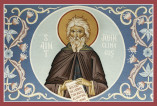 The author of the famous
‘Ladder,’ he came from an unknown place to Mount Sinai as a sixteen-year-old boy and
remained there, first as a novice, then as a hermit and finally as abbot of Sinai, until he died
at the age of eighty, in about 649. His biographer, the monk Daniel, says of him: ‘He
brought his body up to Mount Sinai, but his spirit he brought to the Mount of Heaven’. He
spent nineteen years in obedience to his spiritual father, Martyrios. Anastasios of Mount Sinai,
who saw John once as a young man, foretold that he would be abbot of Mount Sinai. After the death
of his spiritual father, John took himself off to a cave, where he lived for twenty years in
strict asceticism. His disciple, Moses, fell asleep one day in the cool shade of a huge rock.
John was at prayer in his cell, and perceiving that his disciple was in danger, began to pray for
him. Moses came up to him later, fell to his knees and began to thank him for saving him from
certain death. And he related how he had heard John calling him in his sleep and had jumped up at
the very moment that a rock fell. Had he not jumped out of the way, the rock would certainly have
killed him. At the importunate urging of the brethren, John accepted the abbacy, and guided their
souls to salvation with loving zeal. He once heard a monk reproach him for being too verbose. He
was not in the least angered, but was silent for an entire year, not uttering a single word until
the brethren begged him to speak. He then began to instruct them with the wisdom with which God
had endowed him. Once 600 pilgrims came to Mount Sinai. At supper they all noticed an agile young
man dressed as a Jew who was serving at table and giving orders to the other servants, taking
charge of everything. Suddenly, he disappeared. While everyone was pondering this and asking
questions among themselves, John said: ‘Do not bother to look for him; that was the prophet
Moses serving you in his own home.’ During the time that he was silent in his cave, John
wrote many instructive books, of which the most famous, ‘The Ladder,’ is much read to
this day. It describes the way to raise the soul to God as if on a ladder. Before his death, John
appointed his own brother, George, to the abbacy, but George began to grieve greatly at the
approaching parting with John. Then John said that, if he were found worthy to stand close to God
in the next world, he would pray that George be taken up to heaven in the same year. And so it
came to pass. After ten months, George also fell asleep and departed to take his place among
heaven’s citizens alongside his brother John.
The author of the famous
‘Ladder,’ he came from an unknown place to Mount Sinai as a sixteen-year-old boy and
remained there, first as a novice, then as a hermit and finally as abbot of Sinai, until he died
at the age of eighty, in about 649. His biographer, the monk Daniel, says of him: ‘He
brought his body up to Mount Sinai, but his spirit he brought to the Mount of Heaven’. He
spent nineteen years in obedience to his spiritual father, Martyrios. Anastasios of Mount Sinai,
who saw John once as a young man, foretold that he would be abbot of Mount Sinai. After the death
of his spiritual father, John took himself off to a cave, where he lived for twenty years in
strict asceticism. His disciple, Moses, fell asleep one day in the cool shade of a huge rock.
John was at prayer in his cell, and perceiving that his disciple was in danger, began to pray for
him. Moses came up to him later, fell to his knees and began to thank him for saving him from
certain death. And he related how he had heard John calling him in his sleep and had jumped up at
the very moment that a rock fell. Had he not jumped out of the way, the rock would certainly have
killed him. At the importunate urging of the brethren, John accepted the abbacy, and guided their
souls to salvation with loving zeal. He once heard a monk reproach him for being too verbose. He
was not in the least angered, but was silent for an entire year, not uttering a single word until
the brethren begged him to speak. He then began to instruct them with the wisdom with which God
had endowed him. Once 600 pilgrims came to Mount Sinai. At supper they all noticed an agile young
man dressed as a Jew who was serving at table and giving orders to the other servants, taking
charge of everything. Suddenly, he disappeared. While everyone was pondering this and asking
questions among themselves, John said: ‘Do not bother to look for him; that was the prophet
Moses serving you in his own home.’ During the time that he was silent in his cave, John
wrote many instructive books, of which the most famous, ‘The Ladder,’ is much read to
this day. It describes the way to raise the soul to God as if on a ladder. Before his death, John
appointed his own brother, George, to the abbacy, but George began to grieve greatly at the
approaching parting with John. Then John said that, if he were found worthy to stand close to God
in the next world, he would pray that George be taken up to heaven in the same year. And so it
came to pass. After ten months, George also fell asleep and departed to take his place among
heaven’s citizens alongside his brother John.
2. Commemoration of an Uncondemning Monk.
This monk died joyfully because he had never in his life condemned anyone. He was lazy, careless, disinclined to prayer, but throughout his entire life he had never judged anyone. And when he lay dying, he was full of joy. The brethren asked him how he could die so joyfully with all his sins, and he replied: ‘I have just seen the angels, and they showed me a page with all my many sins. I said to them: “The Lord said: ‘Judge not, that ye be not judged.’ I have never judged anyone and I hope in the mercy of God, that He will not judge me.” And the angels tore up the sheet of paper.’ Hearing this, the monks wondered at it and learned from it.
FOR CONSIDERATION
If the humbling of oneself before men is needful that one might be exalted before God, and temporal toil is the prerequisite of immortal life, what does it matter if some shake their heads and laugh at your self-abasement? John the Hesychast was ten years bishop on Ascalon, after which time he realized that worldly honors were hindering him, so he disguised himself as a simple monk and went to the Monastery of St. Sava the Sanctified. He was given the task of collecting and carrying wood and cooking lentils for the workmen. When he was discovered there also, he shut himself in his cell and lived there for forty-seven years on cabbage. You see how the fathers fled earthly honors. Yet, how many people in our day engage in a foolhardy struggle for them, squandering their souls for the sake of dust and ashes.
Daily Scripture Readings taken from The Orthodox New Testament, translated and published by Holy Apostles Convent, Buena Vista, Colorado, copyright © 2000, used with permission, all rights reserved.
Daily Prologue Readings taken from The Prologue of Ochrid, by Bishop Nikolai Velimirovic, translated by Mother Maria, published by Lazarica Press, Birmingham, England, copyright © 1985, all rights reserved. Edited by Dormition Skete.