

Daily Devotional
Saturday, April 11, 2026 (NS), March 29, 2026 (OS)
Fast Day. Wine permitted, but not olive oil.
Holy Week
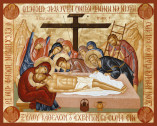
| Holy and Great Saturday |
The commemoration of Hieromartyr Mark, Bishop of Arethusa, and Kyril the deacon, and many others with them, and the holy Martyrs Jonas and Varachysios of Persia.
Scripture Readings
Paschalion — Movable Calendar
Holy and Great Saturday
Epistle
In the Orthros
The Reading is from the First Epistle of Saint Paul to the Corinthians [§ 133]. Brethren:
Note two Readings, one from 1 Cor. 5:6-8 and Gal. 3:13, 14.
Begin with First Corinthians [§ 133]:
5 6A little leaven leaveneth the whole dough. 7Purge out therefore the old leaven, that ye may be a new dough, even as ye are unleavened. For also Christ, our Passover, was sacrificed for us; 8therefore let us be keeping festival, not with old leaven, nor with the leaven of malice and wickedness, but with the unleavened loaves of sincerity and of truth.
Conclude with Galatians [§ 206]:
3 13Christ redeemed us from the curse of the law, having become a curse for us (for it hath been written: “Cursed is everyone who hangeth on a tree [Deut. 21:23]”), 14that the blessing of Abraham might come to pass to the nations in Christ Jesus, in order that we might receive the promise of the Spirit through faith.
In the Divine Liturgy
The Reading is from the Epistle of Saint Paul to the Romans [§ 91]. Brethren:
6 3As many as were baptized into Christ Jesus were baptized into His death. 4Therefore we were buried with Him by the baptism into the death, that even as Christ was raised from the dead through the glory of the Father, thus also we should walk in newness of life. 5For if we have been planted together in the likeness of His death, certainly also we shall be of the resurrection, 6knowing this, that our old man was crucified with Him, that the body of sin might be rendered inactive, in order to no longer serve sin. 7For the one who died hath been justified from sin. 8Now if we died with Christ, we believe that we shall also live with Him, 9knowing that Christ Who was raised from the dead dieth no more; death no longer hath dominion over Him. 10For the death which He died, He died to sin once for all; but the life which He liveth, He liveth to God. 11Thus reckon ye also yourselves to be dead indeed to sin, but alive to God in Christ Jesus our Lord.
Gospel
In the Orthros
The Reading is from the Holy Gospel according to Saint Matthew [§ 114].
27 62On the morrow, which is after the preparation, the chief priests and the Pharisees were gathered together to Pilate, 63saying, “Sir, we were reminded that that deceiver said while He was yet alive, ‘I am being raised after three days.’ 64“Command therefore that the tomb be made secure until the third day, lest perchance His disciples come by night and steal Him, and say to the people, ‘He was raised from the dead’; and the last deceit shall be worse than the first.” 65And Pilate said to them, “Ye have a guard; go your way and make it as secure for yourselves as ye know how.” 66And they went and made the tomb secure, having sealed the stone with the guard being present.
In the Liturgy
The Reading is from the Holy Gospel according to Saint Matthew [§ 115].
28 1Late on the sabbath, at the dawning toward the first day of the week, there came Mary Magdalene and the other Mary to see the tomb. 2And behold, a great earthquake occurred; for an angel of the Lord descended out of heaven, and came and rolled away the stone from the door, and sat upon it. 3And his appearance was as lightning, and his garment white as snow. 4And those keeping guard, because of their fear of him, were shaken and became as dead men. 5And the angel answered and said to the women, “Cease being afraid, for I know that ye seek Jesus Who hath been crucified. 6“He is not here; for He was raised, even as He said. Come, see the place where the Lord was lying. 7“And go quickly and say to His disciples that He was raised from the dead. And behold, He goeth before you into Galilee; there shall ye see Him. Behold, I have told you.” 8And they went out quickly from the sepulcher with fear and great joy, and ran to bring tidings to His disciples. 9But as they were going to bring tidings to His disciples, then behold, Jesus met them, saying, “Rejoice ye.” And they approached and laid hold of His feet, and made obeisance to Him. 10Then Jesus saith to them, “Cease being frightened. Go and bring tidings to My brethren that they should go into Galilee, and there shall they see Me.” 11Now when they were going, behold, some of the guard came into the city and reported to the chief priests all the things that came to pass. 12And after they were gathered together with the elders and took counsel, they gave a considerable amount of money to the soldiers, 13saying, “Say, ‘His disciples came by night and stole Him while we were sleeping.’ 14“And if this should be heard before the governor, we will persuade him and make you free from care.” 15And they took the money and did as they were taught. And this report was spread abroad by the Jews until today.
16Now the eleven disciples went into Galilee, to the mountain where Jesus appointed them. 17And having seen Him, they made obeisance to Him; but some doubted. 18And Jesus approached and spoke to them, saying, “All authority is given to Me in heaven and on earth. 19“Go therefore and make disciples of all the nations, baptizing them in the name of the Father, and of the Son, and of the Holy Spirit, 20“teaching them to observe all things whatsoever I commanded you; and behold, I am with you all the days until the completion of the age.” Amen.
Menaion — Fixed Calendar
The commemoration of Hieromartyr Mark, Bishop of Arethusa, and Kyril the deacon, and many others with them, and the holy Martyrs Jonas and Varachysios of Persia.
No readings given.
Lives of the Saints (Prologue)
April 11th – Civil Calendar
March 29th – Church Calendar
1. St. Mark the Confessor, Bishop of Arethusa in Syria.
St. Gregory the Theologian and Blessed Theodoretus have given us an account of his sufferings. According to these accounts, Mark destroyed some pagan temples and brought many to the Christian Faith during the reign of the Emperor Constantine. But when the Emperor Julian came to the throne and quickly became an apostate from the Faith, some of the inhabitants of Arethusa renounced Christ and lapsed into paganism. They rose up against Mark because he had demolished the temple and demanded that he either rebuild it or pay them a very large sum of money. As Mark refused to do either, he was flogged and flayed and dragged through the streets. They then cut off his ears with strong, fine threads, stripped him naked, smeared him with honey and left him bound to a tree in the summer heat for the wasps, mosquitoes and hornets to eat. The martyr of Christ endured all this without complaint. He was quite old, and his face shone like an angel of the Lord. The pagans lowered the price of their temple again and again, finally demanding a quite insignificant amount which Mark could easily have given. But he refused to give even a single coin for that purpose. His endurance made a great impression on the citizens, and they began to admire him for it and to feel sorry for him, and gradually reduced the price of their temple to nothing just to allow him to remain alive. Finally, they let him go free, and one by one, all came to him to receive instruction and become Christians again. A deacon, Kyril, also suffered at this time for a similar cause in Heliopolis at the foot of Mount Lebanon. He had broken some idols at the time of the liberation of Christianity and was cruelly tortured under Julian for this. The pagans were so enraged with him that, after they had killed him, they tore out his teeth and ripped open his stomach. Many others suffered on the same day as St. Kyril. The evil pagans cut their bodies into small pieces, coated them with barley and fed them to the pigs. But retribution came swiftly upon them; all their teeth fell out and their mouths emitted an unbearable stench.
2. Our Holy Father John the Hermit.
He was the son of Juliana, a Christian woman of Armenia. While still a child, he left his mother and ran off to the desert. He was utterly aflame with love for Christ the Lord. In the beginning he entrusted himself to the guidance of a spiritual father, Pharmutios, who was so pleasing to God that an angel brought him bread every day. John later left him and withdrew into solitude. He let himself down into a dry well and lived there for a full ten years in fasting, prayer and vigils. St. Pharmutios used to bring him some of the angel’s bread, for the angel of God did not wish to bring bread to the young John in person, lest he grow proud through this, so he sent it through Pharmutios, his spiritual father. After ten years of arduous asceticism in this well, St. John went to the Lord and his relics revealed wonder-working power. He lived and was glorified by God and men in the 4th century.
FOR CONSIDERATION
The spiritists of our time accept every appearance from the spiritual world as sent by God and immediately boast that it has been ‘revealed’ to them. I was myself acquainted with an eighty-year-old monk who was respected by everyone as a great spiritual guide. When I asked him if he had ever seen any being from the spiritual world in his lifetime, he answered me: ‘No, never; and praise be to God for His mercy!’ Seeing my astonishment at this, he said: ‘I have constantly prayed to God that nothing should ever appear to me, lest I fall into illusion and accept a devil disguised as an angel. And, until now, God has heard my prayer.’ One noted example serves to show how humble and cautious were the elders in this respect: A devil clothed in angelic light appeared to a certain brother and declared to him: ‘I am the archangel Gabriel, who has been sent to you.’ The brother replied to this greeting: ‘You must have been sent to someone else: I’m not worthy to see angels,’ and the devil instantly became invisible and disappeared.
Daily Scripture Readings taken from The Orthodox New Testament, translated and published by Holy Apostles Convent, Buena Vista, Colorado, copyright © 2000, used with permission, all rights reserved.
Daily Prologue Readings taken from The Prologue of Ochrid, by Bishop Nikolai Velimirovic, translated by Mother Maria, published by Lazarica Press, Birmingham, England, copyright © 1985, all rights reserved. Edited by Dormition Skete.