

Daily Devotional
Friday, March 27, 2026 (NS), March 14, 2026 (OS)
Fast Day. No Meat, Fish, Dairy, Eggs, Alcohol or Olive Oil Allowed.
Holy & Great Fast
Friday of the Fifth Week of the Great Fast
There is No Divine Liturgy This Day Because of the Great Fast.
The commemoration of our venerable Father Benedict of Nursia, and our venerable father among the saints, Efschemon the Confessor, Bishop of Lampsakos.
Scripture Readings
Movable Calendar (Paschalion)
Friday of the Fifth Week of the Great Fast
There is No Divine Liturgy This Day Because of the Great Fast.
No readings given.
Menaion — Fixed Calendar
The commemoration of our venerable Father Benedict of Nursia, and our venerable father among the saints, Efschemon the Confessor, Bishop of Lampsakos.
No readings given.
Lives of the Saints (Prologue)
March 27th – Civil Calendar
March 14th – Church Calendar
1. Our Holy Father Benedict.
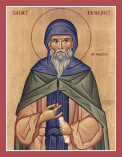 Born in Nursia, Italy in 480, of rich and eminent parents, he did
not persevere long with his schooling, for he realized himself that he could, through
book-learning, lose ‘the great understanding of my soul’. And he left school
‘an untaught sage and an understanding ignoramus’. He fled to a monastery where a
monk, Romanus, gave him the habit, after which he withdrew to a craggy mountain, where he lived
for more than three years in a cave in great struggles with his soul. Romanus brought him bread
and dropped it over the wall of the crag on a rope to the mouth of the cave. When he became known
in the neighborhood, he, to flee the praise of men, moved away from that cave. He was very brutal
with himself. Once, when an impure rage of fleshly lust fell on him, he stripped bare and rolled
among nettles and thorns until he had driven out of himself every thought of a woman. God endowed
him with many spiritual gifts: insight, healing and the driving out of evil spirits, the raising
of the dead and the ability to appear to others from a distance in a dream or vision. He once
discerned that he had been given a glass of poisoned wine. He made the sign of the Cross over the
glass and it broke into pieces. He founded twelve monasteries, each having twelve monks at first.
He later compiled the ‘Benedictine’ rule, which is a model of Orthodox monasticism
for his day. On the sixth day before his death he commanded that his grave, already prepared as
the saint had foreseen that his end was near, should be opened. He gathered all the monks
together, gave them counsel and gave his soul to the Lord Whom he had faithfully served in
poverty and purity. His sister, Scholastica, lived in a women’s monastery, where, guided by
her brother and herself practising great asceticism, she came to great spiritual perfection. When
St. Benedict set his soul free, two monks, one on the road and one at prayer in a distant cell,
had at the same moment the same vision: a path from earth to heaven, curtained with precious
cloth and illuminated at the sides by ranks of people. At the top of that path stood a man of
indescribable beauty and light, who told them that the path was prepared for Benedict, the
beloved of God. After that vision, the two brethren discovered that their beloved abbot had gone
from this world. He died peacefully in about 550 and went to the eternal kingdom of Christ the
King.
Born in Nursia, Italy in 480, of rich and eminent parents, he did
not persevere long with his schooling, for he realized himself that he could, through
book-learning, lose ‘the great understanding of my soul’. And he left school
‘an untaught sage and an understanding ignoramus’. He fled to a monastery where a
monk, Romanus, gave him the habit, after which he withdrew to a craggy mountain, where he lived
for more than three years in a cave in great struggles with his soul. Romanus brought him bread
and dropped it over the wall of the crag on a rope to the mouth of the cave. When he became known
in the neighborhood, he, to flee the praise of men, moved away from that cave. He was very brutal
with himself. Once, when an impure rage of fleshly lust fell on him, he stripped bare and rolled
among nettles and thorns until he had driven out of himself every thought of a woman. God endowed
him with many spiritual gifts: insight, healing and the driving out of evil spirits, the raising
of the dead and the ability to appear to others from a distance in a dream or vision. He once
discerned that he had been given a glass of poisoned wine. He made the sign of the Cross over the
glass and it broke into pieces. He founded twelve monasteries, each having twelve monks at first.
He later compiled the ‘Benedictine’ rule, which is a model of Orthodox monasticism
for his day. On the sixth day before his death he commanded that his grave, already prepared as
the saint had foreseen that his end was near, should be opened. He gathered all the monks
together, gave them counsel and gave his soul to the Lord Whom he had faithfully served in
poverty and purity. His sister, Scholastica, lived in a women’s monastery, where, guided by
her brother and herself practising great asceticism, she came to great spiritual perfection. When
St. Benedict set his soul free, two monks, one on the road and one at prayer in a distant cell,
had at the same moment the same vision: a path from earth to heaven, curtained with precious
cloth and illuminated at the sides by ranks of people. At the top of that path stood a man of
indescribable beauty and light, who told them that the path was prepared for Benedict, the
beloved of God. After that vision, the two brethren discovered that their beloved abbot had gone
from this world. He died peacefully in about 550 and went to the eternal kingdom of Christ the
King.
2. St. Efschemos (Euschemon), Bishop of Lampsacus.
He underwent persecution and imprisonment in a period of iconoclasm, entering into rest in the time of the Emperor Theophilus the Iconoclast (829-842).
3. St. Theognostus (Feognost), Metropolitan of Kiev.
He was Greek by birth and the successor of St. Peter of Kiev. He suffered greatly from the Cossack hordes from Dzinibek, being slanderously denounced to the Cossack ruler by his own Russian people for paying no tribute to the ruler for his position. When the ruler summoned him and questioned him about this, he replied: ‘Christ our God bought His Church from the unbelievers with His precious body. For what do we now pay tribute to unbelievers?’ At last he managed somehow to free himself and return home. He governed the Church for twenty-five years and entered into rest in the Lord in 1353.
FOR CONSIDERATION
It would be hard to find a better example of how we must not be lazy and leave prayer and work until the next day than that which is given us by St. Ephraim the Syrian: ‘Once a brother was inspired (by the devil) to think: “Today I’ll give myself a rest, and tomorrow I’ll keep vigil.” But he answered the thought thus: “Who knows; maybe I shan’t get up tomorrow either—so I’d better get up today.” So also, before he began work, he was inspired with this thought: “Let me give myself a rest today, and I’ll start work tomorrow.” He again replied: “No; I’ll start work today, and the Lord will look after tomorrow.” And St. Anthony teaches: ‘As each day dawns, plan your life as though it were your last on earth, and keep yourself from sin.’
Daily Scripture Readings taken from The Orthodox New Testament, translated and published by Holy Apostles Convent, Buena Vista, Colorado, copyright © 2000, used with permission, all rights reserved.
Daily Prologue Readings taken from The Prologue of Ochrid, by Bishop Nikolai Velimirovic, translated by Mother Maria, published by Lazarica Press, Birmingham, England, copyright © 1985, all rights reserved. Edited by Dormition Skete.