

Daily Devotional
Thursday, March 26, 2026 (NS), March 13, 2026 (OS)
Fast Day, but Wine and Olive Oil Allowed.
Holy & Great Fast
Thursday of the Fifth Week of the Great Fast
There is No Divine Liturgy This Day Because of the Great Fast.
The commemoration of the translation of the relics of our holy father among the saints, Nikephoros, the Confessor and Patriarch of Constantinople.
Scripture Readings
Movable Calendar (Paschalion)
Thursday of the Fifth Week of the Great Fast
There is No Divine Liturgy This Day Because of the Great Fast.
No readings given.
Menaion — Fixed Calendar
The commemoration of the translation of the relics of our holy father among the saints, Nikephoros, the Confessor and Patriarch of Constantinople.
No readings given.
Lives of the Saints (Prologue)
March 26th – Civil Calendar
March 13th – Church Calendar
1. St. Nikephoros, Patriarch of Constantinople. (c. 758-829).
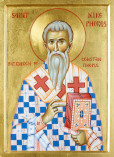 He governed the holy
Church with wisdom and zeal as the greatest arch-pastor of Constantinople. When Leo the Armenian
made his stand against icons, Nikephoros opposed the Emperor; first counselling him and then
denouncing him. For this the accursed emperor exiled him to the island of Prokonnesos. There was
a monastery on that island, which Nikephoros himself had built in honor of St. Theodore. And this
confessor of the Orthodox Faith spent thirteen years there, then died and went to the Lord in
827. Then all the iconoclast emperors perished, and Michael, with his mother Theodora, came to
the imperial throne in 842, and Methodius became patriarch. Then, in 846, the relics of St.
Nikephoros were translated from Prokonnesos to Constantinople and placed first in the Church of
Hagia Sophia, from which he had been driven in his lifetime, and then in the Church of the Holy
Apostles. The main commemoration of this great hierarch is on June 2nd, but on March 13th is
commemorated the finding and translation of his incorrupt relics. St. Nikephoros was driven from
Constantinople on March 13th, and on March 13th, nineteen years later, his relics were brought
back to his patriarchal seat.
He governed the holy
Church with wisdom and zeal as the greatest arch-pastor of Constantinople. When Leo the Armenian
made his stand against icons, Nikephoros opposed the Emperor; first counselling him and then
denouncing him. For this the accursed emperor exiled him to the island of Prokonnesos. There was
a monastery on that island, which Nikephoros himself had built in honor of St. Theodore. And this
confessor of the Orthodox Faith spent thirteen years there, then died and went to the Lord in
827. Then all the iconoclast emperors perished, and Michael, with his mother Theodora, came to
the imperial throne in 842, and Methodius became patriarch. Then, in 846, the relics of St.
Nikephoros were translated from Prokonnesos to Constantinople and placed first in the Church of
Hagia Sophia, from which he had been driven in his lifetime, and then in the Church of the Holy
Apostles. The main commemoration of this great hierarch is on June 2nd, but on March 13th is
commemorated the finding and translation of his incorrupt relics. St. Nikephoros was driven from
Constantinople on March 13th, and on March 13th, nineteen years later, his relics were brought
back to his patriarchal seat.
2. The Holy Martyr Christina of Persia.
She was harshly tortured in Persia in the 4th century for her unfaltering confession of the Christian Faith. The torturers whipped her so terribly that she died from exhaustion. Her soul parted from her martyred body and went to dwell in the eternal joy of Christ her King and Lord.
3. The Hieromartyr Publius.
This priest and martyr was successor in the episcopate in Athens to the famous Dionysius the Areopagite. As bishop, he was tortured by unbelievers and beheaded in the 2nd century. For a brief time of torture he inherited eternal life.
FOR CONSIDERATION
Great Christians are those who have great love for Christ. Oh, how truly great Christians our God-bearing fathers and the martyrs were! In our time, it is difficult for many to imagine this. Here is what one of those saints, St. Simeon the New Theologian, confessed in his monastery before all the monks. Speaking from his experience, how it bore out the truth of the Lord’s words: ‘My yoke is easy and My burden is light,’ he said: ‘Believe me, when I have fled to God my Savior, I have not encountered anything hard or unbearable.... I had a great and unbearable sadness only because I couldn’t find a sufficient means of dying for the love of Christ.’ Are not such souls like flames shut in earthen vessels? Flames are always upright and directed towards heaven. Just take off the lid, and the flame will leap up higher.
Daily Scripture Readings taken from The Orthodox New Testament, translated and published by Holy Apostles Convent, Buena Vista, Colorado, copyright © 2000, used with permission, all rights reserved.
Daily Prologue Readings taken from The Prologue of Ochrid, by Bishop Nikolai Velimirovic, translated by Mother Maria, published by Lazarica Press, Birmingham, England, copyright © 1985, all rights reserved. Edited by Dormition Skete.