

Daily Devotional
Monday, February 9, 2026 (NS), January 27, 2026 (OS)
No Fasting.
Monday of the Thirty-Fifth Week or Meatfare Week
The commemoration of the translation of the relics of our father among the saints, John Chrysostom, Archbishop of Constantinople.
Scripture Readings
Paschalion — Movable Calendar
Monday of the Thirty-Fifth Week or Meatfare Week
Epistle
The Reading is from the First General Epistle of Saint John [§ 71]. Brethren:
For Gk. usage, see 1 Jn. 2:18-3:8; for Sl. usage, see 1 Jn. 2:18-3:10.
2 18It is the last hour; and even as ye heard that the antichrist is coming, even now many antichrists have arisen, from which we know that it is the last hour. 19They went out from among us, but they were not of us; for if they were of us, they would have remained with us; but that they might be made manifest that they are all not of us. 20And ye have an anointing from the Holy One, and ye know all things. 21I did not write to you because ye do not know the truth, but because ye do know it, and because every lie is not of the truth. 22Who is the liar, except the one denying, saying that “Jesus is not the Christ”? This is the antichrist, the one denying the Father and the Son. 23Everyone who denieth the Son, neither doth he have the Father. 24As for you, therefore, what ye heard from the beginning, let it keep on abiding in you. If what ye heard from the beginning should abide in you, ye also shall abide in the Son and in the Father. 25And this is the promise which He Himself promised us—the Life, the Eternal One. 26These things did I write to you concerning those who are trying to lead you astray. 27But the anointing which ye received from Him abideth in you, and ye have no need that anyone be teaching you; but as the same anointing teacheth you concerning all things, and is true, and is not a lie, and even as it taught you, ye shall abide in Him. 28And now, little children, keep on abiding in Him, that whenever He should be made manifest, we may have boldness, and not be made to shrink away in shame from Him in His coming. 29If ye know that He is righteous, ye know that everyone who doeth righteousness hath been born of Him.
3 1Behold of what manner of love the Father hath given to us, that we should be called children of God. On this account the world knoweth us not, because it knew Him not. 2Beloved, now are we children of God, and it was not yet made manifest what we shall be; but we know that if He should be made manifest, we shall be like Him; for we shall see Him even as He is. 3And everyone who hath this hope upon Him purifieth himself, even as that One is pure. 4Everyone who doeth sin also doeth lawlessness, and sin is lawlessness. 5And ye know that He was made manifest that He might take away our sins, and sin is not in Him. 6Everyone who abideth in Him sinneth not; everyone who sinneth hath not seen Him, and knoweth Him not. 7Little children, let no one be leading you astray. The one doing righteousness is righteous, even as that One is righteous. 8The one doing sin is of the devil; for the devil hath been sinning from the beginning. For this the Son of God was made manifest, that He might undo the works of the devil. 9Everyone who hath been born of God doeth no sin, because His seed abideth in him; and he is not able to sin, because he hath been born of God. 10In this are manifest the children of God and the children of the devil. Everyone who doeth not righteousness is not of God, and neither is the one who loveth not his brother.
Gospel
The Reading is from the Holy Gospel according to Saint Mark [§ 49]. At that time:
11 1When Jesus drew near to Jerusalem, to Bethphage and Bethany, toward the Mount of Olives, He sendeth forth two of His disciples, 2and saith to them, “Go ye into the village, the one opposite you; and straightway as ye enter into it, ye shall find a colt which hath been tied, on which no man hath sat. Loose it and bring it. 3“And if anyone should say to you, ‘Why do ye do this?’ say, ‘The Lord hath need of it’; and straightway he will send it here.” 4And they departed, and found the colt which was tied at the door outside in the street; and they loose it. 5And some of those who stood there began saying to them, “What are ye doing, loosing the colt?” 6And they spoke to them even as Jesus commanded them; and they permitted them. 7And they brought the colt to Jesus, and cast their garments upon it, and He sat upon it. 8And many spread their garments in the way; and others were cutting leafy branches from the trees and strewing them in the way. 9And those going before and those following were crying out, saying, “‘Hosanna, blessed is He Who cometh in the name of the Lord [cf. Ps. 117(118):25(26)].’ 10“Blessed be the kingdom of our father David, which cometh in the name of the Lord: Hosanna in the highest.” 11And Jesus entered into Jerusalem and into the temple. And after He looked about for Himself at all things, as it was already the evening hour, He went out to Bethany with the twelve.
Menaion — Fixed Calendar
The commemoration of the translation of the relics of our father among the saints, John Chrysostom, Archbishop of Constantinople.
Epistle
The Reading is from the Epistle of Saint Paul to the Hebrews [§ 318]. Brethren:
7 26Such a High Priest was fitting for us: holy, guileless, undefiled, Who hath been separated from the sinners and hath become higher than the heavens, 27Who hath no need daily, even as the high priests, to offer up sacrifices, first for his own sins, then for those of the people; for this He did once for all after He offered up Himself. 28For the law appointeth men high priests who have weakness; but the word of the oath, which is after the law, appointeth the Son, Who hath been perfected forever.
8 1Now in reference to the things being spoken of, the chief point is: We have such a High Priest, Who sat down on the right of the throne of the majesty in the heavens, 2a Liturgist of the holies and of the tabernacle, the true one, which the Lord pitched, and not man.
Gospel
The Reading is from the Holy Gospel according to Saint John [§ 36]. The Lord said to the Jews who had come to Him:
10 9“I am the door; by Me if anyone should enter, he shall be saved, and shall go in and go out and find pasture. 10“The thief cometh not, except that he might steal, and slay, and destroy. I came that they may have life, and may have it abundantly. 11“I am the good shepherd. The good shepherd layeth down his life for the sheep. 12“But the hireling, who indeed is not a shepherd, whose own the sheep are not, seeth the wolf coming, and leaveth the sheep and fleeth; and the wolf seizeth them and scattereth the sheep. 13“Now the hireling fleeth, because he is a hireling and careth not about the sheep. 14“I am the good shepherd; and I know those that are Mine, and am known of those that are Mine. 15“Even as the Father knoweth Me, I also know the Father; and I lay down My life for the sheep. 16“And I have other sheep which are not of this fold; them also it is needful for Me to bring, and they shall hear My voice; and there shall be one flock and one Shepherd.”
Lives of the Saints (Prologue)
February 9th – Civil Calendar
January 27th – Church Calendar
1. St. John Chrysostom, the Golden Mouth of Orthodoxy.
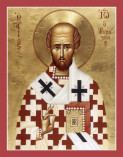 The Church celebrates the memory of this saint on November 13th and
January 30th, but on this day is celebrated the translation of his honored relics from the
Armenian village of Comana, where he died in exile in 407, to Constantinople where earlier, as
patriarch, he had governed the Church. Thirty years after his death, Patriarch Proklos made a
speech in memory of his spiritual father and mentor, and by this speech so roused the love of the
people and the emperor, Theodosios the Younger, towards the great saint that they all wanted the
relics of St. Chrysostom to be translated to Constantinople. It is related that the coffin
containing the relics could not be shifted from its place until the emperor had written a letter
to St. Chrysostom, begging his forgiveness (for Theodosios’ mother, Evdoxia, was guilty of
having persecuted the saint) and appealing to him to return to Constantinople, his former
residence. When this repentant letter was placed on the coffin, the latter became light in
weight. Before the translation, many of the sick, on touching the coffin, were healed. When the
relics arrived at the capital, the emperor again begged forgiveness over them in his
mother’s name, as though it were she herself speaking: ‘While I lived in this
temporal life, I acted in malice towards thee; but now that thou livest in eternal life, be thou
of help to my soul. My glory passes and there is nought to help me; help me, father, in thy
glory; help me before I come to be condemned before the judgment of Christ.’ When the saint
was carried into the Church of the Holy Apostles and placed on the patriarchal throne, the
assembled throng heard these words from his mouth: ‘Peace be unto all!’ The
translation of the relics of St. John Chrysostom was carried out in the year 438.
The Church celebrates the memory of this saint on November 13th and
January 30th, but on this day is celebrated the translation of his honored relics from the
Armenian village of Comana, where he died in exile in 407, to Constantinople where earlier, as
patriarch, he had governed the Church. Thirty years after his death, Patriarch Proklos made a
speech in memory of his spiritual father and mentor, and by this speech so roused the love of the
people and the emperor, Theodosios the Younger, towards the great saint that they all wanted the
relics of St. Chrysostom to be translated to Constantinople. It is related that the coffin
containing the relics could not be shifted from its place until the emperor had written a letter
to St. Chrysostom, begging his forgiveness (for Theodosios’ mother, Evdoxia, was guilty of
having persecuted the saint) and appealing to him to return to Constantinople, his former
residence. When this repentant letter was placed on the coffin, the latter became light in
weight. Before the translation, many of the sick, on touching the coffin, were healed. When the
relics arrived at the capital, the emperor again begged forgiveness over them in his
mother’s name, as though it were she herself speaking: ‘While I lived in this
temporal life, I acted in malice towards thee; but now that thou livest in eternal life, be thou
of help to my soul. My glory passes and there is nought to help me; help me, father, in thy
glory; help me before I come to be condemned before the judgment of Christ.’ When the saint
was carried into the Church of the Holy Apostles and placed on the patriarchal throne, the
assembled throng heard these words from his mouth: ‘Peace be unto all!’ The
translation of the relics of St. John Chrysostom was carried out in the year 438.
2. Our Holy Father Titus of the Kiev Caves.
He was at first a soldier, but receiving a wound in the head in battle, he retired from the world to the monastery of the Caves in Kiev, there to be healed and to receive the monastic schema. He spent his time in ceaseless mourning over his former sins. Before his death he was shown by a heavenly vision that all his sins had been forgiven. His relics lie in the caves of Theodosius.
FOR CONSIDERATION
Fasting is a great thing, but love is greater. If it is by fasting that devils are driven out, passions tamed, the body calmed, the spirit steadied, it is by love that God makes His abode with men. The Lord Himself emphasized fasting as necessary, but proclaimed love as the greatest commandment. In the first half of last century, Jeladin Bey, a Turk, ruled over Ochrid. He was a rebel against the sultan and an independent governor. At that time the Church was ruled by Metropolitan Kalinik. Jeladin and Kalinik, although of different faiths, were very good friends and often visited each other. It happened that Jeladin Bey condemned twenty-five Christians to death by hanging, and the execution was to take place on Great Friday. The metropolitan, deeply distressed by this event, went to Jeladin and besought him to mitigate the sentence. While they were talking, the hour of the midday meal arrived, and the bey invited the metropolitan to eat with him. A dish of lamb had been prepared for the meal. The metropolitan excused himself, as the fast (of the monastic rule, as well as of Holy Friday) prevented him from remaining to eat, and prepared to leave. The bey was angered and said to him: ‘Choose; either you eat with me and free twenty-five people from hanging, or you refrain and they hang.’ The metropolitan crossed himself and sat down to lunch, and Jeladin freed the people from the death sentence.
Daily Scripture Readings taken from The Orthodox New Testament, translated and published by Holy Apostles Convent, Buena Vista, Colorado, copyright © 2000, used with permission, all rights reserved.
Daily Prologue Readings taken from The Prologue of Ochrid, by Bishop Nikolai Velimirovic, translated by Mother Maria, published by Lazarica Press, Birmingham, England, copyright © 1985, all rights reserved. Edited by Dormition Skete.