

Daily Devotional
Sunday, February 8, 2026 (NS), January 26, 2026 (OS)
No Fasting.
The commemoration of the holy New-martyrs and Confessors of the Russian Land.
If the 25th of January falls on Monday, Tuesday, or Wednesday, chant the service of the New-martyrs on the preceding Sunday. If the 25th of January falls on Thursday, Friday, or Saturday, chant the service on the following Sunday. If the 25th of January falls on Sunday, chant the service for the New-martyrs that day, and the service to St. Gregory the Theologian on the 27th of January, in conjunction with that of St. John Chrysostom; in which case the hymns to St. Gregory precede those of St. John's. Thus the service can occur as early as the 22nd of January or as late as the 28th of that month.
If the service coincides with the Sunday of the Publican and the Pharisee, or with that of the Sunday of the Prodigal Son, or with Meatfare Sunday, the service of the New-martyrs is then chanted in conjunction with the Triodion and its Prokeimenon.
If a service to a major saint should fall on the same Sunday, we chant the service to the major saint on the closest Saturday, or on some other day.
If the church's feast day should fall on such a Sunday, chant the church's feast day in conjunction with the Triodion, with no further alteration. The service of the New-martyrs is then moved to the following Sunday.
| Fifth Period Mode Two — Second Eothinon |
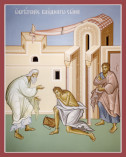
The commemoration of our righteous Father Xenophon and his wife, Mary, and their two sons, Arcadios and John, of Constantinople.
Scripture Readings
Special Commemorations
The commemoration of the holy New-martyrs and Confessors of the Russian Land.
If the 25th of January falls on Monday, Tuesday, or Wednesday, chant the service of the New-martyrs on the preceding Sunday. If the 25th of January falls on Thursday, Friday, or Saturday, chant the service on the following Sunday. If the 25th of January falls on Sunday, chant the service for the New-martyrs that day, and the service to St. Gregory the Theologian on the 27th of January, in conjunction with that of St. John Chrysostom; in which case the hymns to St. Gregory precede those of St. John's. Thus the service can occur as early as the 22nd of January or as late as the 28th of that month.
If the service coincides with the Sunday of the Publican and the Pharisee, or with that of the Sunday of the Prodigal Son, or with Meatfare Sunday, the service of the New-martyrs is then chanted in conjunction with the Triodion and its Prokeimenon.
If a service to a major saint should fall on the same Sunday, we chant the service to the major saint on the closest Saturday, or on some other day.
If the church's feast day should fall on such a Sunday, chant the church's feast day in conjunction with the Triodion, with no further alteration. The service of the New-martyrs is then moved to the following Sunday.
Epistle
The Reading is from the Epistle of Saint Paul to the Romans [§ 99]. Brethren:
8 28We know that to those who love God all things work together for good, to those who are called according to purpose. 29For whom He foreknew, He also foreordained to be conformable to the image of His Son, in order for Him to be the firstborn among many brethren. 30But whom He foreordained, these also He called; and whom He called, these also He justified; and whom He justified, these also He glorified. 31What then shall we say to these things? If God is for us, who can be against us? 32He Who indeed spared not His own Son, but delivered Him up for us all, how shall He not with Him also graciously give us all things? 33Who shall bring an accusation against the elect of God? God is the One Who justifieth. 34Who is the one who condemneth? Christ is the One Who died, but much more is He the One also Who was raised, Who also is at the right of God, Who also intercedeth for us. 35Who shall separate us from the love of Christ? Shall affliction, or distress, or persecution, or famine, or nakedness, or danger, or sword? 36Even as it hath been written: “For on account of Thee, we are being put to death the whole day; we were counted as sheep of slaughter [Ps. 43(44):23(22)].” 37But in all these things we more than conquer through the One Who loved us. 38For I have been persuaded that neither death, nor life, nor angels, nor principalities, nor powers, nor things present, nor things coming, 39nor height, nor depth, nor any other created thing, shall be able to separate us from the love of God, which is in Christ Jesus our Lord.
Gospel
The Reading is from the Holy Gospel according to Saint Luke [§ 106]. The Lord said to His disciples, “Be taking heed of men:
21 12“For they shall lay their hands upon you and persecute you, delivering you up to synagogues and prisons, bringing you before kings and governors on account of My name; 13“but it shall prove to be a testimony for you. 14“Therefore settle it for yourselves in your hearts not to premeditate to make a defense; 15“for I will give you a mouth and wisdom, which all those who oppose you shall not be able to contradict nor withstand. 16“And ye shall be delivered up also by parents, and kinfolk, and friends, and brethren; and they shall put some of you to death. 17“And ye shall be hated by all for My name’s sake. 18“But a hair of your head in no wise shall perish. 19“In your patience win your souls.”
Paschalion — Movable Calendar
Fifth Period
Sunday of the Thirty-Fourth Week or Sunday of the Prodigal Son
Mode Two — Second Eothinon
Epistle
The Reading is from the First Epistle of Saint Paul to the Corinthians [§ 135]. Brethren:
6 12All things are lawful to me, but all things are not expedient; all things are lawful to me, but I will not be brought under the power of any. 13Foods for the belly, and the belly for foods; but God shall bring to nought both this and these. Now the body is not for fornication, but for the Lord; and the Lord for the body. 14And God both raised up the Lord, and will raise up us by His own power. 15Ye know that your bodies are members of Christ, do ye not? Having taken up then the members of Christ, shall I make them members of a harlot? May it not be! 16Or know ye not that he that is joined to the harlot is one body? For, “The two,” saith He, “shall be into one flesh [Gen. 2:24].” 17But he who is joined to the Lord is one spirit. 18Keep on fleeing fornication. Every sin whatsoever a man might do is outside the body, but he who committeth fornication sinneth against his own body. 19Or know ye not that your body is a temple of the Holy Spirit Who is in you, Whom ye have from God, and ye are not your own? 20For ye were bought with a price; glorify then God in your body and in your spirit, which are God’s.
Gospel
The Reading is from the Holy Gospel according to Saint Luke [§ 79]. The Lord said this parable:
15 11“A certain man had two sons. 12“And the younger of them said to the father, ‘Father, give to me the portion of the property which falleth to me.’ And he divided to them his means of living. 13“And not many days after, the younger son, having gathered all together, went abroad into a distant land, and there scattered his property, living profligately. 14“But after he spent all, there arose a severe famine throughout that land, and he began to be in want. 15“And he went and joined himself to one of the citizens of that land; and he sent him into his fields to feed swine. 16“And he was longing to fill his belly from the husks, which the swine were eating; and no one was giving to him. 17“But having come to himself, he said, ‘How many hired servants of my father abound in loaves, and I am perishing with hunger! 18“‘I will arise and go to my father, and will say to him, “Father, I sinned against heaven and before thee, 19“‘“and am no longer worthy to be called thy son; make me as one of thy hired servants.”’ 20“And he rose up and went to his father. But when he was yet far away, his father saw him and was moved with compassion, and ran, and fell upon his neck, and ardently kissed him. 21“And the son said to him, ‘Father, I sinned against heaven and before thee, and am no longer worthy to be called thy son.’ 22“But the father said to his slaves, ‘Bring forth the robe, the chief one, and clothe him, and provide a ring for his hand and sandals for the feet. 23“‘And bring the calf, the fattened one, and slay it; and let us eat and be merry; 24“‘for this my son was dead and is alive again; and he was lost and is found.’ And they began to be merry. 25“Now his son, the elder one, was in a field; and as he came and drew near to the house, he heard music and dancing. 26“And he summoned one of his servants, and began inquiring what these things may be. 27“And he said to him, ‘Thy brother is come, and thy father slew the calf, the fattened one, because he received him back safe and sound.’ 28“But he was angry and not willing to go in. Then his father went out and besought him. 29“And he answered and said to his father, ‘Behold, so many years I am serving thee, and never did I transgress thy commandment, and never didst thou give a kid to me, in order that I might make merry with my friends; 30“‘but when this thy son came, the one who devoured thy means of living with harlots, thou didst slay for him the calf, the fattened one.’ 31“And he said to him, ‘Child, thou art always with me, and all that is mine is thine. 32“‘But to make merry and to rejoice was fitting, because this thy brother was dead and is alive again, and was lost and is found.’”
Menaion — Fixed Calendar
The commemoration of our righteous Father Xenophon and his wife, Mary, and their two sons, Arcadios and John, of Constantinople.
No readings given.
Synaxarion Readings
Sunday of the Prodigal Son
If anyone be a prodigal as I, take courage and turn back; for the gates of God’s mercies are opened to all.
On this day we celebrate the Sunday of the Prodigal Son, dedicated as the second service of the Triodion by the divine fathers for the following reason. There are some who recognize much in themselves that is unbecoming, who live a life of great dissipation from their youth, whose lives are full of drunkenness and immorality, who having fallen thus into the depths of evil, become despondent, giving birth to pride, from whence they have no desire to advance to any of the virtues, preferring their bondage to evil and falling ever deeper into evil. Having a fatherly love for even these individuals, and desiring to lead them out of their despair, the holy fathers prescribed this parable for the second preparatory Sunday in order to tear up the passion of despair by the roots, to lead them to acceptance of the virtues, and to demonstrate to sinners the abundance of God’s compassion upon sinners and prodigals in His great goodness and love for mankind. For there is no sin which cannot be overcome by the knowledge of His love for mankind, and this is what is presented in this parable of Christ.
Now the sons of man—that is, of the Logos, God and Man—are two: the righteous and the sinful. It is the eldest who abides ever in God’s blessings, following His commandments and remaining always by Him. But the younger son, having become attached to sin and renouncing his closeness to God through shameful deeds, has wasted God’s love for mankind and for him and has lived as a prodigal. For having completely rejected Him after Whose image he was created, and having followed an evil demon, willingly enslaving himself to this demon’s pleasure, he was unable to fulfill his desire. For sin is an unsatisfying thing that becomes a habitual source of only temporary pleasure. It may be compared to the husks that are fed to swine. At first it seems that they might be something tasty, but they turn out to be very dry and are much like weeds, which is how sin takes possession. For the prodigal son had hardly come to his senses when, perishing from hunger for virtue, he comes to his father, saying, “Father, I have sinned before heaven and before thee, and I am not worthy to be called thy son.” Yet the father receives him in repentance, not reproaching him but embracing him and kissing him in a display of divine and fatherly love. And he clothes him, a symbol of Baptism, putting a ring on his finger, a symbol of the grace of the All-Holy Spirit. He also puts sandals on his feet, not so much as a protection from some serpent or scorpion that might sting him on his path to God, but rather as a means of crushing the heads of those creatures. And then in a tremendous display of joy he slaughters the fatted calf for him, his only-begotten Son, and the Father grants him communion of His body and blood. Now the elder son expresses his amazement at his father’s limitless mercy. But the lover of mankind exhorts him to silence with loving and kind words of humility, saying, “Thou art ever with me, and it was meet that we should make merry and be glad, for my son was formerly dead in his sin and is alive again, having repented of the foolish things he has done. He was lost, since he was far from me in his licentious habits, and he was found by me, suffering in my compassion and calling him back in my mercy.” This parable may be applied to us as well, which is why the holy fathers have prescribed it for today. We who have sinned as the prodigal are encouraged to weed out despair and fear through repentance, confession, and good works. For this is a great aid and a powerful weapon against the assaults of the adversary.
In Thine ineffable love for mankind, O Christ our God, have mercy upon us. Amen.
Translated from Triodion, siest ‘Tripesnets: Triod’ Postnaya, Moscow, 1904, by Robert Parent.
Lives of the Saints (Prologue)
February 8th – Civil Calendar
January 26th – Church Calendar
1. Our Holy Father Xenophon and our Mother Maria, and their sons John and Arkadios.
They were rich and respected citizens of Constantinople. Xenophon and Maria lived godly lives, and made every effort to give their sons a Christian upbringing. When the boys were grown, their parents sent them to Beirut to study, but a storm capsized their ship. By God’s providence, both John and Arkadios were somehow saved and thrown onto the shore by the waves; in two separate places, however, so that each thought the other had perished. Out of grief for each other, they became monks in two different monasteries. After two years of mourning, their parents traveled to Jerusalem to venerate the holy places. There, helped by the insight of a holy man, the brothers were first united with each other and then with their parents. Out of gratitude to God, Xenophon and Maria gave away all their goods to the poor and both embraced the monastic state. This touching story of these four holy souls demonstrates clearly how the Lord guides most wonderfully the destinies of those who believe in Him; how He looses on them trials and sorrows, that they may later, yet more greatly strengthened in their faith, experience the greater joy. They lived and died in the fifth century.
2. Our Holy Father Simeon the Ancient.
A friend and companion of St. Palladios, he lived in asceticism in a cave from his early youth right up to his death. He founded two monasteries and entered into rest in the Lord in the year 390. He was named ‘the Ancient’ by St. Simeon the Stylite, who lived somewhat later.
3. St. David, King of Georgia (1089-1130).
He restored and strengthened Georgia as a country. He was a great zealot for the Christian Faith. He built many new churches throughout Georgia, and restored ancient ones. He is regarded as the regenerator of Orthodoxy in Georgia.
FOR CONSIDERATION
The greatest blessing any country can have is that of good and holy men living within it. Compared with this blessing, all other blessings are as nothing. Devout Christian kings regarded holy people in their lands as the greatest blessing from God. The holy Emperor Constantine the Great said: ‘We bless the Lord Jesus Christ that there exists in my day three glorious saints: the blessed Abba Anthony, Abba Elenius and Abba Efchius.’ Before the Battle of Kulikovo, a battle significant for Russia, the devout Prince Dimitri of the Don went off with his chief advisors and commanders to the forest of Radonezh to seek St. Sergius and beg his prayers. And although the prince prepared his armies for the war of liberation from the Tartars, he placed greater confidence in the prayers of one holy man than in a vast army and many weapons.
Daily Scripture Readings taken from The Orthodox New Testament, translated and published by Holy Apostles Convent, Buena Vista, Colorado, copyright © 2000, used with permission, all rights reserved.
Daily Prologue Readings taken from The Prologue of Ochrid, by Bishop Nikolai Velimirovic, translated by Mother Maria, published by Lazarica Press, Birmingham, England, copyright © 1985, all rights reserved. Edited by Dormition Skete.