

Daily Devotional
Saturday, January 24, 2026 (NS), January 11, 2026 (OS)
No Fasting.
The Saturday After the Theophany
Saturday of the Thirty-Third Week
The commemoration of the Afterfeast of Theophany, and our venerable Father Theodosios the Cœnobiarch.
Scripture Readings
Special Commemorations
The Saturday After the Theophany
Epistle
The Reading is from the Epistle of Saint Paul to the Ephesians [§ 233].
6 10Brethren, keep on being empowered in the Lord and in the strength of His might. 11Put on the full armor of God, for you to be able to stand against the wiles of the devil; 12because for us the wrestling is not against blood and flesh, but against the principalities, against the powers, against the cosmic rulers of the darkness of this age, against spiritual hosts of evil on account of the heavenly things. 13For this cause take up the full armor of God, in order that ye might be able to withstand in the evil day, and having counteracted all things, to stand. 14Stand therefore, having girt your loins with truth, and having put on for yourselves the breastplate of righteousness, 15and having shod your feet in readiness of the Gospel of peace; 16on the whole, take up the shield of faith, with which ye shall be able to quench all the fiery darts of the evil one. 17And take the helmet of salvation, and the sword of the Spirit, which is the word of God.
Gospel
The Reading is from the Holy Gospel according to Saint Matthew [§ 7]. At that time:
4 1Jesus was led up by the Spirit into the wilderness to be tempted by the devil. 2And having fasted forty days and forty nights, afterwards He hungered. 3And the tempter, having come to Him, said, “If Thou art God’s Son, command that these stones become loaves.” 4But He answered and said, “It hath been written: ‘Man shall not live by bread alone, but by every word which goeth forth out of the mouth of God [cf. Deut. 8:3].’” 5Then the devil taketh Him to the holy city, and setteth Him upon the wing of the temple, 6and saith to Him, “If Thou art God’s Son, cast Thyself down; for it hath been written: ‘He shall enjoin His angels concerning Thee; and upon their hands shall they take Thee up, lest ever Thou strike Thy foot against a stone [cf. Ps. 90(91):11, 12].’” 7Jesus said to him, “On the other hand, it hath been written: ‘Thou shalt not tempt the Lord thy God [Deut. 6:16].’” 8Again, the devil taketh Him to an exceedingly high mountain, and showeth Him all the kingdoms of the world, and the glory of them. 9And he saith to Him, “All these things will I give to Thee if Thou wilt fall down and make obeisance to me.” 10Then Jesus saith to him, “Get thee behind Me, Satan. For it hath been written: ‘Thou shalt make obeisance to the Lord thy God, and Him alone shalt thou worship [cf. Deut. 6:13].’” 11Then the devil leaveth Him, and behold, angels drew near and were ministering to Him.
Paschalion — Movable Calendar
Saturday of the Thirty-Third Week
Epistle
The Reading is from the Second Epistle of Saint Paul to Saint Timothy [§ 293]. Child Timothy:
2 11Faithful is the saying. For if we died with Him, we shall also live with Him. 12If we endure, we shall also reign with Him. If we deny Him, He also will deny us. 13If we are faithless, yet that One remaineth faithful; He is not able to deny Himself.
14These things be putting in remembrance, solemnly testifying before the Lord not to dispute about words to no use, to the overturn of those who hear. 15Endeavor to present thyself approved to God, a workman that hath no cause for shame, cutting in a straight line the word of the truth. 16But profane and empty babblings, be shunning; for they will advance to more ungodliness, 17and their word will have spread as gangrene, of whom is Hymenæos and Philetos, 18who missed the mark concerning the truth, saying the resurrection already came to pass; and they are overturning the faith of some. 19Nevertheless the foundation of God standeth firm, having this seal: “The Lord knoweth those who are His [cf. Num. 16:5]”; and, “Let everyone who nameth the name of Christ stand off from injustice [cf. Num. 16:27; Is. 26:13, 52:11; Jer. 20:9].”
Gospel
The Reading is from the Holy Gospel according to Saint Matthew [§ 104]. The Lord said this parable:
25 1“The kingdom of the heavens shall be likened to ten virgins, who took their lamps and went forth to meet the bridegroom. 2“And five of them were prudent, and five were foolish. 3“Those who were foolish took lamps for themselves and took no oil with them; 4“but the prudent took oil in their vessels with their lamps. 5“But while the bridegroom tarried, they all dozed and went on sleeping. 6“But in the middle of the night, there came to pass a cry, ‘Behold, the bridegroom cometh; go ye out to meet him!’ 7“Then all those virgins were wakened and trimmed their lamps. 8“And the foolish said to the prudent, ‘Give us of your oil, for our lamps are going out.’ 9“But the prudent answered, saying, ‘Peradventure there might not be enough for us and you, but go rather to those who sell, and buy for yourselves.’ 10“But while they went away to buy, the bridegroom came, and they who were ready went in with him to the wedding festivities; and the door was shut. 11“And afterwards the remaining virgins came also, saying, ‘Lord, lord, open to us.’ 12“But he answered and said, ‘Verily I say to you, I know ye not.’ 13“Be watching then, for ye know not the day nor the hour in which the Son of Man cometh.”
Menaion — Fixed Calendar
The commemoration of the Afterfeast of Theophany, and our venerable Father Theodosios the Cœnobiarch.
Epistle
The Reading is from the Epistle of Saint Paul to the Hebrews [§ 334]. Brethren:
13 7Be remembering those who lead you, who spoke to you the word of God, whose faith keep on imitating, observing attentively the end of their conduct: 8Jesus Christ, the same yesterday and today and to the ages. 9Cease being carried about by various and strange teachings. For it is good for the heart to be confirmed by grace, not by foods, in which those walking therein were not profited. 10We have an altar from which those serving the tabernacle have no authority to eat; 11for the bodies of those animals, “whose blood is being brought into the holies for sins” by the high priest, “are being burned outside of the encampment [cf. Lev. 16:27].” 12Wherefore Jesus also, that He might sanctify the people by His own blood, suffered outside of the gate. 13Let us be going forth therefore to Him outside of the encampment, bearing His reproach; 14for we have no abiding city here, but we seek the coming one. 15Through Him, then, let us be offering up a “sacrifice of praise [Lev. 7:2(12)]” continually to God, that is, “the fruit of the lips [cf. Hos. 14:3(2); Is. 57:19],” giving thanks to His name. 16But cease being forgetful of doing good and of contributing; for God is well pleased with such sacrifices.
for Sl. usage, see [2 Cor. 4:6-15].
Gospel
The Reading is from the Holy Gospel according to Saint Matthew [§ 43]. The Lord said to His disciples:
11 27“All things were delivered to Me by My Father. And no one doth fully know the Son, except the Father; nor doth anyone fully know the Father, except the Son, and he to whomsoever the Son is willing to reveal Him. 28“Come to Me, all ye who labor and are burdened, and I will give you rest. 29“Take up My yoke upon you and learn from Me, for I am meek and humble in heart; and ye shall find rest to your souls. 30“For My yoke is good and My burden is light.”
Lives of the Saints (Prologue)
January 24th – Civil Calendar
January 11th – Church Calendar
1. Our Holy Father Theodosios the Great.
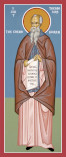 The first founder and organizer of cenobitic
monasticism, he was born of devout parents in Cappadocia, in the village of Mogarisses. As a
young man, he visited St. Simeon the Stylite, who blessed him and predicted for him great
spiritual glory. Theodosios set out in search of a place in which to found a monastery. He took
with him a censer containing cold charcoal and incense. At the place where the charcoal suddenly
ignited of itself, he stopped, settled down and began to lead a life of asceticism. There very
quickly gathered round him many monks of different nationalities and with different languages. He
therefore built a church for each language group, so that services were conducted and God praised
at the same moment in Greek, Armenian, Georgian and so forth. But on a day when they were to
receive holy Communion, all the brethren gathered in the great church, where the service was
conducted in Greek. The refectory was common to all; they held all possessions in common, labored
in common, endured in common and often hungered in common. Theodosios was a sublime example to
all the monks; an example in work, in prayer, in fasting, in vigils and in all the Christian
virtues. And God endowed him with the gifts of wonder-working, to heal the sick, to be present
and help from a distance, to tame wild beasts, to predict the future and to increase bread and
wheat. Prayer was on his lips day and night. He entered peacefully into rest in the Lord in the
year 529, at the age of 105.
The first founder and organizer of cenobitic
monasticism, he was born of devout parents in Cappadocia, in the village of Mogarisses. As a
young man, he visited St. Simeon the Stylite, who blessed him and predicted for him great
spiritual glory. Theodosios set out in search of a place in which to found a monastery. He took
with him a censer containing cold charcoal and incense. At the place where the charcoal suddenly
ignited of itself, he stopped, settled down and began to lead a life of asceticism. There very
quickly gathered round him many monks of different nationalities and with different languages. He
therefore built a church for each language group, so that services were conducted and God praised
at the same moment in Greek, Armenian, Georgian and so forth. But on a day when they were to
receive holy Communion, all the brethren gathered in the great church, where the service was
conducted in Greek. The refectory was common to all; they held all possessions in common, labored
in common, endured in common and often hungered in common. Theodosios was a sublime example to
all the monks; an example in work, in prayer, in fasting, in vigils and in all the Christian
virtues. And God endowed him with the gifts of wonder-working, to heal the sick, to be present
and help from a distance, to tame wild beasts, to predict the future and to increase bread and
wheat. Prayer was on his lips day and night. He entered peacefully into rest in the Lord in the
year 529, at the age of 105.
2. Blessed Michael of Klops.
A fool for Christ, a Russian of princely family, he made himself a fool in order to hide his virtues from the world and escape the praise of men, and he thus received praise from God. He died in the year 1453 in the monastery of Klops near Novgorod, where his relics are preserved.
FOR CONSIDERATION
A man who is open to a bribe cannot be a Christian. The Orthodox fathers of the Church were never open either to bribes or intimidation. Bribery in things of the Faith is equivalent to Judas’ betrayal of Christ for money; such bribery is a characteristic only of certain heretics. When the Emperor Anastasios (491-518) fell into the Eftychian heresy, he rebelled against the decisions of the Fourth Ecumenical Council and attempted to revoke them. In order to win the chief leaders of the Church to his side, he began sending them various gifts. St. Theodosios was the first in renown in Palestine, and to him the emperor sent thirty liters of gold, ostensibly for the needs of his monastery. Theodosios realized immediately that the emperor meant this as a bribe, and acted with very great wisdom. He would not keep the money for the monastery, although it was in great need, nor return it to the emperor for him to work more evil with it against Orthodoxy, so he instantly distributed all the gold to the poor in the emperor’s name, that this act of charity might strengthen his prayers for the emperor’s repentance and return to the true path.
Daily Scripture Readings taken from The Orthodox New Testament, translated and published by Holy Apostles Convent, Buena Vista, Colorado, copyright © 2000, used with permission, all rights reserved.
Daily Prologue Readings taken from The Prologue of Ochrid, by Bishop Nikolai Velimirovic, translated by Mother Maria, published by Lazarica Press, Birmingham, England, copyright © 1985, all rights reserved. Edited by Dormition Skete.