

Daily Devotional
Saturday, December 13, 2025 (NS), November 30, 2025 (OS)
Fast Day, but Fish, Wine and Olive Oil Allowed.
Saturday of the Twenty-Seventh Week
The commemoration of the holy, glorious, and all-famed Apostle Andrew the First-called.
Scripture Readings
Paschalion — Movable Calendar
Saturday of the Twenty-Seventh Week
Epistle
The Reading is from the Epistle of Saint Paul to the Galatians [§ 213]. Brethren:
5 22The fruit of the Spirit is love, joy, peace, long-suffering, kindness, goodness, faith, 23meekness, self-control; against such things there is no law. 24But they who are of the Christ crucified the flesh with the passions and the lusts. 25If we live by the Spirit, let us also be walking by the Spirit. 26Let us not become vainglorious, provoking one another, envying one another.
6 1Brethren, even if a man should be overtaken in some transgression, ye, the spiritual ones, be restoring such a one in the spirit of meekness, looking out for thyself, lest thou also be tempted. 2Keep on bearing one another’s burdens, and thus fill up the law of the Christ.
Gospel
The Reading is from the Holy Gospel according to Saint Luke [§ 67]. The Lord said:
12 32“Cease being afraid, little flock, for your Father is well pleased to give you the kingdom. 33“Sell your possessions and give alms. Make for yourselves purses which do not become old, an unfailing treasure in the heavens, where no thief draweth near nor moth destroyeth; 34“for where your treasure is, there your heart will be also. 35“Let your loins be girded about and the lamps be kept burning; 36“and be ye like to men waiting for their own lord—whenever he should depart from the wedding festivities—that when he cometh and knocketh, straightway, they might open to him. 37“Happy are those slaves whom the lord, after he cometh, shall find watching. Verily I say to you that he shall gird himself about and shall have them recline at table, and will come forth and minister to them. 38“And if he should come in the second watch, and in the third watch should he come, and find them thus, happy are those slaves. 39“But know ye this, that if the master of the house had known in what hour the thief was coming, he would have watched and not let his house be broken into. 40“Ye therefore also keep on becoming ready, for in the hour ye think not, the Son of Man cometh.”
Menaion — Fixed Calendar
The commemoration of the holy, glorious, and all-famed Apostle Andrew the First-called.
Epistle
The Reading is from the First Epistle of Saint Paul to the Corinthians [§ 131]. Brethren:
4 9I think that God showed forth us the apostles last, as condemned to death; for we became a spectacle to the world, both to angels and to men. 10We are fools for Christ’s sake, but ye are wise in Christ. We are weak, but ye are strong. Ye are held in honor, but we are dishonored. 11Until the present hour, we both hunger and thirst, and are naked, and are being buffeted, and never at rest. 12And we toil working with our own hands. Being reviled, we bless; being persecuted, we bear up; 13being evilly spoken of, we beseech. We became as the filth of the world, the off-scouring of all until now. 14I do not write these things shaming you, but admonishing you as my beloved children. 15For if ye have myriads of tutors in Christ, yet ye have not many fathers; for in Christ Jesus I begot you through the Gospel. 16Therefore, I beseech you, keep on becoming imitators of me.
Gospel
The Reading is from the Holy Gospel according to Saint John [§ 4]. At that time:
1 35John was standing, and two of his disciples. 36And having looked at Jesus walking, he saith, “Behold, the Lamb of God!” 37And the two disciples heard Him speaking, and they followed Jesus. 38And Jesus turned, and beheld them following, and saith to them, “What seek ye?” And they said to Him, “Rabbi” (which is to say, being interpreted, Teacher), “where art Thou staying?” 39He said to them, “Come and see.” Then they went and saw where He was staying. And they stayed with Him that day; and it was about the tenth hour. 40Andrew, the brother of Simon Peter, was one of the two who heard this from John, and followed Him. 41This same one first findeth his own brother Simon, and saith to him, “We have found the Messiah” (which is, being interpreted, the Christ), 42and he led him to Jesus. And having looked at him, Jesus said, “Thou art Simon, the son of Jonas. Thou shalt be called Kephas” (which is interpreted, a stone).
43On the morrow Jesus intended to go forth into Galilee; and He findeth Philip, and saith to him, “Follow thou Me.” 44Now Philip was from Bethsaida, of the city of Andrew and Peter. 45Philip findeth Nathanael, and saith to him, “We have found the One of Whom Moses in the law, and the prophets, wrote—Jesus the son of Joseph, Who is from Nazareth.” 46And Nathanael said to him, “Out of Nazareth can there be any good thing?” Philip saith to him, “Come and see.” 47Jesus saw Nathanael coming toward Him, and saith concerning him, “Behold, truly an Israelite in whom is no guile.” 48Nathanael saith to Him, “From what place knowest Thou me?” Jesus answered and said to him, “Before Philip called thee, when thou wast under the fig tree, I saw thee.” 49Nathanael answered, and saith to Him, “Rabbi, Thou art the Son of God; Thou art the King of Israel.” 50Jesus answered and said to him, “Because I said to thee, ‘I saw thee underneath the fig tree,’ believest thou? Thou shalt see greater things than these.” 51And He saith to him, “Verily, verily, I say to thee, henceforth ye shall see the heaven having been opened, and the angels of God ascending and descending upon the Son of Man.”
Lives of the Saints (Prologue)
December 13th – Civil Calendar
November 30th – Church Calendar
1. The Holy Apostle Andrew the First-Called.
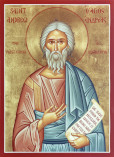 He was the son of Jonah and brother of Peter,
born in Bethsaida and a fisherman by profession. He was first a disciple of St. John the Baptist,
but when John pointed to the Lord Jesus and said: ‘Behold the Lamb of God’ (Jn.
1:36), St. Andrew left his first teacher and followed Christ. After that, Andrew brought his
brother Peter to the Lord. After the descent of the Holy Spirit, it fell to the lot of the first
of Christ’s apostles, St. Andrew, to preach the Gospel in Byzantium and Thrace, then in the
lands along the Danube, in Russia and around the Black Sea, and finally in Epirus, Greece and the
Peloponnese, where he suffered. In Byzantium he installed St. Stachys as its first bishop; in
Kiev he raised the Cross on high and prophesied a Christian future for the Russian people; in
Thrace, Epirus, Greece and the Peloponnese, he brought many people to the Faith and gave them
bishops and priests. In the city of Patras he performed many wonders in the name of Christ and
brought many to the Lord, among whom were the brother and wife of the imperial governor,
Aegeatus. Aegeatus, infuriated by this, put Andrew to torture and then crucified him. While he
was still alive on the cross, the apostle of Christ taught the Christians who were gathered round
him. The people wanted to take him down from the cross, but he would not let them. Finally, the
apostle prayed to God and a strange radiance surrounded him. This light lasted for half an hour,
and when it disappeared, the apostle gave his holy soul into God’s hands. Thus the
first-called apostle, who first of the twelve great apostles came to know the Lord and followed
Him, finished his earthly course. St. Andrew suffered for his Lord in the year 62. His relics
were translated to Constantinople, but his head was later taken to Rome and one hand to
Moscow.
He was the son of Jonah and brother of Peter,
born in Bethsaida and a fisherman by profession. He was first a disciple of St. John the Baptist,
but when John pointed to the Lord Jesus and said: ‘Behold the Lamb of God’ (Jn.
1:36), St. Andrew left his first teacher and followed Christ. After that, Andrew brought his
brother Peter to the Lord. After the descent of the Holy Spirit, it fell to the lot of the first
of Christ’s apostles, St. Andrew, to preach the Gospel in Byzantium and Thrace, then in the
lands along the Danube, in Russia and around the Black Sea, and finally in Epirus, Greece and the
Peloponnese, where he suffered. In Byzantium he installed St. Stachys as its first bishop; in
Kiev he raised the Cross on high and prophesied a Christian future for the Russian people; in
Thrace, Epirus, Greece and the Peloponnese, he brought many people to the Faith and gave them
bishops and priests. In the city of Patras he performed many wonders in the name of Christ and
brought many to the Lord, among whom were the brother and wife of the imperial governor,
Aegeatus. Aegeatus, infuriated by this, put Andrew to torture and then crucified him. While he
was still alive on the cross, the apostle of Christ taught the Christians who were gathered round
him. The people wanted to take him down from the cross, but he would not let them. Finally, the
apostle prayed to God and a strange radiance surrounded him. This light lasted for half an hour,
and when it disappeared, the apostle gave his holy soul into God’s hands. Thus the
first-called apostle, who first of the twelve great apostles came to know the Lord and followed
Him, finished his earthly course. St. Andrew suffered for his Lord in the year 62. His relics
were translated to Constantinople, but his head was later taken to Rome and one hand to
Moscow.
2. St. Frumentios, the Enlightener of Abyssinia.
In the time of the Emperor Constantine the Great, a learned man from Tyre called Meropios traveled to India. He took with him two young Christians, brothers called Edessios and Frumentios. On the journey, the ship foundered in a storm on the Abyssinian coast, and the wild Abyssinians killed all the people from the ship except these two brothers, Edessios and Frumentios. They lived in Abyssinia for several years and succeeded in entering the service of the king. Frumentios began to preach the Christian Faith, at first fairly cautiously, and became convinced that the land was ripe for such preaching. The two brothers then took ship, Edessios to Tyre to his parents and Frumentios to Alexandria, to Patriarch Athanasius the Great. Frumentios described the situation in Abyssinia to the patriarch and sought pastors to bring the people to the Faith. St. Athanasius consecrated Frumentios bishop, and he returned to Abyssinia where, by his zeal and his miracles, he brought the whole of Abyssinia to the Faith during his lifetime. This great pastor of Christ’s flock and enlightener of Abyssinia died peacefully in the year 370, and entered into the kingdom of his Lord.
FOR CONSIDERATION
‘All is given to the apostles,’ says St. John Chrysostom. This means: all gifts, all powers, all the fullness of the grace that God gives to all the faithful is given to the apostles. We see this in the life of the great Apostle Andrew the First-Called: how he is apostle and evangelist, prophet, pastor and teacher (Eph. 4:11). As an evangelist, he carried the good news of the Gospel to the four corners of the earth; as a prophet he prophesied the Baptism of the Russian people and the greatness of Kiev as a city and as a center of Christianity; as a pastor he founded and organized many churches; as a teacher he tirelessly taught right up to his crucifixion, and then on the cross till his last breath. And, on top of this, he was a martyr. This was by a gift of the Holy Spirit that is not given to all. We see in this apostle, as in all the others, the fullness of the grace of the Holy Spirit.
That every act performed by a follower of Christ must be supported by grace is testified to by St. Frumentios. When he returned to Abyssinia from Alexandria as a consecrated bishop, he began to perform great wonders, thus bringing the people to the Faith in great masses. The envious king then asked him: ‘You lived among us for so many years, and we never saw you work such wonders. Whence is it that you do so now?’ To this blessed Frumentios replied: ‘This is not my action, but that of the grace of the priesthood,’ and the saint then explained to the king how he had, for the sake of Christ, forsaken his parents, marriage and the whole world, and how he had, through consecration at the hands of St. Athanasius, received the grace of priesthood, the grace of wonder-working.
Daily Scripture Readings taken from The Orthodox New Testament, translated and published by Holy Apostles Convent, Buena Vista, Colorado, copyright © 2000, used with permission, all rights reserved.
Daily Prologue Readings taken from The Prologue of Ochrid, by Bishop Nikolai Velimirovic, translated by Mother Maria, published by Lazarica Press, Birmingham, England, copyright © 1985, all rights reserved. Edited by Dormition Skete.