

Daily Devotional
Wednesday, November 26, 2025 (NS), November 13, 2025 (OS)
Fast Day, but Fish, Wine and Olive Oil Allowed.
Wednesday of the Twenty-Fifth Week
The commemoration of our holy father among the saints, John Chrysostom, Archbishop of Constantinople.
Scripture Readings
Paschalion — Movable Calendar
Wednesday of the Twenty-Fifth Week
Epistle
The Reading is from the Second Epistle of Saint Paul to the Thessalonians [§ 275].
2 1Brethren, we beseech you with regard to the coming of our Lord Jesus Christ and our gathering together before Him, 2in order that ye be not quickly shaken from your reason, nor to be stirred—neither by a spirit, nor by a word, nor by an epistle as if by us—as if the day of Christ hath arrived. 3Let no one deceive you in any way; for that day shall not come unless the apostasy should come first, and the man of the sin be revealed, the son of the perdition, 4who opposeth and exalteth himself above all which is called God or an object of worship, so as for him to sit in the temple of God as God, showing himself that he is God. 5Do ye not remember that when I was yet with you I was telling you these things? 6And now ye know that which restraineth, in order that he be revealed in his own time. 7For the mystery of the lawlessness already is energizing itself, only there is the one who restraineth now, until he should come to be taken out of the midst. 8And then the lawless one shall be revealed—whom the Lord shall destroy by the breath of His mouth, and shall bring to nought by the manifestation of His coming— 9whose coming is according to the energy of Satan in all power and signs and lying wonders, 10and in all deceit of the unrighteousness in those who are perishing, because they received not the love of the truth, in order for them to be saved. 11And on this account God shall send to them an influence of error for them to believe the lie, 12that they all might be judged who believe not the truth, but had pleasure in the unrighteousness.
Gospel
The Reading is from the Holy Gospel according to Saint Luke [§ 78]. At that time:
15 1All the tax collectors and the sinners were drawing near to hear Jesus. 2And the Pharisees and the scribes were murmuring, saying, “This One receiveth sinners and eateth with them.” 3And He spoke this parable to them, saying, 4“What man among you, having a hundred sheep and having lost one of them, doth not leave the ninety-nine in the wilderness and go after the lost one until he should find it? 5“And having found it, he layeth it upon his own shoulders, rejoicing. 6“And after he cometh to the house, he calleth together his friends and the neighbors, saying to them, ‘Rejoice with me, for I found my sheep which hath been lost.’ 7“I say to you that thus there shall be more joy in the heavens over one sinner who repenteth than over ninety-nine righteous ones who have no need of repentance. 8“Or what woman having ten drachmas, if she should lose one drachma, doth not light a lamp, and sweep the house, and seek diligently until she should find it? 9“And having found it, she calleth together her friends and neighbors, saying, ‘Rejoice with me, for I found the drachma which I lost.’ 10“Thus, I say to you, joy ariseth in the presence of the angels of God over one sinner who repenteth.”
Menaion — Fixed Calendar
The commemoration of our holy father among the saints, John Chrysostom, Archbishop of Constantinople.
Epistle
The Reading is from the Epistle of Saint Paul to the Hebrews [§ 318]. Brethren:
7 26Such a High Priest was fitting for us: holy, guileless, undefiled, Who hath been separated from the sinners and hath become higher than the heavens, 27Who hath no need daily, even as the high priests, to offer up sacrifices, first for his own sins, then for those of the people; for this He did once for all after He offered up Himself. 28For the law appointeth men high priests who have weakness; but the word of the oath, which is after the law, appointeth the Son, Who hath been perfected forever.
8 1Now in reference to the things being spoken of, the chief point is: We have such a High Priest, Who sat down on the right of the throne of the majesty in the heavens, 2a Liturgist of the holies and of the tabernacle, the true one, which the Lord pitched, and not man.
Gospel
The Reading is from the Holy Gospel according to Saint John [§ 36]. The Lord said to those Jews who had come to Him:
10 9“I am the door; by Me if anyone should enter, he shall be saved, and shall go in and go out and find pasture. 10“The thief cometh not, except that he might steal, and slay, and destroy. I came that they may have life, and may have it abundantly. 11“I am the good shepherd. The good shepherd layeth down his life for the sheep. 12“But the hireling, who indeed is not a shepherd, whose own the sheep are not, seeth the wolf coming, and leaveth the sheep and fleeth; and the wolf seizeth them and scattereth the sheep. 13“Now the hireling fleeth, because he is a hireling and careth not about the sheep. 14“I am the good shepherd; and I know those that are Mine, and am known of those that are Mine. 15“Even as the Father knoweth Me, I also know the Father; and I lay down My life for the sheep. 16“And I have other sheep which are not of this fold; them also it is needful for Me to bring, and they shall hear My voice; and there shall be one flock and one Shepherd.”
Lives of the Saints (Prologue)
November 26th – Civil Calendar
November 13th – Church Calendar
1. St. John Chrysostom (the Golden-Tongued), Patriarch of Constantinople.
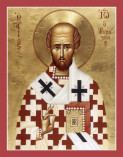 He was born in Antioch in the year 347, his father’s name being
Secundus and his mother’s Anthusa. Studying Greek philosophy, John became disgusted with
Hellenic paganism and turned to the Christian Faith as the one and all-embracing truth. John was
baptized by Saint Meletius, Patriarch of Antioch. After their death, John became a monk and began
to live in strict asceticism. He wrote a book: ‘On the Priesthood,’ after which the
holy Apostles John and Peter appeared to him, prophesying for him great service, great grace and
also great suffering. When the time came for him to be ordained priest, an angel of God appeared
at the same time to Patriarch Saint Flavian (Saint Meletius’ successor) and to Saint John
himself. When the patriarch ordained him, a shining white dove was seen above Saint John’s
head. Renowned for his wisdom, his asceticism and the power of his words, Saint John was, at the
desire of Emperor Arkadios, chosen as Patriarch of Constantinople. He governed the Church for six
years as patriarch with unequalled zeal and wisdom, sending missionaries to the pagan Celts and
Scythians and purging the Church of simony, deposing many bishops who were given to this vice. He
extended the Church’s charitable works, wrote the service for the divine Liturgy which
bears his name, put heretics to shame, denounced the Empress Evdoxia, interpreted the Scriptures
with his golden mind and tongue and left to the Church many precious books of sermons. The people
glorified him; the jealous loathed him; the empress twice had him sent into exile. He spent three
years in exile, and died on the day of the Feast of the Exaltation of the Holy Cross, September
14th, 407, in a place called Comana in Armenia. The holy Apostles John and Peter again appeared
to him at the time of his death, and also the holy Martyr Vasiliskos (see May 22nd), in whose
church he received holy Communion for the last time. ‘Glory to God for all things!’
were his last words, and with them the soul of Saint John Chrysostom the Patriarch entered into
Paradise. Of his relics, the head is preserved at the monastery of Vatopedi on Mount Athos.
He was born in Antioch in the year 347, his father’s name being
Secundus and his mother’s Anthusa. Studying Greek philosophy, John became disgusted with
Hellenic paganism and turned to the Christian Faith as the one and all-embracing truth. John was
baptized by Saint Meletius, Patriarch of Antioch. After their death, John became a monk and began
to live in strict asceticism. He wrote a book: ‘On the Priesthood,’ after which the
holy Apostles John and Peter appeared to him, prophesying for him great service, great grace and
also great suffering. When the time came for him to be ordained priest, an angel of God appeared
at the same time to Patriarch Saint Flavian (Saint Meletius’ successor) and to Saint John
himself. When the patriarch ordained him, a shining white dove was seen above Saint John’s
head. Renowned for his wisdom, his asceticism and the power of his words, Saint John was, at the
desire of Emperor Arkadios, chosen as Patriarch of Constantinople. He governed the Church for six
years as patriarch with unequalled zeal and wisdom, sending missionaries to the pagan Celts and
Scythians and purging the Church of simony, deposing many bishops who were given to this vice. He
extended the Church’s charitable works, wrote the service for the divine Liturgy which
bears his name, put heretics to shame, denounced the Empress Evdoxia, interpreted the Scriptures
with his golden mind and tongue and left to the Church many precious books of sermons. The people
glorified him; the jealous loathed him; the empress twice had him sent into exile. He spent three
years in exile, and died on the day of the Feast of the Exaltation of the Holy Cross, September
14th, 407, in a place called Comana in Armenia. The holy Apostles John and Peter again appeared
to him at the time of his death, and also the holy Martyr Vasiliskos (see May 22nd), in whose
church he received holy Communion for the last time. ‘Glory to God for all things!’
were his last words, and with them the soul of Saint John Chrysostom the Patriarch entered into
Paradise. Of his relics, the head is preserved at the monastery of Vatopedi on Mount Athos.
2. The Holy Martyrs Antoninos, Nikephoros, Herman and Manetha.
The first three were watching one day how the pagans, at one of their feasts, were worshipping idols with shouts and dancing, and they came out before the crowd and began to preach the one God in Trinity. Firmilian, the governor of Palestinian Caesarea, where this took place, was so enraged at the action of these three Christians that he ordered that they be beheaded forthwith. Manetha was a Christian maiden. She followed the martyrs when they were taken to the scaffold, and was herself seized and burned to death. They all suffered in the year 308, and entered into the eternal joy of God eternal.
3. Our Holy Father, the New-Martyr Damaskenos.
Born in Galata in Constantinople, he was first named Diamantis. He led a dissolute life in his youth, even embracing Islam. Then a bitter repentance grew in him, and he went to the Holy Mountain where, as a monk, he lived for twelve years in strict asceticism in the Lavra of St. Athanasius. Desiring martyrdom, to cleanse him from his sin, he traveled to Constantinople and went into the mosques, making the sign of the Cross and calling out to the Turks that their faith was false, and that Jesus Christ is God and Lord. He was beheaded before the gateway of the Phanar on November 13th, 1681. His relics are preserved on Halki, in the monastery of the Holy Trinity.
FOR CONSIDERATION
Both punishment and reward are in the hands of God. But, as this earthly life is but a shadow of the true life of heaven, so punishment and reward here on earth are but a shadow of that true, eternal punishment and reward. The greatest persecutors of God’s holy hierarch Chrysostom were Theophilus, Patriarch of Alexandria and the Empress Evdoxia. After Chrysostom’s death by martyrdom, harsh punishment fell on them both. Theophilus went mad, and the Empress Evdoxia was driven from the court by the Emperor Arkadios. Evdoxia soon fell ill of an incurable disease, sores opening all over her body and worms coming out of the wounds. There was such a stench from them that people in the street could scarcely pass in front of her house. Doctors made use of the most fragrant perfumes, unguents and incenses in an attempt to mitigate the stench from the stricken empress, but with little success, and she finally died in filth and agony. But God’s hand was even heavier upon her after her death. The coffin containing her body shook day and night for thirty whole years, until the Emperor Theodosios translated St. Chrysostom’s relics to Constantinople. But what happened to St. Chrysostom after his death? He was rewarded with a reward such as God alone can give. Adeltius, the Arab bishop who received the exiled Chrysostom into his house in Cucusus, prayed to God after the saint’s death that He would reveal to him where St. John Chrysostom’s soul was. Once, when he was at prayer, he was as though taken out of himself, and saw a youth bathed in light. The youth led him to heaven and showed him the ranks of the hierarchs, pastors and teachers of the Church, naming each of them, but they did not see John there. Then the angel of God led him to the way out from Paradise, and Adeltius was very downcast. When the angel asked the cause of his sadness, Adeltius replied that he was very distressed not to have seen his teacher, John Chrysostom, among those there. The angel answered him: ‘No man who is still in the flesh can see him, for he stands beside the throne of God, together with the angelic company of the cherubim and seraphim.’
Daily Scripture Readings taken from The Orthodox New Testament, translated and published by Holy Apostles Convent, Buena Vista, Colorado, copyright © 2000, used with permission, all rights reserved.
Daily Prologue Readings taken from The Prologue of Ochrid, by Bishop Nikolai Velimirovic, translated by Mother Maria, published by Lazarica Press, Birmingham, England, copyright © 1985, all rights reserved. Edited by Dormition Skete.