

Daily Devotional
Sunday, November 23, 2025 (NS), November 10, 2025 (OS)
No Fasting.
Sunday of the Twenty-Fourth Week
Grave Mode — Second Eothinon
The commemoration of the holy Apostles Olympas, Rodion, Sosipater, Tertius, Erastos, and Quartus of the Seventy.
Scripture Readings
Paschalion — Movable Calendar
Sunday of the Twenty-Fourth Week
Grave Mode — Second Eothinon
Epistle
The Reading is from the Epistle of Saint Paul to the Ephesians [§ 221]. Brethren:
2 14Christ is our peace, the One Who made the both one, and broke down the middle wall of the hedge, 15having abolished by ordinances the enmity—the law of the commandments—in His flesh, in order that He might create in Himself the two into one new man, making peace, 16and might thoroughly reconcile them both in one body to God through the Cross, having slain the enmity by it. 17And He came and preached the good tidings, peace to you who were afar off and to those who were near. 18For through Him we both have access in one Spirit to the Father. 19So then ye are no longer strangers and sojourners, but fellow citizens of the saints and of the household of God, 20who were built up on the foundation of the apostles and prophets, Jesus Christ Himself being the cornerstone, 21in Whom every building, being joined together, increaseth to a holy temple in the Lord, 22in Whom ye also are being built up together for a dwelling place of God in the Spirit.
Gospel
The Reading is from the Holy Gospel according to Saint Luke [§ 53]. At that time:
10 25A certain doctor of the law came to Jesus, tempting Him, and saying, “Teacher, by having done what shall I inherit eternal life?” 26And He said to him, “In the law what hath been written? How readest thou?” 27And he answered and said, “Thou shalt love the Lord thy God with all thy heart, and with all thy soul, and with all thy strength, and with all thy mind [cf. Deut. 6:5; 11:13]; and thy neighbor as thyself [cf. Lev. 19:18].” 28And He said to him, “Thou didst answer rightly; be doing this, and thou shalt live.” 29But he, wishing to justify himself, said to Jesus, “And who is my neighbor?” 30And taking it up, Jesus said, “A certain man was going down from Jerusalem to Jericho, and fell among robbers, who both stripped him and laid blows upon him, and went away, leaving him, as it happened, half-dead. 31“Now, by a coincidence, a certain priest was going down on that road. And having seen him, he passed by on the opposite side. 32“And in like manner also a Levite, having come to be by the place, came and saw him, and passed by on the opposite side. 33“But a certain Samaritan, as he journeyed, came down to him; and having seen him, he was moved with compassion. 34“And he drew near and bound up his wounds, pouring over oil and wine; and he put him upon his own beast, and brought him to an inn, and took care of him. 35“And on the morrow, after he came forth, he took out two denarii, and gave them to the innkeeper, and said to him, ‘Take care of him; and whatsoever thou shalt spend besides, on my coming back, I will repay thee.’ 36“Which then of these three seemeth to thee to have proved to be a neighbor of the one who fell among the robbers?” 37And he said, “The one who rendered mercy in dealing with him.” Then Jesus said to him, “Go on thy way, and be thou doing in like manner.”
Menaion — Fixed Calendar
The commemoration of the holy Apostles Olympas, Rodion, Sosipater, Tertius, Erastos, and Quartus of the Seventy.
No readings given.
Lives of the Saints (Prologue)
November 23rd – Civil Calendar
November 10th – Church Calendar
1. The Holy Apostles Olympas, Erastus, Quartus, Herodion, Sosipater and Tertius.
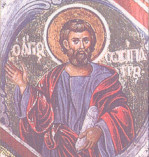 They were all among the Seventy. The last three are
also commemorated elsewhere: Herodion on April 8th, Sosipater on April 28th and Tertius on
October 30th. Ss. Olympas and Herodion were followers of the Apostle Peter, and when Peter
suffered, they suffered too, being beheaded at Nero’s command. Erastus was steward of
the Church in Jerusalem, and later became Bishop of Paneas in Palestine. Quartus was bishop
in Beirut; he suffered greatly and brought many to the Christian Faith. Sosipater was
bishop in Iconium, and Tertius followed him as bishop there. They strove in spirit, became
victors and were crowned with wreaths of glory. They were all among the Seventy. The last three are
also commemorated elsewhere: Herodion on April 8th, Sosipater on April 28th and Tertius on
October 30th. Ss. Olympas and Herodion were followers of the Apostle Peter, and when Peter
suffered, they suffered too, being beheaded at Nero’s command. Erastus was steward of
the Church in Jerusalem, and later became Bishop of Paneas in Palestine. Quartus was bishop
in Beirut; he suffered greatly and brought many to the Christian Faith. Sosipater was
bishop in Iconium, and Tertius followed him as bishop there. They strove in spirit, became
victors and were crowned with wreaths of glory.
|
2. The Holy Martyr Orestes.
From the town of Tyana in Cappadocia, St. Orestes was a cradle Christian and a doctor by profession. He was harshly interrogated by a wicked governor, Maximinus, in the reign of Diocletian (284-305). When the governor urged him to deny Christ and worship idols, Orestes replied: ‘If you knew the power of the Crucified, you would reject idolatrous lies and worship the true God.’ For this he was harshly beaten, then flayed and cut about, then burned in boiling lead and finally thrown into prison to die of hunger. The young Orestes spent seven days without bread or water. On the eighth day, he was brought before the governor, who began to threaten him with terrible tortures. To this Orestes replied: ‘I am ready to undergo every torture, having the sign of my Lord Jesus Christ inscribed on my heart.’ Then the governor ordered that twenty nails be hammered into his legs and that he be bound behind a horse and dragged through thistles and rocks until he expired. In the place where Orestes’ body was thrown, a man radiant as the sun appeared, gathered the bones and took them to a hill near Tyana, burying them there. This great saint, Orestes, appeared to St. Dimitri of Rostov and showed him all his wounds.
3. St. Nonnus, Bishop of Heliopolis.
He was renowned as a great ascetic in the Tabennisiot monastery in Egypt, because of which he was chosen as bishop in 448, in the diocese of Edessa. He was later translated to the diocese of Heliopolis, and there brought thirty thousand Arabs to the Christian Faith. After the death of Bishop Ibo, St. Nonnus returned to Edessa, where he remained till his death in 471. Through his prayers, the notorious sinner Pelagia was brought to the Christian Faith. She was later glorified for the holiness of her life (see Oct. 8th).
FOR CONSIDERATION
The strange paths of God’s providence are demonstrated in an exceptional and strange event in the monastery of Docheiariou in the time of Blessed Neophytos, the nephew of St. Efthymios. When, after Efthymios’ death, Neophytos began to build a new, bigger church to St. Nicholas the Wonder-worker, he ran out of funds and prayed to God for help, and God helped him in a strange way. Near the monastery of Docheiariou there lay a peninsular called ‘Longos’. On this peninsular, Neophytos had a smallish patch of monastic land, near which there was a stone statue of a man. On the sculpture was written: ‘He who smites me on the head will find much gold.’ Many had struck at the statue’s head but had found nothing. Neophytos sent a novice, Basil, off on some task. This Basil was standing one day in front of the statue, ruminating on the mystery of this inscription. At that moment, the sun came out and the statue’s shadow was thrown to the west. Basil took a stone and smote the head of the shadow, then began to dig there, finding a metal pot of gold. He immediately ran and told Abbot Neophytos. The abbot told three trusted monks to go with Basil in the monastery’s boat and bring the gold. The monks set off, loaded the gold into the ship and started for home. But while they were on the sea, the devil put it into their heads to keep the gold for themselves.
The three older monks, deluded by the devil, bound Basil with cords, tied a rock round his neck and threw him into the sea. When Basil had sunk into the depths of the sea, the Archangels Michael and Gabriel suddenly appeared to him in the form of two resplendent youths, and taking hold of him, carried him to the church at Docheiariou, depositing him in front of the Beautiful Gates of the locked church. The next day, when the monks went into the church, they found Basil lying bound before the altar. The abbot questioned him, and learned of the strange thing that had happened to him. The three monks then arrived, and seeing Basil alive, were thunderstruck. The abbot punished them fittingly, took the gold, and completed the church. He dedicated it, not to St. Nicholas, but to the Archangels Michael and Gabriel. This is the reason why Efthymios’ old church at Docheiariou is dedicated to St. Nicholas, but the new one to the holy Archangels Michael and Gabriel.
Daily Scripture Readings taken from The Orthodox New Testament, translated and published by Holy Apostles Convent, Buena Vista, Colorado, copyright © 2000, used with permission, all rights reserved.
Daily Prologue Readings taken from The Prologue of Ochrid, by Bishop Nikolai Velimirovic, translated by Mother Maria, published by Lazarica Press, Birmingham, England, copyright © 1985, all rights reserved. Edited by Dormition Skete.