

Daily Devotional
Monday, October 20, 2025 (NS), October 7, 2025 (OS)
No Fasting.
Monday of the Twentieth Week
7. The commemoration of the holy Martyrs Sergius and Bacchus.
Scripture Readings
Paschalion — Movable Calendar
Monday of the Twentieth Week
Epistle
The Reading is from the Epistle of Saint Paul to the Philippians [§ 241]. Brethren:
2 12Even as ye always obeyed, not as in my presence only, but now much rather in mine absence, be working out your own salvation with fear and trembling; 13for God is the One Who energizeth in you both to will and to energize for the sake of His good pleasure. 14Be doing all things without murmurings and disputings, 15in order that ye might become blameless and unsullied, children of God without blemish in the midst of a crooked and wayward generation, among whom ye shine as luminaries in the world, 16holding forth the word of life, for a boast to me in the day of Christ, that I ran not in vain, nor labored in vain.
Gospel
The Reading is from the Holy Gospel according to Saint Luke [§ 33]. At that time:
7 36A certain one of the Pharisees was asking Jesus that He would eat with him. And He entered into the house of the Pharisee, and reclined at table. 37And behold, a woman in the city who was a sinner, when she found out that He was reclining at table in the house of the Pharisee, brought an alabaster flask of perfumed ointment, 38and she stood beside His feet behind Him, weeping; and she began to wet His feet with tears, and was wiping them off with the hairs of her head; and she was kissing His feet ardently and anointing them with the perfumed ointment. 39Now when the Pharisee who invited Him saw it, he spoke within himself, saying, “This One, if He were a prophet, would know who and of what sort the woman is who toucheth Him, for she is a sinner.” 40And Jesus answered and said to him, “Simon, I have something to say to thee.” And he saith, “Teacher, say it.” 41“There were two debtors to a certain creditor: the one was owing five hundred denarii, and the other fifty. 42“But when they had nothing to pay back the debt, he showed himself gracious to both. Say which of them then will love him more?” 43Simon answered and said, “I suppose that he, to whom he showed himself the more gracious.” And He said to him, “Rightly thou didst judge.” 44And He turned to the woman, and said to Simon, “Seest thou this woman? I entered into thy house; water thou gavest Me not for My feet, but she with tears did wet My feet, and with the hairs of her head wiped them off. 45“A kiss thou gavest Me not, but she from the time that I entered did not cease from ardently kissing My feet. 46“With oil thou didst not anoint My head, but she anointed My feet with perfumed ointment. 47“For which reason I say to thee, her sins, which are many, have been forgiven, for she loved much. But to whom little is forgiven, the same loveth little.” 48And He said to her, “Thy sins have been forgiven.” 49And those reclining at table with Him began to say among themselves, “Who is this Who even forgiveth sins?” 50And He said to the woman, “Thy faith hath saved thee; go thy way in peace.”
Menaion — Fixed Calendar
7. The commemoration of the holy Martyrs Sergius and Bacchus.
Epistle
For Gk. usage, see [Heb. 11:33-12:2]. For Sl. usage, see [Heb. 11:33-40].
The Reading is from the Epistle of Saint Paul to the Hebrews [§§ 330, 331]. Brethren:
11 33All the saints through faith struggled against kingdoms, wrought righteousness, attained to promises, stopped mouths of lions, 34quenched the power of fire, escaped the edges of the sword, were empowered out of weakness, became strong in battle, turned back encampments of aliens. 35Women received their dead by resurrection. And others were tortured, not accepting release, that they might attain a better resurrection. 36And others received trial of mockings and of scourgings, and, moreover, of bonds and of imprisonment. 37They were stoned, they were sawn asunder, were tempted; they died, murdered by the sword. They went about in sheepskins, in goatskins, being in need, afflicted, ill-treated— 38of whom the world was not worthy. They were made to wander in deserts, and in mountains, and in caves, and in the holes of the earth. 39And these all, having been approved by testimony through faith, received not for themselves the promise, 40God having foreseen some better thing concerning us, that they should not be made perfect without us.
12 1Therefore we also, having so great a cloud of witnesses which is set around us, and having laid aside every weight and sin that is easily circumvented, let us by means of patience be running the course which is set before us, 2looking to Jesus, the originator and accomplisher of our faith, Who, in exchange for the joy set before Him, endured a cross, having despised the shame, and hath sat down on the right of the throne of God.
Gospel
The Reading is from the Holy Gospel according to Saint Luke [§ 106]. The Lord said to His disciples, “Be taking heed of men:
21 12“For they shall lay their hands upon you and persecute you, delivering you up to synagogues and prisons, bringing you before kings and governors on account of My name; 13“but it shall prove to be a testimony for you. 14“Therefore settle it for yourselves in your hearts not to premeditate to make a defense; 15“for I will give you a mouth and wisdom, which all those who oppose you shall not be able to contradict nor withstand. 16“And ye shall be delivered up also by parents, and kinfolk, and friends, and brethren; and they shall put some of you to death. 17“And ye shall be hated by all for My name’s sake. 18“But a hair of your head in no wise shall perish. 19“In your patience win your souls.”
Lives of the Saints (Prologue)
October 20th – Civil Calendar
October 7th – Church Calendar
1. The Holy Martyrs Sergius and Bacchus.
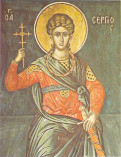
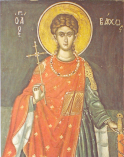 These holy and wonderful martyrs and heroes
of the Christian Faith were at first nobles at the court of the Emperor Maximian. The emperor
himself valued them greatly for their courage, wisdom and zeal, but when he heard that these
great nobles of his were Christians, his love for them turned to fury. And once, when there was a
great offering of sacrifices to idols, the emperor summoned Sergius and Bacchus to offer
sacrifice together with him, and they openly refused to obey him in this. Beside himself with
anger, the emperor ordered that their robes, rings and marks of eminence be stripped from them
and they be dressed in women’s clothing. He then put iron yokes on their necks and led them
thus through the streets of Rome, to be mocked by each and all. The emperor then sent them to
Asia, to Antiochus the governor, for torture. Antiochus had achieved his distinguished rank with
the help of Sergius and Bacchus, who had at one time recommended him to the emperor. When
Antiochus began to urge them to deny Christ and save themselves from dishonorable suffering and
death, the two saints replied: ‘Both honor and dishonor, both life and death—all are one to
him who seeks the heavenly kingdom.’ Antiochus threw Sergius into prison and ordered that
Bacchus be tortured first. The servants took turns in beating holy Bacchus until his whole body
was broken into fragments. His holy spirit went forth from his broken and bloodstained body and
was borne to the Lord by angels. St. Bacchus suffered in the town of Varvallis. Then holy Sergius
was led out. Iron shoes studded with nails were put on his feet, and he was driven out into the
Syrian town of Resapha, and there beheaded with the sword. His soul went to Paradise where,
together with his friend Bacchus, he received the wreath of immortal glory from Christ his King
and Lord. These two glorious knights suffered for the Christian Faith in about 303.
These holy and wonderful martyrs and heroes
of the Christian Faith were at first nobles at the court of the Emperor Maximian. The emperor
himself valued them greatly for their courage, wisdom and zeal, but when he heard that these
great nobles of his were Christians, his love for them turned to fury. And once, when there was a
great offering of sacrifices to idols, the emperor summoned Sergius and Bacchus to offer
sacrifice together with him, and they openly refused to obey him in this. Beside himself with
anger, the emperor ordered that their robes, rings and marks of eminence be stripped from them
and they be dressed in women’s clothing. He then put iron yokes on their necks and led them
thus through the streets of Rome, to be mocked by each and all. The emperor then sent them to
Asia, to Antiochus the governor, for torture. Antiochus had achieved his distinguished rank with
the help of Sergius and Bacchus, who had at one time recommended him to the emperor. When
Antiochus began to urge them to deny Christ and save themselves from dishonorable suffering and
death, the two saints replied: ‘Both honor and dishonor, both life and death—all are one to
him who seeks the heavenly kingdom.’ Antiochus threw Sergius into prison and ordered that
Bacchus be tortured first. The servants took turns in beating holy Bacchus until his whole body
was broken into fragments. His holy spirit went forth from his broken and bloodstained body and
was borne to the Lord by angels. St. Bacchus suffered in the town of Varvallis. Then holy Sergius
was led out. Iron shoes studded with nails were put on his feet, and he was driven out into the
Syrian town of Resapha, and there beheaded with the sword. His soul went to Paradise where,
together with his friend Bacchus, he received the wreath of immortal glory from Christ his King
and Lord. These two glorious knights suffered for the Christian Faith in about 303.
2. The Holy Martyr Polychronios.
Born in the district of Gampnanitus of peasant parents, he worked as a young man in the vineyard of a Constantinopolitan man, giving himself to fasting and prayer day and night. Seeing his way of life, angelic in its purity and restraint, the overseer was amazed and gave him far higher wages than they had agreed. St. Polychronios used the money to build a church. At the time of the Council of Nicaea in 325, Polychronios was a reader and showed such zeal in the defence of Orthodoxy against the Arians that he was ordained priest. Later, these wicked heretics, out of revenge, fell on St. Polychronios in the church itself and cut him to pieces. Thus suffered this great defender of the truth and purity of Orthodoxy, and received the wreath of glory from his most glorious Lord.
In the Greek Synaxarion there are also commemorated today the ninety-nine ascetics of Crete. It is said that the hundredth never joined them, which was interpreted as meaning that the hundredth was Christ the Lord Himself, their Leader. The most renowned among them was St. John, a great man of prayer and a wonder-worker. He prayed so much kneeling that he was in the end unable to stand, but moved around on his knees. Seeing him going about like this, a woodcutter thought that he was a wild beast and shot him with an arrow. Then a very great wonder was wrought, for all the rest of the ninety-nine ascetics breathed their last on the selfsame day. It is not known when they lived.
FOR CONSIDERATION
A vision of St. Andrew: Once holy Andrew was sitting with his disciple Epiphanios and talking with him of the salvation of the soul. At that time, a demon came to Epiphanios and began to set a trap for him, to turn his thoughts in another direction, but he dared not approach Andrew. Andrew then cried to him in fury: ‘Get away from here, you impure adversary!’ The devil recoiled and replied wickedly: ‘You’re the greatest enemy I have in the whole of Constantinople!’ Andrew did not drive him away at once, but let him speak. And the devil began: ‘I feel that the time is coming when my trade will be destroyed. At that time, men will be worse than I am now, and children more adept at wickedness than those who are full-grown. And I shall then take my rest and shall do nothing more to men, for they will do my will of themselves.’ Andrew asked him. ‘At what sins do your people most rejoice?’ The devil replied: ‘The service of idols, slander, evil against one’s neighbor, the Sodomite sins of drunkenness and love of money—these give us most joy.’ Andrew asked again: ‘And how do you bear it when someone who has served you denies you and your works?’ The devil replied: ‘You know that better than I do. We find it hard to bear, and do our utmost to bring him back, for many who have denied us and turned to God have come back to us.’ When the evil spirit had said this and much else, holy Andrew breathed on him and he disappeared.
Daily Scripture Readings taken from The Orthodox New Testament, translated and published by Holy Apostles Convent, Buena Vista, Colorado, copyright © 2000, used with permission, all rights reserved.
Daily Prologue Readings taken from The Prologue of Ochrid, by Bishop Nikolai Velimirovic, translated by Mother Maria, published by Lazarica Press, Birmingham, England, copyright © 1985, all rights reserved. Edited by Dormition Skete.