

Daily Devotional
Friday, October 17, 2025 (NS), October 4, 2025 (OS)
Fast Day. No Meat, Fish, Dairy, Eggs, Alcohol or Olive Oil Allowed.
Friday of the Nineteenth Week
The commemoration of Hieromartyr Hierotheos, Bishop of Athens.
Scripture Readings
Paschalion — Movable Calendar
Friday of the Nineteenth Week
Epistle
The Reading is from the Epistle of Saint Paul to the Philippians [§ 239]. Brethren:
1 27Be conducting yourselves worthily of the Gospel of the Christ, that whether I come and see you or am absent, I might hear of the things concerning you, that ye stand in one spirit, with one soul striving together for the faith of the Gospel, 28and in nothing being frightened by those who oppose, which to them, indeed, is a proof of destruction, but to you of salvation, and this from God. 29For to you it was granted on behalf of Christ, not only to believe in Him, but also to suffer on His behalf, 30having the same struggle which ye saw in me, and now hear to be in me.
2 1If there be then any comfort in Christ, if any consolation of love, if any communion of the Spirit, if any affection from the inward parts and compassionate feelings, 2make full my joy, that ye be minding the same thing, having the same love, united in soul, minding the one thing, 3doing nothing according to factious ambition or vainglory, but in humility esteeming one another above themselves, 4not looking each one to one’s own things, but each also to the things of others.
Gospel
The Reading is from the Holy Gospel according to Saint Luke [§ 32].
7 31The Lord said, “To what then shall I liken the men of this generation? And to what are they like? 32“They are like little children sitting in a marketplace and calling to one another, and saying, ‘We played on the flute to you, and ye danced not; we sang a dirge to you, and ye wept not.’ 33“For John the Baptist hath come neither eating bread nor drinking wine, and ye say, ‘He hath a demon.’ 34“The Son of Man hath come eating and drinking, and ye say, ‘Behold, a man, a glutton and a wine-drinker, a friend of tax collectors and sinners.’ 35“And yet wisdom is justified by all of her children!”
Menaion — Fixed Calendar
The commemoration of Hieromartyr Hierotheos, Bishop of Athens.
Epistle
The Reading is from the Epistle of Saint Paul to the Hebrews [§ 335]. Brethren:
13 17Be obedient to those who lead you, and keep on submitting, for they are watchful for your souls, as those about to render an account, that they may do this with joy, and not groaning; for this would be unprofitable for you. 18Keep on praying for us; for we trust that we have a good conscience, in all things wishing to conduct ourselves well. 19But I beseech you more abundantly to do this, that I might be restored more quickly to you.
20Now the God of peace Who brought up from the dead our Lord Jesus, the Shepherd of the sheep, the great One, in the blood of an everlasting covenant, 21may He render you perfect in every good work, in order to do His will, doing in you that which is well-pleasing before His face, through Jesus Christ, to Whom be glory to the ages of the ages. Amen.
Gospel
No reading given.
Lives of the Saints (Prologue)
October 17th – Civil Calendar
October 4th – Church Calendar
1. The Hieromartyr Hierotheos.
He was a friend of Dionysius the Areopagite, and received the Christian Faith from the Apostle Paul a little after Dionysius. This apostle later made him bishop in Athens. At the time of the dormition of the most holy Mother of God, Hierotheos arrived in Jerusalem and took part in the funeral. With his divine singing, he brought heartfelt joy to many and showed himself to be greatly inspired. He labored greatly for the sake of the Gospel, brought many pagans to the truth, governed his flock well and finally ended a martyr for Christ, Who gave him a twofold wreath in His heavenly kingdom: of the hierarch and of the martyr.
2. St. Stefan Štiljanović.
A Serbian despot, born of the Paštrović family, he governed the Serbian people during a most difficult period, struggling courageously against the Turks and the Latins. A righteous and godly man and a patriot, this great prince can be compared with St. Alexander Nevsky or with the holy king John Vladimir. He entered into rest at the beginning of the sixteenth century (according to some, in 1515). A light appeared at his grave at night, by means of which his holy relics were found, being kept for a long time in the monastery of Šišatovac in the mountains of Fruška Gora* and then, during the Second World War, taken to Belgrade and placed in the Cathedral beside the body of Prince Lazar. His wife Helena, seeing Stefan’s incorrupt relics and the miracles wrought by them, became a nun and gave herself to asceticism till her death.
* Translator`s note: A mountain range in north-east Yugoslavia.
3. Our Holy Father Ammon of Nitria.
An Egyptian and a wine-grower by profession, he was forced by his kinsmen to marry against his will, but he would not live with a woman. On the first day, he called his bride his sister and counseled her, together with him, to guard her virginity for the sake of greater good things from heaven, and they lived thus for a whole eighteen years. Later, by mutual arrangement, his wife founded a women’s monastery in their house and Ammon went off to the Nitrian desert, where he gave himself to the ascesis of solitude. He received great gifts of insight and wonder-working from God for the purity of his heart. A man and woman brought him their insane son that he might heal him by his prayers, but Ammon would not do so. After long pestering on the part of the parents, Ammon said: ‘The sickness and health of your son are in your hands. Return the stolen ox to the widow (and he named her), and your son will be healed.’ The parents, amazed at such insight on the saint’s part, acknowledged their sin and promised that they would return the stolen ox as soon as they got home. Then holy Ammon prayed to God, and the child was healed. Ammon was a close friend of St. Anthony the Great. When Ammon died in Nitria in about 350, St. Anthony saw from his cell window the soul of Ammon in the heights, and said to the brethren: ‘Abba Ammon has today moved on, and I see his holy soul being borne by the angels into heaven.’
4. Our Holy Father Paul the Simple.
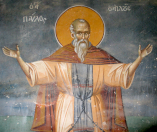 He lived in the world as a
married man to the age of sixty. Catching his wife in sin, he left everything and went to
St. Anthony in the desert, becoming a monk at his hands. Although he was simple and
unlettered, he achieved such spiritual perfection that he saw every man’s soul as
ordinary men see each other’s bodies. He was a great wonder-worker, and in some
things, outstripped St. Anthony himself. He died in great old age, in 340, and went to
angelic joy. He lived in the world as a
married man to the age of sixty. Catching his wife in sin, he left everything and went to
St. Anthony in the desert, becoming a monk at his hands. Although he was simple and
unlettered, he achieved such spiritual perfection that he saw every man’s soul as
ordinary men see each other’s bodies. He was a great wonder-worker, and in some
things, outstripped St. Anthony himself. He died in great old age, in 340, and went to
angelic joy.
|
FOR CONSIDERATION
A vision of St. Andrew the Fool for Christ: St. Paul was not the only one to be caught up into Paradise and hear ‘unspeakable words’ (II Cor. 12:4). Over eight hundred and fifty years after St. Paul, this happened to St. Andrew. One winter night, holy Andrew was lying among the dogs on a dunghill, to warm his frozen body. An angel appeared to him and caught him up to Paradise (whether in the body or out of the body, Andrew himself was unable to explain) and kept him for two weeks in the heavenly world, bearing him to the third heaven. ‘I saw myself clad in shining garments like lightning, with a wreath of flowers on my head and girt with a kingly girdle, and I rejoiced greatly at this beauty, and marveled in mind and heart at the unspeakable loveliness of God’s Paradise, and I walked around it with great gladness.’
After that, Andrew writes of how he saw Christ the Lord: ‘And when a flaming hand drew aside the curtain, I saw my Lord as the Prophet Isaias saw Him aforetime, sitting upon a throne, high and lifted up and surrounded by seraphim. He was clad in a red garment, His face shone and His eyes rested on me with great kindness. Seeing Him, I fell down before Him, worshipping before the awesome throne of His glory. I have no words for the joy that gripped me at the sight of His face; and now, remembering this vision, I am filled with unspeakable joy. And I heard my most merciful Creator speak three words to me with His most sweet and pure lips, which so sweetened my heart and inflamed it with love for Him that I melted as wax at such spiritual warmth.’ When St. Andrew asked also after this if it would be possible to see the most holy Mother of God, it was said to him that she was for the moment not in heaven, but had gone down to earth to be of help to the poor and needy.
Daily Scripture Readings taken from The Orthodox New Testament, translated and published by Holy Apostles Convent, Buena Vista, Colorado, copyright © 2000, used with permission, all rights reserved.
Daily Prologue Readings taken from The Prologue of Ochrid, by Bishop Nikolai Velimirovic, translated by Mother Maria, published by Lazarica Press, Birmingham, England, copyright © 1985, all rights reserved. Edited by Dormition Skete.