

Daily Devotional
Wednesday, October 8, 2025 (NS), September 25, 2025 (OS)
Fast Day, but Wine and Olive Oil Allowed.
Wednesday of the Eighteenth Week
The commemoration of our holy Mother Ephrosyne of Alexandria, and our venerable father, Sergius the Wonder-worker, Abbot of Radonezh.
Scripture Readings
Paschalion — Movable Calendar
Wednesday of the Eighteenth Week
Epistle
The Reading is from the Epistle of Saint Paul to the Ephesians [§ 231]. Brethren:
5 25Husbands, be loving your own wives, even as the Christ also loved the Church, and gave Himself up for her, 26in order that He might sanctify her, having cleansed her in the laver of the water with the word, 27that He might present her to Himself the glorious Church, not having spot, or wrinkle, or any of such things; but that she may be holy and unblemished. 28So ought the husbands to love their own wives as their own bodies. He who loveth his own wife loveth himself. 29For no one ever hated his own flesh, but nourisheth and cherisheth it, even as also the Lord the Church. 30For we are members of His body, of His flesh, and of His bones. 31“Because of this shall a man leave his father and mother, and shall cleave to his wife, and the two shall be into one flesh [cf. Gen. 2:24].” 32This mystery is great; but I speak in regard to Christ and in regard to the Church. 33However do ye severally be loving in this manner each one his own wife as himself, and the wife in this manner that she be fearing the husband.
Gospel
The Reading is from the Holy Gospel according to Saint Luke [§ 21]. At that time:
5 33The Pharisees came to Jesus and said to Him, “Why do the disciples of John fast often and make entreaties, and likewise those of the Pharisees, but Thine eat and drink?” 34And He said to them, “Ye are not able to make the sons of the bridechamber fast while the bridegroom is with them, are ye? 35“But days will come, whenever the bridegroom shall have been taken away from them, and then shall they fast in those days.” 36And He was also telling them a parable: “No one putteth a patch of a new garment on an old garment; otherwise both the new garment teareth and the patch that is from the new doth not agree with the old. 37“And no one putteth new wine into old wineskins; otherwise the new wine will burst the wineskins, and it will be poured out, and the wineskins will be destroyed. 38“But new wine must be put into new wineskins, and both are preserved. 39“And no one, having drunk old wine, straightway doth wish new; for he saith, ‘The old is better.’”
Menaion — Fixed Calendar
The commemoration of our holy Mother Ephrosyne of Alexandria, and our venerable father, Sergius the Wonder-worker, Abbot of Radonezh.
Epistle
For the Venerable Father:
The Reading is from the Epistle of Saint Paul to the Galatians [§ 213]. Brethren:
5 22The fruit of the Spirit is love, joy, peace, long-suffering, kindness, goodness, faith, 23meekness, self-control; against such things there is no law. 24But they who are of the Christ crucified the flesh with the passions and the lusts. 25If we live by the Spirit, let us also be walking by the Spirit. 26Let us not become vainglorious, provoking one another, envying one another.
6 1Brethren, even if a man should be overtaken in some transgression, ye, the spiritual ones, be restoring such a one in the spirit of meekness, looking out for thyself, lest thou also be tempted. 2Keep on bearing one another’s burdens, and thus fill up the law of the Christ.
Gospel
For the venerable Father:
The Reading is from the Holy Gospel according to Saint Luke [§ 24]. At that time:
6 17 Jesus stood upon a level place. And there was a crowd of His disciples, and a great multitude of the people from all of Judæa and Jerusalem and the seacoast of Tyre and Sidon, who came to hear Him, and to be healed of their diseases— 18even those who were troubled by unclean spirits; and they were cured. 19And all the crowd was seeking to touch Him, for power was coming forth from Him and healing all. 20And He lifted up His eyes to His disciples, and began to say:
“Blessed are the poor, for yours is the kingdom of God.
21“Blessed are ye who hunger now, for ye shall be filled.
Blessed are ye who weep now, for ye shall laugh.
22“Blessed are ye whenever men hate you, and whenever they separate you, and reproach you, and cast out your name as evil, on account of the Son of Man.
23“Rejoice in that day and leap for joy, for behold, your reward is great in the heavens.”
Lives of the Saints (Prologue)
October 8th – Civil Calendar
September 25th – Church Calendar
1. Our Holy Mother Ephrosyne.
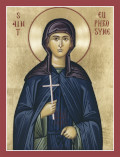 The daughter of a rich and eminent man, Paphnutios, from
Alexandria, she was besought of God by her childless parents, who brought their daughter up in
the Christian Faith. Not wishing to marry, the young Ephrosyne, in order to hide from her father,
dressed herself in men’s clothing and presented herself to the abbot of a monastery as a
eunuch of the Emperor Theodosios with the name of Smaragdus. The abbot received her and placed
her under the guidance of the monk Agapetus as spiritual father. By her fasting and prayers,
Smaragdus quickly outstripped the other monks in the monastery. When she had spent thirty-eight
years in strict asceticism, Paphnutios visited the monastery and the abbot placed him in
Smaragdus’ care for prayer and counsel. Smaragdus recognized Paphnutios, but Paphnutios did
not recognize her. When her father confessed his grief for his lost daughter, Smaragdus told him
not to lose hope, for he would see his daughter again once more in this life, and asked him to
come again in three days’ time. When Paphnutios returned, Smaragdus was on her deathbed.
Then the dying monk said to Paphnutios: ‘I am Ephrosyne your daughter; you are my
father.’ Her father could not for a long time collect himself, for sheer astonishment. Then
Ephrosyne breathed her last and her father wept over her. After burying his daughter, Paphnutios
remained in the monastery and settled in the cell of his departed, holy daughter. After ten years
of asceticism, holy Paphnutios entered into rest in the Lord.
The daughter of a rich and eminent man, Paphnutios, from
Alexandria, she was besought of God by her childless parents, who brought their daughter up in
the Christian Faith. Not wishing to marry, the young Ephrosyne, in order to hide from her father,
dressed herself in men’s clothing and presented herself to the abbot of a monastery as a
eunuch of the Emperor Theodosios with the name of Smaragdus. The abbot received her and placed
her under the guidance of the monk Agapetus as spiritual father. By her fasting and prayers,
Smaragdus quickly outstripped the other monks in the monastery. When she had spent thirty-eight
years in strict asceticism, Paphnutios visited the monastery and the abbot placed him in
Smaragdus’ care for prayer and counsel. Smaragdus recognized Paphnutios, but Paphnutios did
not recognize her. When her father confessed his grief for his lost daughter, Smaragdus told him
not to lose hope, for he would see his daughter again once more in this life, and asked him to
come again in three days’ time. When Paphnutios returned, Smaragdus was on her deathbed.
Then the dying monk said to Paphnutios: ‘I am Ephrosyne your daughter; you are my
father.’ Her father could not for a long time collect himself, for sheer astonishment. Then
Ephrosyne breathed her last and her father wept over her. After burying his daughter, Paphnutios
remained in the monastery and settled in the cell of his departed, holy daughter. After ten years
of asceticism, holy Paphnutios entered into rest in the Lord.
2. Our Holy Father Sergius (Sergy) of Radonezh.
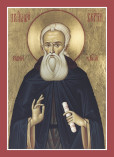 A great ascetic and light of the Russian Church, he
was born in 1313 in Rostov of devout parents, Kiril and Maria. After the death of his parents,
Bartholomew—for that was his baptismal name—became a monk and founded the community of the Holy
Trinity in the forest of Radonezh. A gentle and meek servant of God, occupied only with labor and
prayer, he was made worthy of the gifts of wonder-working for the purity of his heart, raising
the dead in the name of Christ. The holy Mother of God appeared to him a number of times. Princes
and bishops came to him for counsel, and he gave his blessing to Prince Dimitri of the Don and
foretold his victory in Russia’s war of liberation against the Tartars. He had insight into
men’s hearts and into distant events. His community became filled with monks during his
lifetime, and has served through the ages as one of the chief centers of spiritual life and of
God’s miracles. St. Sergius entered into rest in 1392. After his death, he appeared a
number of times to various people.
A great ascetic and light of the Russian Church, he
was born in 1313 in Rostov of devout parents, Kiril and Maria. After the death of his parents,
Bartholomew—for that was his baptismal name—became a monk and founded the community of the Holy
Trinity in the forest of Radonezh. A gentle and meek servant of God, occupied only with labor and
prayer, he was made worthy of the gifts of wonder-working for the purity of his heart, raising
the dead in the name of Christ. The holy Mother of God appeared to him a number of times. Princes
and bishops came to him for counsel, and he gave his blessing to Prince Dimitri of the Don and
foretold his victory in Russia’s war of liberation against the Tartars. He had insight into
men’s hearts and into distant events. His community became filled with monks during his
lifetime, and has served through the ages as one of the chief centers of spiritual life and of
God’s miracles. St. Sergius entered into rest in 1392. After his death, he appeared a
number of times to various people.
3. Our Holy Mother Ephrosyne of Suzdal.
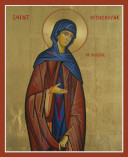 Her baptismal name was Theodula, and she was
the daughter of Michael Vsevolodovitch and the betrothed of Menas, Prince of Suzdal. She
had never desired marriage, and prayed to God to keep her in virginity till her death. When
they took her as a bride to Suzdal, Prince Menas died suddenly. She did not return to her
parents but retired to a monastery, where she lived in asceticism till her death. She was
endowed by God with wonder-working gifts, and entered into rest in 1250. Her baptismal name was Theodula, and she was
the daughter of Michael Vsevolodovitch and the betrothed of Menas, Prince of Suzdal. She
had never desired marriage, and prayed to God to keep her in virginity till her death. When
they took her as a bride to Suzdal, Prince Menas died suddenly. She did not return to her
parents but retired to a monastery, where she lived in asceticism till her death. She was
endowed by God with wonder-working gifts, and entered into rest in 1250.
|
FOR CONSIDERATION
A saint is not remarkable on the surface; all his riches are internal, in his soul. A peasant came a long way to the monastery to see St. Sergius. When he asked for the abbot, he was told that he was working in the garden. The peasant went off to the garden and saw a man there in poor and dirty clothing, hoeing along with the other workers. The peasant returned to the monastery dissatisfied, thinking within himself that the monks were making fun of him, and repeated, that there might be no mistake, that he wanted to see the famous holy father, Sergius. Sergius arrived back at the monastery just then, and welcomed the peasant, serving him at table. The saint looked into the heart of his guest, and saw there the thoughts about himself. To quiet him, he told him that he would see St. Sergius if he waited a little. Just then, a prince arrived at the monastery with his nobles. Both the prince and the nobles bowed low to Sergius and asked his blessing. The monks then removed the peasant from the room to make room for the new guests, and this peasant looked with wonder from afar, and peered to see that which he had spurned the sight of from nearby. He chided himself for his ignorance and was deeply ashamed. When the prince had departed, the peasant quickly went up to the saint, fell at his feet and asked his forgiveness. And the great saint was gentle with him, and said: ‘Don’t grieve, my son; you thought a true thing of me, reckoning me as nothing, while others are deluded in thinking me something great.’
Daily Scripture Readings taken from The Orthodox New Testament, translated and published by Holy Apostles Convent, Buena Vista, Colorado, copyright © 2000, used with permission, all rights reserved.
Daily Prologue Readings taken from The Prologue of Ochrid, by Bishop Nikolai Velimirovic, translated by Mother Maria, published by Lazarica Press, Birmingham, England, copyright © 1985, all rights reserved. Edited by Dormition Skete.