

Daily Devotional
Tuesday, September 30, 2025 (NS), September 17, 2025 (OS)
No Fasting.
Tuesday of the Seventeenth Week
The commemoration of the Afterfeast of the Exaltation, and the holy Martyr Sophia, and her daughters, the Martyrs Faith, Hope, and Love.
Scripture Readings
Paschalion — Movable Calendar
Tuesday of the Seventeenth Week
Epistle
The Reading is from the Epistle of Saint Paul to the Ephesians [§ 222]. Brethren:
2 19Ye are no longer strangers and sojourners, but fellow citizens of the saints and of the household of God, 20who were built up on the foundation of the apostles and prophets, Jesus Christ Himself being the cornerstone, 21in Whom every building, being joined together, increaseth to a holy temple in the Lord, 22in Whom ye also are being built up together for a dwelling place of God in the Spirit.
3 1For this cause I, Paul, the prisoner of the Christ, Jesus, on behalf of you, the nations— 2if, indeed, ye heard of the dispensation of the grace of God which was given to me in regard to you, 3that by revelation He made known to me the mystery (even as I wrote before briefly, 4according to which reading ye are able to perceive my understanding in the mystery of the Christ), 5which in other generations was not made known to the sons of men, as now it was revealed to His holy apostles and prophets in the Spirit: 6the nations are to be joint-heirs, and fellow members of the body, and joint-partakers of His promise in the Christ, through the Gospel, 7of which I became a minister, according to the gift of the grace of God which was given to me according to the energy of His power.
Gospel
The Reading is from the Holy Gospel according to Saint Luke [§ 11]. At that time:
3 23Jesus Himself was about thirty years old when He began, being, as was supposed, a son of Joseph, the son of Eli, 24the son of Matthan, the son of Levi, the son of Melchi, the son of Joanna, the son of Joseph, 25the son of Mattathias, the son of Amos, the son of Naum, the son of Esli, the son of Nangai, 26the son of Maath, the son of Mattathias, the son of Semei, the son of Josech, the son of Juda, 27the son of Joannan, the son of Resa, the son of Zorobabel, the son of Salathiel, the son of Neri, 28the son of Melchi, the son of Addi, the son of Kosam, the son of Elmodam, the son of Er, 29the son of Jose, the son of Eliezer, the son of Joreim, the son of Matthat, the son of Levi, 30the son of Symeon, the son of Juda, the son of Joseph, the son of Jonan, the son of Eliakeim, 31the son of Melea, the son of Mainan, the son of Mattatha, the son of Nathan, the son of David, 32the son of Jesse, the son of Obed, the son of Booz, the son of Salmon, the son of Naason, 33the son of Aminadab, the son of Aram, the son of Joram, the son of Esrom, the son of Phares, the son of Juda, 34the son of Jacob, the son of Isaac, the son of Abraham, the son of Thara, the son of Nachor, 35the son of Saruch, the son of Ragav, the son of Phalek, the son of Ever, the son of Sala, 36the son of Kainan, the son of Arphaxad, the son of Sem, the son of Noah, the son of Lamech, 37the son of Mathusala, the son of Enoch, the son of Jared, the son of Maleleel, the son of Kainan, 38the son of Enos, the son of Seth, the son of Adam, the son of God.
4 1And Jesus, full of the Holy Spirit, returned from the Jordan, and was being led in the Spirit into the wilderness.
Menaion — Fixed Calendar
The commemoration of the Afterfeast of the Exaltation, and the holy Martyr Sophia, and her daughters, the Martyrs Faith, Hope, and Love.
No readings given.
Lives of the Saints (Prologue)
September 30th – Civil Calendar
September 17th – Church Calendar
1. The Holy Martyrs Faith, Hope, and Love, and their mother Sophia.
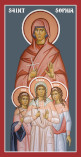 They lived and suffered in
Rome in the time of the Emperor Hadrian. The wise Sophia (as her name—Sophia—wisdom, indicates)
was left a widow, and as a Christian, steeped herself and her daughters in the Christian Faith.
At the time that Hadrian’s persecuting hand stretched out over the virtuous house of
Sophia, Faith was twelve, Hope ten and Love nine. The four of them were brought before the
emperor, with their arms entwined ‘like a woven wreath,’ humbly but firmly confessing
their faith in Christ the Lord and refusing to offer sacrifice to the goddess Artemis. At the
moment of their passion, the mother urged her valiant daughters to endure to the end. ‘Your
heavenly Lover, Jesus Christ, is eternal health, inexpressible beauty and life eternal. When your
bodies are slain by torture, He will clothe you in incorruption and the wounds on your bodies
will shine in heaven like the stars.’ The torturers inflicted harsh torture on Faith, Hope,
and Love one by one. They beat them, stabbed them and threw them into fire and boiling pitch, and
finally beheaded them one after the other. Sophia took the dead bodies of her daughters out of
the town and buried them, and stayed by their grave in prayer for three days and nights, then
gave her soul to God, hastening to the heavenly company where the blessed souls of her daughters
awaited her.
They lived and suffered in
Rome in the time of the Emperor Hadrian. The wise Sophia (as her name—Sophia—wisdom, indicates)
was left a widow, and as a Christian, steeped herself and her daughters in the Christian Faith.
At the time that Hadrian’s persecuting hand stretched out over the virtuous house of
Sophia, Faith was twelve, Hope ten and Love nine. The four of them were brought before the
emperor, with their arms entwined ‘like a woven wreath,’ humbly but firmly confessing
their faith in Christ the Lord and refusing to offer sacrifice to the goddess Artemis. At the
moment of their passion, the mother urged her valiant daughters to endure to the end. ‘Your
heavenly Lover, Jesus Christ, is eternal health, inexpressible beauty and life eternal. When your
bodies are slain by torture, He will clothe you in incorruption and the wounds on your bodies
will shine in heaven like the stars.’ The torturers inflicted harsh torture on Faith, Hope,
and Love one by one. They beat them, stabbed them and threw them into fire and boiling pitch, and
finally beheaded them one after the other. Sophia took the dead bodies of her daughters out of
the town and buried them, and stayed by their grave in prayer for three days and nights, then
gave her soul to God, hastening to the heavenly company where the blessed souls of her daughters
awaited her.
2. The Holy Martyr Agathokleia.
She was a servant of one Nicholas and his wife Paulina, who were at first Christians but forsook Christianity and turned again to idol-worship. Holy Agathokleia refused to follow the example of her masters, and for this was harshly tortured both by them and by the judge. Finally, her mistress killed her by pouring burning coals on her neck, but God glorified His handmaid in His heavenly kingdom.
3. The 156 Holy Martyrs of Egypt.
They were all Egyptians, and suffered for Christ the Lord in 310, some by the sword and some by fire. Among them were two old bishops, Peleus and Nilus, a priest, Zeno, and two renowned men, Patermuthius and Elias. With them also suffered Bishop Silvanus and an eminent, blind old man, John, who knew the Scriptures by heart and recited them to gatherings of Christians. They were all crowned with wreaths and entered into the eternal kingdom of Christ.
4. The Holy Martyr Theodota.
She endured eight years of harsh torture on the part of the governor, Simplicius, who finally went out of his mind. She was beheaded with the sword in the time of the Emperor Alexander Severus, in about 230.
FOR CONSIDERATION
A God-fearing and faithful ruler is a blessing from heaven on his whole people. King Vatslav (Wenceslas) of the Czechs was such a ruler. His zeal for the holy things of the Faith and his strictness of life are reminiscent of the ancient ascetics. He devoted his days to administrative work and his nights to prayer, and he often prepared and cooked the holy bread, most especially when he himself was to receive holy Communion. He was concerned in the building of many churches, in which daily services were celebrated, and gave especial care to the poor and needy. He was a lover of peace, although a great and fearless hero. When the neighboring prince, Radislav, invaded the Czech lands, Vatslav sent him a letter, asking him what had roused him to make war against him. Radislav replied haughtily that he was after the whole of the Czech lands and Vatslav’s throne. Then Vatslav gathered together a large army and marched against his enemy. Then, seeing the two great armies, he mourned the coming loss of life and sent the following message to Radislav: ‘The quarrel is between the two of us. You want to conquer this land, and I refuse to let you. Let us settle this matter by single combat. What purpose would be served by a bloody conflict between our two armies?’ Prince Radislav agreed to single combat, and being overcome by Vatslav, begged his forgiveness on his knees.
Daily Scripture Readings taken from The Orthodox New Testament, translated and published by Holy Apostles Convent, Buena Vista, Colorado, copyright © 2000, used with permission, all rights reserved.
Daily Prologue Readings taken from The Prologue of Ochrid, by Bishop Nikolai Velimirovic, translated by Mother Maria, published by Lazarica Press, Birmingham, England, copyright © 1985, all rights reserved. Edited by Dormition Skete.