

Daily Devotional
Sunday, September 21, 2025 (NS), September 8, 2025 (OS)
No Fasting.
The Sunday Before the Exaltation of the Cross
Sunday of the Fifteenth Week
Mode Plagal Two — Fourth Eothinon
| The commemoration of the Nativity of our all-holy Lady, the Theotokos and Virgin Mary, and the finding of the wonderworking Icon of the most holy Theotokos, known as the Kursk-Root Icon of the Sign. |
Scripture Readings
Special Commemorations
The Sunday Before the Exaltation of the Cross
Epistle
The Reading is from the Epistle of Saint Paul to the Galatians [§ 215]. Brethren:
6 11See with what size letters I am writing to you with mine own hand. 12As many as wish to make a good show in the flesh, these constrain you to be circumcised, only that they may not be persecuted for the Cross of Christ. 13For not even they themselves who are circumcised keep the law, but they wish you to be circumcised, in order that they might boast in your flesh. 14But may it not be for me to boast, except in the Cross of our Lord Jesus Christ, through Whom the world hath been crucified to me, and I to the world. 15For in Christ Jesus neither circumcision hath any strength, nor uncircumcision, but a new creation. 16And as many as walk by this rule, peace be upon them and mercy, and upon the Israel of God.
17Henceforth, let no one be giving me troubles, for I bear in my body the marks of the Lord Jesus.
18The grace of our Lord Jesus Christ be with your spirit, brethren. Amen.
Gospel
The Reading is from the Holy Gospel according to Saint John [§ 9]. The Lord said:
3 13“No one hath gone up into the heavens, except the One Who came down from out of the heavens, the Son of Man, Who is in the heavens. 14“And even as Moses lifted up the serpent in the wilderness, thus it is needful for the Son of Man to be lifted up; 15“that everyone who believeth in Him should not perish, but may have everlasting life. 16“For God so loved the world that He gave His only-begotten Son, that everyone who believeth in Him should not perish, but may have everlasting life. 17“For God did not send forth His Son into the world in order that He might condemn the world, but that the world might be saved through Him.”
Paschalion — Movable Calendar
Sunday of the Fifteenth Week
Mode Plagal Two — Fourth Eothinon
Epistle
The Reading is from the Second Epistle of Saint Paul to the Corinthians [§§ 176, 177]. Brethren:
4 6It is God Who said, “Let there be light [cf. Gen. 1:3]” to shine out of darkness, Who shined in our hearts, for the illumination of the knowledge of the glory of God in the face of Jesus Christ.
7But we have this treasure in earthen vessels, that the preeminence of the power may be of God, and not from us. 8In every way we are afflicted, but not straitened; we are at a loss, but not utterly at a loss; 9persecuted, but not abandoned; cast down, but not destroyed— 10always bearing about in the body the dying of the Lord Jesus, that the life also of Jesus might be made manifest in our body. 11For we, the living, are always being delivered to death on account of Jesus, that also the life of Jesus might be made manifest in our mortal flesh. 12So that indeed death energizeth itself in us, but life in you. 13But having the same spirit of faith, according to that which hath been written: “I believed, wherefore I spoke [Ps. 115(116):1(10)],” we also believe, and therefore speak, 14knowing that the One Who raised up the Lord Jesus shall raise up us also through Jesus, and shall present us with you. 15For all things are for your sakes, that the grace, which abounded through the majority, might cause the giving of thanks to abound more to the glory of God.
Gospel
The Reading is from the Holy Gospel according to Saint Matthew [§ 92]. At that time:
22 35A certain doctor of the Jewish law came to Jesus and questioned Him, putting Him to the test, saying, 36“Teacher, which is the great commandment in the law?” 37And Jesus said to him, “‘Thou shalt love the Lord thy God with all thy heart, and with all thy soul, and with all thy mind [cf. Deut. 6:5, 10:12, 30:6].’ 38“This is the first and great commandment. 39“And the second is like it, ‘Thou shalt love thy neighbor as thyself [Lev. 19:18].’ 40“On these two commandments hang all the law and the prophets.” 41But while the Pharisees were gathered together, Jesus questioned them, 42saying, “What think ye concerning the Christ? Whose Son is He?” They say to Him, “David’s.” 43He saith to them, “How then doth David in spirit call Him ‘Lord,’ saying, 44“‘The Lord said to my Lord, “Sit Thou on My right, until I should place Thine enemies as a footstool of Thy feet [Ps. 109(110):1]”’? 45“If David then calleth Him ‘Lord,’ how is He his Son?” 46And no one was able to answer Him a word, nor did anyone dare from that day to question Him any more.
Menaion — Fixed Calendar
The commemoration of the Nativity of our all-holy Lady, the Theotokos and Virgin Mary, and the finding of the wonderworking Icon of the most holy Theotokos, known as the Kursk-Root Icon of the Sign.
Epistle
For the Nativity of the Virgin Mary:
The Reading is from the Epistle of Saint Paul to the Philippians [§ 240]. Brethren:
2 5Let this mind be in you which was also in Christ Jesus, 6Who, existing in the form of God, deemed it not a prize to be seized to be equal with God; 7but He emptied Himself and took the form of a slave, and came to be in the likeness of men. 8And having been found in fashion as a man, He humbled Himself and became obedient even to death—indeed, the death of a cross. 9Wherefore God also exalted Him exceedingly, and freely gave to Him a name that is above every name, 10that in the name of Jesus every knee should bow, of those in heaven and on earth and under the earth; 11and every tongue should confess for itself that Jesus Christ is Lord, to the glory of God the Father.
For the Icon:
The Reading is from the Epistle of Saint Paul to the Hebrews [§ 320]. Brethren:
9 1The first tabernacle also used to have both ordinances of worship and the sanctuary of this world. 2For a tabernacle was furnished: the first in which were both the lampstand and the table, and the laying forth of the loaves, which is called Holy; 3and after the second veil, a tabernacle which is called Holy of Holies, 4which hath a golden censer, and the ark of the covenant which hath been covered all around from every side with gold, in which was the golden jar having the manna, and the rod of Aaron that budded, and the tablets of the covenant; 5and above it were the cherubim of glory overshadowing the mercy seat, concerning which now is not the time to speak severally. 6Now after these things were thus furnished, the priests, on the one hand, enter into the first tabernacle, performing worship services; 7on the other hand, into the second, the high priest entereth alone once for all every year, not without blood, which he offereth on behalf of himself and the faults of ignorance of the people.
Gospel
In the Orthros
For the Nativity of the Virgin Mary:
The Reading is from the Holy Gospel according to Saint Luke [§ 4].
1 39In those days Mariam rose up and went into the hill country with haste, into a city of Juda; 40and she entered into the house of Zacharias, and greeted Elisabeth. 41And it came to pass, as Elisabeth heard the salutation of Mary, the babe leaped in her womb; and Elisabeth was filled with the Holy Spirit. 42And she cried out with a loud voice, and said, “Blessed art thou among women, and blessed is the fruit of thy womb. 43“And whence is this to me, that the Mother of my Lord should come to me? 44“For behold, as the sound of thy salutation came into mine ears, the babe in my womb leaped in exultant joy. 45“And happy is she who believed, for there shall be a fulfillment of those things which were spoken to her from the Lord.” 46And Mariam saith:
“My soul doth magnify the Lord, 47“and my spirit hath rejoiced in God my Savior,
48“for He looked upon the low estate of His slave. For behold, from henceforth all generations shall call me blessed.
49“For the mighty One did great things to me, and holy is His name.”... 56And Mariam stayed with her about three months, and returned to her own house.
In the Liturgy
For the Nativity of the Virgin Mary and the Icon:
The Reading is from the Holy Gospel according to Saint Luke [§ 54]. At that time:
10 38Jesus entered into a certain village. And a certain woman, by name Martha, received Him into her house. 39And she had a sister called Mary, who also sat down beside the feet of Jesus, and was listening to His word. 40But Martha was distracted about much serving, and she came up to Him and said, “Lord, is it no concern to Thee that my sister left me to serve alone? Speak to her therefore that she should help me.” 41And Jesus answered and said to her, “Martha, Martha, thou art anxious and troubled about many things. 42“But there is need of one thing, and Mary chose the good part, which shall not be taken away from her.”...
11 27And it came to pass, as He was speaking these things, a certain woman out of the crowd lifted up her voice and said to Him, “Blessed is the womb that bore Thee, and the breasts which Thou didst suck.” 28But He said, “Yea rather, blessed are they who hear the word of God and keep it.”
Lives of the Saints (Prologue)
September 21st – Civil Calendar
September 8th – Church Calendar
1. The Nativity of the Most Holy Mother of God.
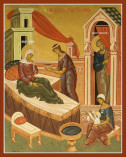 The holy Virgin Mary was born of her aged
parents, Joachim and Anna. Her father was of the tribe of David and her mother of the tribe of
Aaron, and so she was of royal blood from her father and priestly blood from her mother. By this,
she foreshadowed Him Who would be born of her as King and High Priest. Her parents were already
old and had no children, and because of this, were ashamed before men and humble before God. In
their humility, they prayed with tears that God would bring joy to their old age with the gift of
a child, as He had once given joy to the aged Abraham and Sarah, giving them their son Isaac.
God, almighty and all-seeing, gave them a joy far exceeding all their expectations and their
wildest dreams, for He gave them not just a daughter, but the Mother of God; He illumined them
not only with temporal joy but with eternal. God gave them just one daughter, who later gave them
just one grandson—but what a daughter and what a Grandson! Mary full of grace, blessed among
women, the temple of the Holy Spirit, altar of the living God, table of living bread, ark of
God’s holy things, tree of the most delicious fruits, glory of the human race, praise of
womanhood, fount of virginity and purity—this was the daughter given by God to Joachim and Anna.
Born in Nazareth, she was after three years taken to the Temple in Jerusalem, whence she returned
again to Nazareth and shortly afterwards heard the tidings of the holy Archangel Gabriel
concerning the birth of the Son of God, the Savior of the world, from her most pure and virginal
body.
The holy Virgin Mary was born of her aged
parents, Joachim and Anna. Her father was of the tribe of David and her mother of the tribe of
Aaron, and so she was of royal blood from her father and priestly blood from her mother. By this,
she foreshadowed Him Who would be born of her as King and High Priest. Her parents were already
old and had no children, and because of this, were ashamed before men and humble before God. In
their humility, they prayed with tears that God would bring joy to their old age with the gift of
a child, as He had once given joy to the aged Abraham and Sarah, giving them their son Isaac.
God, almighty and all-seeing, gave them a joy far exceeding all their expectations and their
wildest dreams, for He gave them not just a daughter, but the Mother of God; He illumined them
not only with temporal joy but with eternal. God gave them just one daughter, who later gave them
just one grandson—but what a daughter and what a Grandson! Mary full of grace, blessed among
women, the temple of the Holy Spirit, altar of the living God, table of living bread, ark of
God’s holy things, tree of the most delicious fruits, glory of the human race, praise of
womanhood, fount of virginity and purity—this was the daughter given by God to Joachim and Anna.
Born in Nazareth, she was after three years taken to the Temple in Jerusalem, whence she returned
again to Nazareth and shortly afterwards heard the tidings of the holy Archangel Gabriel
concerning the birth of the Son of God, the Savior of the world, from her most pure and virginal
body.
2. The Feast of the Kalishto Icon of the Holy Mother of God.
In the monastery of the most holy Mother of God near the village of Kalishto, to the west of Struga, the holy Mother of God revealed her power and mercy through numerous miracles. Many of the sick were miraculously healed, and robbers that intended plundering or desecrating the monastery were fiercely punished by an unseen power. The miraculous icon of the most holy Mother of God stands in the church, and nearby are two healing springs—of St. Peter and St. Ananias. Not far from the main church, in a cave, stands the chapel of St. Athanasius.
3. The Feast of the Pochaev Icon of the Holy Mother of God.
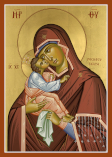 In the province of Volinsk there
stands the famous monastery of the Mother of God in Pochaev, where she first appeared in
about 1340 to two monks who were living the ascetic life in a cave. From that time, the
place became an inexhaustible fount of innumerable miracles. In the province of Volinsk there
stands the famous monastery of the Mother of God in Pochaev, where she first appeared in
about 1340 to two monks who were living the ascetic life in a cave. From that time, the
place became an inexhaustible fount of innumerable miracles.
|
FOR CONSIDERATION
St. Dionysius the Areopagite writes of the immeasurable joy, the outer and inner radiance and the indescribable fragrance that he sensed in the presence of the holy Mother of God when he visited her in Jerusalem. In his enthusiasm, he says that if he did not acknowledge the one, true God, he would acknowledge her, the holy Virgin Mary, as God. The holy Virgin made such a strong and deep impression even during her earthly life, and she received an incomparably greater power after her physical death when, by God’s will, she was exalted above the hosts of angels. Her power comes from her ceaseless prayer to God for the faithful, for all who turn to her for help. St. John of Novgorod, when he and his people prayed to her for help against an enemy army, knew that, at that moment, she was praying to God with tears for them, and Novgorod was miraculously saved. As she was in travail at the crucifixion of her Son, so she is in travail for all the weak who turn to her for help. It can be said that the whole earth is protected by the miracles of her mercy. There lives in Belgrade today a cafe proprietor, C.J., born in the village of Labunishte near Struga, whose mother took him, blind, to the monastery of Kalishto and where, after the priest had prayed over him before the icon of the holy Mother of God, he had received his sight. The first monk at Pochaev saw a flaming pillar stretching from earth to heaven, and in this flaming pillar he saw the holy Mother of God. She was standing on a rock, and a healing spring arose at that spot, and today gives healing to many of the sick.
Daily Scripture Readings taken from The Orthodox New Testament, translated and published by Holy Apostles Convent, Buena Vista, Colorado, copyright © 2000, used with permission, all rights reserved.
Daily Prologue Readings taken from The Prologue of Ochrid, by Bishop Nikolai Velimirovic, translated by Mother Maria, published by Lazarica Press, Birmingham, England, copyright © 1985, all rights reserved. Edited by Dormition Skete.