

Daily Devotional
Wednesday, September 17, 2025 (NS), September 4, 2025 (OS)
Fast Day, but Wine and Olive Oil Allowed.
Wednesday of the Fifteenth Week
4.The commemoration of Hieromartyr Babylas, Bishop of Antioch the Great, the holy Prophet Moses the God-seer, and Hierarch Ioasaph, Bishop of Belgorod.
Scripture Readings
Paschalion — Movable Calendar
Wednesday of the Fifteenth Week
Epistle
The Reading is from the Epistle of Saint Paul to the Galatians [§ 207].
3 15Brethren, I am speaking in accordance with human example: all the same, no one setteth aside or maketh additions to a man’s will which hath been ratified. 16Now the promises were spoken to Abraham and to his Seed. He saith not, “And to seeds,” as upon many; but as of One, “And to thy Seed [Gen. 13:15],” Who is Christ. 17And I say this: A covenant which hath been ratified before by God to Christ, the law, which hath come into being after four hundred and thirty years, doth not invalidate, so as to abolish the promise. 18For if the inheritance is by means of the law, it is no longer by means of a promise; but God hath graciously granted it to Abraham through a promise. 19Why then the law? It was added on account of transgressions, until the Seed should come to whom promise hath been made, having been disposed through angels in a Mediator’s hand. 20Now the Mediator is not of one, but God is one. 21Then is the law against the promises of God? May it not be! For if a law was given which was able to give life, verily righteousness would have been by means of the law. 22But the Scripture closed up all things under sin, in order that the promise by means of faith in Jesus Christ might be given to those who believe.
Gospel
The Reading is from the Holy Gospel according to Saint Mark [§ 23]. At that time:
6 7Jesus calleth to Himself His twelve disciples, and began to send them forth two by two; and He was giving them authority over the spirits, the unclean ones. 8And He commanded them that they may take nothing for the journey, except a staff only—no leathern pouch, no bread, no money in their belt; 9but be shod with sandals, and not to put on two tunics. 10And He was saying to them, “Wheresoever ye enter into a house, be lodging there until ye go forth from that place. 11“And as many as will not receive you, nor hear you, when ye go out from that place, shake off the dust which is under your feet, for a testimony to them. Verily I say to you, it shall be more tolerable for Sodom and Gomorrah in the day of judgment than for that city.” 12And they went out and proclaimed that all should repent. 13And they were casting out many demons, and anointing with oil many sick, and curing them.
Menaion — Fixed Calendar
4.The commemoration of Hieromartyr Babylas, Bishop of Antioch the Great, the holy Prophet Moses the God-seer, and Hierarch Ioasaph, Bishop of Belgorod.
Epistle
For the Hieromartyr and the Prophet:
For Gk. usage, see [Heb. 11:33-12:2]; for Sl. usage, see [Heb. 11:33-40].
The Reading is from the Epistle of Saint Paul to the Hebrews [§§ 330, 331]. Brethren:
11 33All the saints through faith struggled against kingdoms, wrought righteousness, attained to promises, stopped mouths of lions, 34quenched the power of fire, escaped the edges of the sword, were empowered out of weakness, became strong in battle, turned back encampments of aliens. 35Women received their dead by resurrection. And others were tortured, not accepting release, that they might attain a better resurrection. 36And others received trial of mockings and of scourgings, and, moreover, of bonds and of imprisonment. 37They were stoned, they were sawn asunder, were tempted; they died, murdered by the sword. They went about in sheepskins, in goatskins, being in need, afflicted, ill-treated— 38of whom the world was not worthy. They were made to wander in deserts, and in mountains, and in caves, and in the holes of the earth. 39And these all, having been approved by testimony through faith, received not for themselves the promise, 40God having foreseen some better thing concerning us, that they should not be made perfect without us.
12 1Therefore we also, having so great a cloud of witnesses which is set around us, and having laid aside every weight and sin that is easily circumvented, let us by means of patience be running the course which is set before us, 2looking to Jesus, the originator and accomplisher of our faith, Who, in exchange for the joy set before Him, endured a cross, having despised the shame, and hath sat down on the right of the throne of God.
For the Hierarch:
The Reading is from the Epistle of Saint Paul to the Hebrews [§ 318]. Brethren:
7 26Such a High Priest was fitting for us: holy, guileless, undefiled, Who hath been separated from the sinners and hath become higher than the heavens, 27Who hath no need daily, even as the high priests, to offer up sacrifices, first for his own sins, then for those of the people; for this He did once for all after He offered up Himself. 28For the law appointeth men high priests who have weakness; but the word of the oath, which is after the law, appointeth the Son, Who hath been perfected forever.
8 1Now in reference to the things being spoken of, the chief point is: We have such a High Priest, Who sat down on the right of the throne of the majesty in the heavens, 2a Liturgist of the holies and of the tabernacle, the true one, which the Lord pitched, and not man.
Gospel
For the Hieromartyr and the Prophet:
The Reading is from the Holy Gospel according to Saint Matthew [§ 38]. The Lord said to His disciples:
10 32“Everyone therefore who shall confess in Me before men, I also will confess in him before My Father Who is in the heavens. 33“But whosoever shall deny Me before men, him will I also deny before My Father Who is in the heavens. 34“Never think that I came to cast peace on the earth; I came not to cast peace, but a sword. 35“For I came to divide in two a man against his father, and a daughter against her mother, and a daughter-in-law against her mother-in-law; 36“and a man’s enemies shall be those of his own household. 37“The one who loveth father or mother more than Me is not worthy of Me; and the one who loveth son or daughter more than Me is not worthy of Me. 38“And whosoever taketh not his cross and followeth after Me is not worthy of Me. 39“The one who findeth his life shall lose it; and the one who loseth his life on account of Me shall find it. 40“The one who receiveth you receiveth Me, and the one who receiveth Me receiveth the One Who sent Me forth. 41“The one who receiveth a prophet in the name of a prophet shall receive a prophet’s reward; and the one who receiveth a righteous man in the name of a righteous man shall receive a righteous man’s reward. 42“And whosoever shall give to one of these little ones only a cup of cold water to drink in the name of a disciple, verily, I say to you, in no wise shall he lose his reward.”
11 1And it came to pass, when Jesus finished commanding His twelve disciples, He passed over from that place to teach and preach in their cities.
For Sl. usage, see [Lk. 12:32-40].
For the Hierarch:
The Reading is from the Holy Gospel according to Saint John [§ 36]. The Lord said to the Jews who had come to Him:
10 9“I am the door; by Me if anyone should enter, he shall be saved, and shall go in and go out and find pasture. 10“The thief cometh not, except that he might steal, and slay, and destroy. I came that they may have life, and may have it abundantly. 11“I am the good shepherd. The good shepherd layeth down his life for the sheep. 12“But the hireling, who indeed is not a shepherd, whose own the sheep are not, seeth the wolf coming, and leaveth the sheep and fleeth; and the wolf seizeth them and scattereth the sheep. 13“Now the hireling fleeth, because he is a hireling and careth not about the sheep. 14“I am the good shepherd; and I know those that are Mine, and am known of those that are Mine. 15“Even as the Father knoweth Me, I also know the Father; and I lay down My life for the sheep. 16“And I have other sheep which are not of this fold; them also it is needful for Me to bring, and they shall hear My voice; and there shall be one flock and one Shepherd.”
Lives of the Saints (Prologue)
September 17th – Civil Calendar
September 4th – Church Calendar
1. The Hieromartyr Babylas.
This ‘great and wonderful man, if one can call him a man,’ as St. John Chrysostom expresses it, was archbishop in Antioch in the time of the wicked Emperor Numerian. This Numerian made a peace-treaty with some barbarian king, who was of better character and a greater lover of peace than himself. As a sign of his sincere desire for a lasting peace, the king gave his little son to be brought up at Numerian’s court. One day, Numerian butchered the boy and offered him as a sacrifice to the idols. Still hot from his wicked shedding of innocent blood, this evildoer went to a Christian church to see what was happening there. Holy Babylas was at prayer with the people. He heard that the emperor was coming with his retinue and intended to enter the church. Babylas stopped the service, went out in front of the church and told the emperor that, as an idolater, he was not permitted entry to the holy church where the one, true God was worshipped. Speaking of Babylas, St. Chrysostom says: ‘Who else in the world would he fear, having with such authority withstood the emperor? By this he taught kings not to spread their power further than the measure given them by God, and also showed the clergy how to use their authority.’ The shamed emperor turned back, but planned revenge. The following day, the emperor summoned Babylas, and began to berate him and bid him to offer sacrifice to idols, which the saint, naturally, steadfastly refused to do. The emperor then bound him with chains and threw him into prison. He also tortured three children: Urban, aged twelve, Prilidian, aged nine and Hippolinus, aged seven. Babylas was their spiritual father and teacher, and they had stayed near him out of love for him. They were the sons of a Christian woman, Christodoula, who herself suffered for Christ. The emperor first ordered that each child be beaten with the number of blows that totaled his age, and then had them thrown into prison. Babylas, in bonds, was present at the beheading of the children, giving them courage, and then laid his honored head under the sword. He was buried by Christians, in the chains in which he was bound at his death, in one grave with the three children. Their holy souls flew off to the company of heaven, and their wonder-working relics remained to be of support to the faithful, along with the enduring witness of their heroism in the Faith. They suffered in about 283.
2. The Holy Prophet Moses, who beheld God.
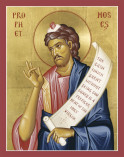 A great leader and lawgiver of Israel, he was born in Egypt
in about 1550 B.C. He spent forty years in Egypt at Pharaoh’s court, forty years as a
shepherd in meditation on God and the world, and his last forty years he led the people
through the wilderness to the Promised Land, which he saw but did not enter, having at one
time sinned against God (Numbers 20:12). He entered into rest at the age of a hundred and
twenty. He appeared from the other world on Tabor at the Lord’s Transfiguration, and
according to the testimony of St. John of the Ladder, appeared to the monks of Sinai. A great leader and lawgiver of Israel, he was born in Egypt
in about 1550 B.C. He spent forty years in Egypt at Pharaoh’s court, forty years as a
shepherd in meditation on God and the world, and his last forty years he led the people
through the wilderness to the Promised Land, which he saw but did not enter, having at one
time sinned against God (Numbers 20:12). He entered into rest at the age of a hundred and
twenty. He appeared from the other world on Tabor at the Lord’s Transfiguration, and
according to the testimony of St. John of the Ladder, appeared to the monks of Sinai.
|
FOR CONSIDERATION
The power of the saints after their death is much stronger than during their lifetime. ‘This is why God has left us the relics of the saints,’ says St. Chrysostom in a matchless sermon on St. Babylas. Babylas was buried in Antioch. At that time, the Emperor Gallius, brother of Julian the Apostate, was reigning in harness along with Constantine’s son, Constantius. Urged by a sense of devotion, Gallius brought Babylas’ relics to the outskirts of Daphne, built a small church there and placed the martyr’s relics in it. There was a famous temple of Apollo in Daphne, built on the place where, according to a pagan legend, a young girl turned into a tree (daphni—laurel), to save herself from the god Apollo, who was pursuing her with uncontrollable lust. The idol of Apollo stood here, and was reputed to tell the future to all who consulted it. From the time that Babylas’ relics were buried near the temple, the demon in the idol remained silent and stopped prophesying. When the Emperor Julian the Apostate later set out on his ruinous war against the Persians, he came to this temple to consult the idol on its outcome. The idol replied timidly that it could not give a clear answer ‘because of the dead’ buried in the vicinity. This referred to Babylas, the presence of whose body had silenced the demon. Julian ordered that Babylas’ relics be taken back to Antioch. As soon as the martyr’s relics were removed, fire fell from heaven and consumed the temple of Apollo, destroying it for all time. Julian marched against the Persians, and died a terrible death in punishment for his blasphemous life. Such was the power of the martyr of Christ after his death: he silenced demons and called down fire from heaven to destroy the idolatrous temple, and the godless, apostate emperor was punished with a dishonorable death.
Daily Scripture Readings taken from The Orthodox New Testament, translated and published by Holy Apostles Convent, Buena Vista, Colorado, copyright © 2000, used with permission, all rights reserved.
Daily Prologue Readings taken from The Prologue of Ochrid, by Bishop Nikolai Velimirovic, translated by Mother Maria, published by Lazarica Press, Birmingham, England, copyright © 1985, all rights reserved. Edited by Dormition Skete.