

Daily Devotional
Wednesday, August 13, 2025 (NS), July 31, 2025 (OS)
Fast Day. No Meat, Fish, Dairy, Eggs, Alcohol or Olive Oil Allowed.
Wednesday of the Tenth Week
The commemoration of the holy and Righteous Evdokimos, and the Forefeast of the Procession of the precious Cross.
Scripture Readings
Paschalion — Movable Calendar
Wednesday of the Tenth Week
Epistle
The Reading is from the First Epistle of Saint Paul to the Corinthians [§ 165]. Brethren:
16 4If it be worthy for me also to go, they shall go with me. 5But I will come to you whenever I pass through Macedonia; for I am passing through Macedonia. 6And it may be that I will stay, or even spend the winter with you, that ye may send me forth wheresoever I may go. 7For I am not intending to see you while passing by; but I am hoping to tarry a certain time with you, if the Lord permit. 8But I will tarry in Ephesus until the Pentecost. 9For a great and effectual door hath opened to me, and they who oppose are many.
10Now if Timothy should come, be seeing to it that he might be with you without fear; for he worketh the work of the Lord, even as I do. 11Let no one therefore despise him. But send him forth in peace, that he might come to me; for I await him with the brethren. 12Now concerning our brother Apollos, I besought him much that he should come to you with the brethren; but it was not at all his will that he should come now, but he will come whenever he should have opportunity.
Gospel
The Reading is from the Holy Gospel according to Saint Matthew [§ 86]. The Lord said this parable:
21 28“A certain man had two children, and he came to the first and said, ‘Child, go today and work in my vineyard.’ 29“And he answered and said, ‘I will not’; but afterward he felt regret and went forth. 30“And he came to the second and spoke in like manner. And he answered and said, ‘I go, sir’; and he went not forth. 31“Which of the two did the will of the father?” They say to Him, “The first.” Jesus saith to them, “Verily I say to you that the tax collectors and the harlots go into the kingdom of God before you. 32“For John came to you in the way of righteousness, and ye believed him not; but the tax collectors and the harlots believed him; and ye, having seen, felt no regret afterward in order to believe him.”
Menaion — Fixed Calendar
The commemoration of the holy and Righteous Evdokimos, and the Forefeast of the Procession of the precious Cross.
Epistle
For the Righteous one:
The Reading is from the Epistle of Saint Paul to the Romans [§ 97]. Brethren:
8 14As many as are led by the Spirit of God, these are sons of God. 15For ye did not receive a spirit of bondage again to fear, but ye received a Spirit of adoption, whereby we cry, “Abba, Father.” 16The Spirit Himself beareth witness with our spirit, that we are children of God: 17And if children, also heirs—on the one hand heirs of God, on the other hand joint-heirs of Christ, if indeed we suffer with Him, in order that we might also be glorified together. 18For I reckon that the sufferings of the present time are not worthy in comparison to the future glory to be revealed in us. 19For the earnest expectation of the creation eagerly awaiteth the revelation of the sons of God. 20For creation was subjected to vanity, not willingly, but on account of Him Who subjected it in hope, 21that the creation itself also shall be freed from the bondage of corruption into the glorious freedom of the children of God.
for Sl. usage, see [Gal. 5:22-6:2].
Gospel
For the Righteous one:
The Reading is from the Holy Gospel according to Saint Luke [§ 36]. The Lord said:
8 16“No one, having lit a lamp, covereth it with a vessel or putteth it underneath a bed, but placeth it upon a lampstand, that they who enter in may see the light. 17“For nothing is secret which shall not become manifest, nor hidden that shall not be known and come to light. 18“Be taking heed then how ye hear: for whosoever hath, it shall be given to him; and whosoever hath not, even what he seemeth to have shall be taken away from him.”
19And His Mother and brethren came to Him, and were not able to meet with Him on account of the crowd. 20And it was reported to Him by some who said, “Thy Mother and Thy brethren are standing outside, wishing to see Thee.” 21And He answered and said to them, “My mother and My brethren are these who hear the word of God and do it.”
for Sl. usage, see [Mt. 11:27-30].
Lives of the Saints (Prologue)
August 13th – Civil Calendar
July 31st – Church Calendar
1. St. Evdokimos (Eudocimus).
He was born in Cappadocia of devout parents, Basil and Evdokia. In the time of the Emperor Theophilus (829-842), Evdokimos was a young army officer. Even as a soldier, he endeavored with his whole heart to live according to the precepts of the Gospel. He kept his purity unstained and avoided converse with any woman except his mother. He was liberal to the poor, assiduous in the reading of holy books and yet more assiduous in prayer to God. He fled vain chatter and idle talk. ‘Among all the chaos and vanity of the world, he was like a lily among thistles, and like gold in the furnace.’ For his rare virtues, the emperor made him military governor of Cappadocia. In this high state, Evdokimos strove to be righteous before God and man. By God’s providence, he died early, at the age of thirty-three, and his relics were found to have healing power. An insane man touched his tomb and was healed, and a paralytic child stood upright and was made whole. After eighteen months, his mother opened his coffin, and found his body as though still alive, with no mark of corruption—and a wonderful fragrance arose from the saint’s body. His relics were later translated to Constantinople and buried in the new church of the holy Mother of God, built by Evdokimos’ parents.
2. The Holy Martyr Julitta.
From Caesarea in Cappadocia, she was involved in a quarrel with her neighbor over some land. The neighbor went to the judge and denounced her as a Christian, which put her at that time outside the protection of the law. St. Julitta was more willing to give up her land than her faith. But the wicked pagans were not willing even then to leave her in peace, but tortured her and finally burned her, in the year 303. Thus this handmaid of Christ sacrificed both her lands and her body for the sake of the eternal salvation of her soul.
3. St. Joseph of Arimathea.
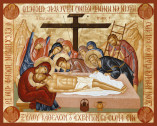 Noble Joseph, a rich man, a member of the Jewish sanhedrin and a secret
follower of Christ (Matt. 27:57; Jn 19:38), took Christ’s body down from the Cross
together with Nicodemus, and laid it in his own new tomb. For this, he was fettered by the
Jews and cast into prison. The risen Lord appeared to him and brought him to belief in His
Resurrection. The Jews then released him from prison and drove him from his fatherland. He
travelled around the world, preaching the Gospel of Christ, and took this Good News to
England, where he entered into rest in the Lord. Noble Joseph, a rich man, a member of the Jewish sanhedrin and a secret
follower of Christ (Matt. 27:57; Jn 19:38), took Christ’s body down from the Cross
together with Nicodemus, and laid it in his own new tomb. For this, he was fettered by the
Jews and cast into prison. The risen Lord appeared to him and brought him to belief in His
Resurrection. The Jews then released him from prison and drove him from his fatherland. He
travelled around the world, preaching the Gospel of Christ, and took this Good News to
England, where he entered into rest in the Lord.
|
4. St. John (Ioan) the Exarch.
A well-known Bulgarian priest and theologian in the time of the Emperor Simeon (893-927), he translated St. Basil’s ‘On the Six Days of Creation’ and St. John of Damascus’ ‘Exact Exposition of the Orthodox Faith’ into Slavonic. He entered peacefully into rest in the Lord.
FOR CONSIDERATION
Ascetics in the desert labor to break their own wills and live according to the will of God. Some may think, mistakenly, that a hermit lives completely alone. No hermit thinks that. He lives in the company of God and of His angels, and of the departed saints. Where a man’s mind is, there is his life. A hermit’s mind is set on the greatest, most pure and most numerous company in which a man can be. Once, Abba Mark reproached St. Arsenius the hermit thus: ‘For what cause do you flee our society and discourse?’ Arsenius replied: ‘God knows that I love you, but it is not possible to be with God and with men. In heaven, thousand upon thousand have but one will, but the wills of men are many and varied. That is why I cannot leave God and be with men.’
Daily Scripture Readings taken from The Orthodox New Testament, translated and published by Holy Apostles Convent, Buena Vista, Colorado, copyright © 2000, used with permission, all rights reserved.
Daily Prologue Readings taken from The Prologue of Ochrid, by Bishop Nikolai Velimirovic, translated by Mother Maria, published by Lazarica Press, Birmingham, England, copyright © 1985, all rights reserved. Edited by Dormition Skete.