

Daily Devotional
Friday, August 8, 2025 (NS), July 26, 2025 (OS)
Fast Day. No Meat, Fish, Dairy, Eggs, Alcohol or Olive Oil Allowed.
Friday of the Ninth Week
The commemoration of Hieromartyr Hermolaos and the Martyrs Hermippos and Hermocrates at Nicomedia, and the righteous Martyr Paraskeve of Rome.
Scripture Readings
Paschalion — Movable Calendar
Friday of the Ninth Week
Epistle
The Reading is from the First Epistle of Saint Paul to the Corinthians [§ 157]. Brethren:
14 26Whenever ye come together, each one of you hath a psalm, hath a teaching, hath a tongue, hath a revelation, hath an interpretation. Let all things be done with a view to edify. 27If anyone speak in a tongue, let it be by two or at the most three, and in turn, and let one interpret. 28But if there be no interpreter, let him keep silent in church; and let him speak to himself and to God. 29And let two or three prophets speak, and let the others discern. 30But if anything should be revealed to another sitting by, let the first keep silent. 31For ye can all prophesy one by one, that all may learn and all may be comforted. 32And the spirits of prophets are subject to prophets. 33For God is not a God of confusion, but of peace, as in all the churches of the saints.
34Let your women keep silent in the churches; for it hath not been permitted to them to speak, but to be subordinate, even as also saith the law. 35And if they wish to learn anything, let them inquire of their own husbands at home; for it is shameful for women to speak in church. 36Or did the word of God come forth from you? Or did it come down only to you? 37If anyone think to be a prophet or spiritual, let him acknowledge what I write to you, that they are commandments of the Lord. 38But if any be ignorant, let him be ignorant. 39Therefore, brethren, keep on being zealous to prophesy, and cease forbidding to speak in tongues. 40Let all things be done decently and according to order.
Gospel
The Reading is from the Holy Gospel according to Saint Matthew [§ 83]. At that time:
21 12Jesus entered into the temple of God and cast out all those who sold and bought in the temple, and overthrew the tables of the money changers, and the seats of those who sold the doves. 13And He saith to them, “It hath been written: ‘My house shall be called a house of prayer [Is. 56:7]’; but ye made it ‘a den of robbers [Jer. 7:11].’” 14And the blind and lame came to Him in the temple; and He cured them. 15But after the chief priests and the scribes saw the wonders which He did, and the children crying out in the temple and saying, “Hosanna, to the Son of David,” they were indignant, 16and said to Him, “Hearest Thou what these say?” And Jesus saith to them, “Yes; did ye never read, ‘Out of the mouth of babes and sucklings Thou hast perfected praise for Thyself [Ps. 8:2]’?” 17And He left them behind and went out of the city to Bethany, and He lodged there.
18Now in the morning as He returned into the city, He hungered. 19And having seen a single fig tree in the way, He came to it and found nothing on it, except leaves only, and said to it, “Let there be no more fruit from thee forever.” And forthwith the tree was withered. 20And after the disciples saw it, they wondered, saying, “How was the fig tree withered forthwith?”
Menaion — Fixed Calendar
The commemoration of Hieromartyr Hermolaos and the Martyrs Hermippos and Hermocrates at Nicomedia, and the righteous Martyr Paraskeve of Rome.
Epistle
For the Hieromartyr:
The Reading is from the First Epistle of Saint Paul to Saint Timothy [§ 284]. Child Timothy:
For Gk. usage, see 1 Tim. 3:13-4:5; for Sl. usage, see 1 Tim. 3:14-4:5.
3 13They who have served well as deacons acquire a good degree for themselves and much boldness in faith which is in Christ Jesus.
14These things I write to thee, hoping to come to thee more quickly. 15But if I delay, I write in order that thou mayest know how one ought to be conducting oneself in the house of God, which is the Church of the living God, pillar and stay of the truth. 16And confessedly, great is the mystery of piety: God was manifested in the flesh, justified in the Spirit, seen by angels, proclaimed among the nations, believed on in the world, taken up in glory.
4 1Now the Spirit speaketh expressly that in latter times some shall apostatize from the faith, giving heed to deceiving spirits and teachings of demons, 2speaking lies in hypocrisy, having been branded as to their own conscience, 3forbidding to marry, bidding to abstain from foods, which God created for partaking with giving of thanks by the faithful and those who have fully known the truth. 4For every creature of God is good, and nothing is to be cast away, if it is received with giving of thanks; 5for it is sanctified by the word of God and intercessory prayer.
For the righteous Martyr:
The Reading is from the Epistle of Saint Paul to the Galatians [§§ 208, 209]. Brethren:
3 23Before faith came, we were being guarded under the law, having been closed up to the faith about to be revealed. 24Therefore the law hath become our tutor until Christ, in order that we might be justified by faith. 25But faith having come, we are no longer under a tutor. 26For all are sons of God through faith in Christ Jesus. 27For as many as were baptized into Christ, ye put on Christ. 28There is neither Jew nor Greek, there is neither slave nor free, there is neither male and female; for ye are all one in Christ Jesus. 29And if ye are Christ’s, then are ye Abraham’s seed, and heirs according to promise.
4 1Now I say, as long as the heir is an infant, he differeth nothing from a slave, though he is lord of all; 2but he is under guardians and stewards until the appointed time of the father. 3So we also, when we were infants, were enslaved under the elements of the world. 4But when the fullness of the time came, God sent forth His Son, born of a woman, born under the law, 5in order that He might redeem those under the law, that we might receive what is our due, the adoption as sons.
Gospel
No reading given.
Lives of the Saints (Prologue)
August 8th – Civil Calendar
July 26th – Church Calendar
1. The Hieromartyr Hermolaus.
He was a priest in Nikomedia in the time of the Emperor Maximian, and was with the twenty thousand martyrs condemned by the emperor to be burned in their church (see December 28th). Hermolaus somehow escaped death on that occasion, together with two other priests, Hermippus and Hermocrates. Hermolaus baptized St. Panteleimon, with whom he was brought to trial, tortured and finally beheaded. Hermippus and Hermocrates suffered with them, and they were all crowned with wreaths of victory and glory in the kingdom of Christ. They suffered with honor in about 304.
2. Our Holy Mother, the Martyr Paraskeve.
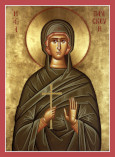 Born in Rome of Christian parents, she was brought
up from her earliest youth in the Christian Faith and gave herself wholeheartedly to the
fulfilling of God’s commandments in her life. She brought others to the Faith by means of
her true and deep faith and devout life. When her parents died, Paraskeve gave all her goods away
to the poor and received the monastic schema. As a nun, she preached the truth of Christ with
ever more burning zeal, not hiding from anyone, even though the Christian Faith was at that time
subject to bloody persecution by the Roman authorities. Wicked Jews denounced Paraskeve for
preaching a forbidden faith, and she was brought to trial before the Emperor Antoninus. All the
emperor’s flattery was unavailing in shaking the faith of this servant of God. She was then
put to torture by fire, and a white-hot helmet was placed on her head, but God saved her
miraculously and she escaped and left Rome. She again began to go from city to city, there to
bring the pagan people to the true Faith. In two more cities she was brought before princes and
judges, and tortured for her Lord, performing on these occasions great miracles by the power of
God and quickly recovering from her wounds. The pagans, as ever, called her miracles magic, and
ascribed her recovery to the power and mercy of their gods. St. Paraskeve once said to a prince
who was torturing her: ‘It is not your gods, O prince, who heal me, but my Christ, the true
God.’ She was finally beheaded by a Prince Tarasios. Thus gloriously ended the fruitful
life of this holy woman. Her relics were later taken to Constantinople. She suffered for Christ
in the second century.
Born in Rome of Christian parents, she was brought
up from her earliest youth in the Christian Faith and gave herself wholeheartedly to the
fulfilling of God’s commandments in her life. She brought others to the Faith by means of
her true and deep faith and devout life. When her parents died, Paraskeve gave all her goods away
to the poor and received the monastic schema. As a nun, she preached the truth of Christ with
ever more burning zeal, not hiding from anyone, even though the Christian Faith was at that time
subject to bloody persecution by the Roman authorities. Wicked Jews denounced Paraskeve for
preaching a forbidden faith, and she was brought to trial before the Emperor Antoninus. All the
emperor’s flattery was unavailing in shaking the faith of this servant of God. She was then
put to torture by fire, and a white-hot helmet was placed on her head, but God saved her
miraculously and she escaped and left Rome. She again began to go from city to city, there to
bring the pagan people to the true Faith. In two more cities she was brought before princes and
judges, and tortured for her Lord, performing on these occasions great miracles by the power of
God and quickly recovering from her wounds. The pagans, as ever, called her miracles magic, and
ascribed her recovery to the power and mercy of their gods. St. Paraskeve once said to a prince
who was torturing her: ‘It is not your gods, O prince, who heal me, but my Christ, the true
God.’ She was finally beheaded by a Prince Tarasios. Thus gloriously ended the fruitful
life of this holy woman. Her relics were later taken to Constantinople. She suffered for Christ
in the second century.
3. Our Holy Father Moses (Moisey) the Hungarian.
He was at the court of the young Prince Boris of Russia. Then, when the godless Svyatopolk murdered Boris, Moses escaped and fled to Kiev. A little later, he was taken to Poland as a slave by King Boleslav, and sold for 1,000 gold pieces to a young and depraved widow, the wife of one of Boleslav’s dead generals. This wicked woman tried to turn Moses to debauchery, but he would not be turned, having vowed to live chastely before the Lord. She then suggested marriage to him, but he refused. Moses secretly received monastic profession from a monk of the Holy Mountain, and appeared before his owner in his monastic schema. She bound him, and ordered that he be flogged and his private parts cut off. He spent five full years in hopeless enslavement to this evil woman, five years of pain and torture. But suddenly King Boleslav perished in a rebellion, in which this woman was also killed. Then Moses was free to go back to Kiev, where, with St. Anthony, he gave himself to prayer and silence. Overcoming all his vices, he helped many to free themselves from theirs; and his holy relics helped many (see the life of St. John the Long-suffering on July 18th). After ten years of silence in the Caves, St. Moses entered into rest on July 26th, 1043, and went to the eternal and virginal kingdom of Christ.
FOR CONSIDERATION
No passion is overcome without a great struggle. The holy fathers called the passion of concupiscence a mortal passion. When a dissolute man is saved from this passion, he is like a dead man raised to life. For those who live in the world, this passion is roused mainly through sight, but for those living in the desert it is roused mainly through thought and imagination. St. Sarah, that great ascetic, was tormented by the passion of lust for thirty years in the desert. She always succeeded, through prayer, in overcoming it and driving it from her. Once, this passion appeared to her in bodily form, and said to her: ‘You have overcome me, Sarah!’ Sarah humbly replied: ‘It is not I who have overcome you, but the Lord Christ.’ And, from that time, lustful thoughts left her forever. When St. Poemen was asked how a man could fight against lustful passions, he replied: ‘If a man guards his stomach and his tongue, he will be able to conquer himself.’ St. Anthony says that there are in the body three kinds of impulse: ‘...one natural, one from lack of restraint in food, and one from the demons’. Others have, further, spoken of lust taking its strength from anger and pride. But they were all in agreement that, alongside man’s sobriety and toil, God’s help is essential for a man to uproot the passion entirely. That it is possible for a man to keep himself pure is witnessed, among many others, by St. Moses the Hungarian, who lived fifty years in the world and ten in a monastery, sixty years in all, in utter, virginal purity.
Daily Scripture Readings taken from The Orthodox New Testament, translated and published by Holy Apostles Convent, Buena Vista, Colorado, copyright © 2000, used with permission, all rights reserved.
Daily Prologue Readings taken from The Prologue of Ochrid, by Bishop Nikolai Velimirovic, translated by Mother Maria, published by Lazarica Press, Birmingham, England, copyright © 1985, all rights reserved. Edited by Dormition Skete.