

Daily Devotional
Wednesday, July 23, 2025 (NS), July 10, 2025 (OS)
Fast Day, but Wine and Olive Oil Allowed.
Wednesday of the Seventh Week
The commemoration of the deposition of the Robe of our Lord in Moscow, and the 45 Martyrs of Nicopolis in Armenia, and our venerable Father Anthony of the Kiev Caves, first of all the monks of Russia.
Scripture Readings
Paschalion — Movable Calendar
Wednesday of the Seventh Week
Epistle
The Reading is from the First Epistle of Saint Paul to the Corinthians [§ 137]. Brethren:
7 12If any brother hath an unbelieving wife, and she consenteth to dwell with him, let him not leave her. 13And a woman who hath an unbelieving husband, and he consenteth to dwell with her, let her not leave him. 14For the unbelieving husband hath been sanctified in the wife, and the unbelieving wife hath been sanctified in the husband; for otherwise then your children are unclean, but now they are holy. 15But if the unbelieving separate himself, let him separate himself. The brother or sister hath not been placed under bondage in such cases. But God hath called us in peace. 16For how knowest thou, O wife, whether thou shalt save thy husband? Or how knowest thou, O husband, whether thou shalt save thy wife? 17Only as God distributed to each, as the Lord hath called each, so let him be walking. And thus I prescribe in all the churches. 18Was anyone called who hath been circumcised? Let him not become uncircumcised. Was anyone called in uncircumcision? Let him not be circumcised. 19Circumcision is nothing, and uncircumcision is nothing, but keeping the commandments of God. 20Each one in the calling in which he was called, in this let him abide. 21Wast thou called being a slave? Let it not be a care to thee; but if thou art able to become free, use it rather. 22For he who is called in the Lord, being a slave, is the Lord’s freedman; and likewise also he who is called, being free, is a slave of Christ. 23Ye were bought with a price; cease making yourselves slaves of men. 24Wherein each was called, brethren, in this let him abide with God.
Gospel
The Reading is from the Holy Gospel according to Saint Matthew [§ 60]. At that time:
14 35After the men of that place recognized Jesus, they sent out into all that country round about, and brought to Him all those who were ill. 36And they besought Him that they might only touch the fringe of His garment; and as many as touched were made to recover.
15 1Then the scribes and Pharisees from Jerusalem came to Jesus, saying, 2“Why do Thy disciples transgress the tradition of the elders? For they do not wash their hands whenever they eat bread.” 3And He answered and said to them, “Why do ye also transgress the commandment of God on account of your tradition? 4“For God commanded, saying, ‘Be honoring thy father and thy mother [Ex. 20:12]’; and, ‘the one who speaketh evil of father or mother, let him come to an end by death [cf. Ex. 21:16].’ 5“But ye say, ‘Whosoever shall say to his father or his mother, “Whatsoever thou mightest be profited by me is a votive gift”—then in no wise shall he be bound to honor his father or his mother’; 6“and thus ye invalidate the commandment of God on account of your tradition. 7“Hypocrites! Well did Esaias prophesy concerning you, saying, 8“‘This people draweth nigh to Me with their mouth, and honoreth Me with their lips, but their heart is far from Me. 9“‘And in vain they reverence Me, teaching as precepts the commandments of men [cf. Is. 29:13].’” 10And He called the crowd and said to them, “Be ye hearing and understanding: 11“Not that which entereth into the mouth defileth the man; but that which goeth forth out of the mouth, this defileth the man.”
Menaion — Fixed Calendar
The commemoration of the deposition of the Robe of our Lord in Moscow, and the 45 Martyrs of Nicopolis in Armenia, and our venerable Father Anthony of the Kiev Caves, first of all the monks of Russia.
Epistle
For the Robe:
The Reading is from the First Epistle of Saint Paul to the Corinthians [§ 125]. Brethren:
1 18The word, that of the Cross, on the one hand, to those who are perishing is foolishness, but on the other hand, to us who are being saved, it is the power of God. 19For it hath been written: “I will destroy the wisdom of the wise, and will set at nought the comprehension of the intelligent [cf. Is. 29:14].” 20Where is the wise? Where is the scribe? Where is the disputer of this age? Did not God make foolish the wisdom of this world? 21For since, in the wisdom of God, the world knew not God through its wisdom, it pleased God through the foolishness of the preaching to save those who believe. 22For indeed, Jews ask for a sign, and Greeks seek wisdom; 23but we proclaim Christ Who hath been crucified, to Jews, on the one hand, a stumbling block, and to Greeks, on the other hand, foolishness, 24but to those who are called, both Jews and Greeks, Christ, God’s power and God’s wisdom.
For the venerable Father:
The Reading is from the Epistle of Saint Paul to the Galatians [§ 213]. Brethren:
5 22The fruit of the Spirit is love, joy, peace, long-suffering, kindness, goodness, faith, 23meekness, self-control; against such things there is no law. 24But they who are of the Christ crucified the flesh with the passions and the lusts. 25If we live by the Spirit, let us also be walking by the Spirit. 26Let us not become vainglorious, provoking one another, envying one another.
6 1Brethren, even if a man should be overtaken in some transgression, ye, the spiritual ones, be restoring such a one in the spirit of meekness, looking out for thyself, lest thou also be tempted. 2Keep on bearing one another’s burdens, and thus fill up the law of the Christ.
Gospel
In the Orthros
For the Lord’s Robe:
The Reading is from the Holy Gospel according to Saint Matthew [§ 112]. At that time:
27 27The soldiers of the governor took Jesus with them into the Prætorium, and gathered together the whole cohort against Him. 28And they stripped Him and put around Him a scarlet cloak. 29And after they plaited a crown of thorns, they put it upon His head, and a reed in His right hand. And having fallen on their knees before Him, they kept on mocking Him and saying, “Hail, King of the Jews!” 30And they spit upon Him, and took the reed and kept on striking Him on His head. 31And when they mocked Him, they took the cloak off Him and put His own garments on Him, and led Him away in order to crucify Him. 32And as they came out, they found a man, a Cyrenian, by name Simon. This one they impressed into service, in order that he might take up His Cross.
In the Liturgy
For the Lord’s Robe:
The Reading is from the Holy Gospel according to Saint Mark [§ 67]. At that time:
15 16The soldiers led Jesus away inside the court, which is the Prætorium, and they called together all the cohort. 17And they clothed Him with purple. And having plaited a crown of thorns, they put it on Him, 18and began to salute Him, “Hail, King of the Jews!” 19And they kept on striking His head with a reed and spitting on Him; and bowing their knees, they were making obeisance to Him. 20And when they mocked Him, they took the purple off Him, and put His own garments on Him; and they lead Him out in order that they might crucify Him. 21And they impress into service one Simon a Cyrenian—the father of Alexander and Rufus—as he passed by coming from a field, in order that he might take up His Cross.
22And they bring Him to a place, Golgotha, which is, being interpreted, Place of a Skull. 23And they were attempting to give Him wine having been flavored with myrrh, but He did not take it. 24And having crucified Him, they were dividing among themselves His garments, casting a lot upon them, to determine who should take what. 25And it was the third hour, and they crucified Him. 26And the inscription of His accusation had been written above: “The King of the Jews.” 27And with Him they crucify two robbers, one on the right and one on His left. 28And the Scripture was fulfilled which saith, “And He was reckoned with the lawless [Is. 53:12].” 29And those passing by blasphemed Him, shaking their heads and saying, “Ha! Thou Who destroyest the temple and buildest it in three days! 30“Save Thyself, and come down from the Cross.” 31And in like manner also the chief priests, mocking with the scribes, were saying to one another, “Others He saved, Himself He is not able to save. 32“Let the Christ, the King of Israel, come down now from the Cross, in order that we might see and believe on Him.”
For the venerable Father:
The Reading is from the Holy Gospel according to Saint Matthew [§ 10]. At that time:
4 25Great crowds followed Jesus from Galilee, and Decapolis, and Jerusalem, and Judæa, and beyond the Jordan.
5 1And seeing the crowds, He went up into the mountain; and after He sat down, His disciples came to Him. 2And He opened His mouth and began to teach them, saying:
3“Blessed are the poor in spirit, for theirs is the kingdom of the heavens.
4“Blessed are they who mourn, for they shall be comforted.
5“Blessed are the meek, for they shall inherit the earth.
6“Blessed are they who hunger and thirst after righteousness, for they shall be filled.
7“Blessed are the merciful, for they shall find mercy.
8“Blessed are the pure in heart, for they shall see God.
9“Blessed are the peacemakers, for they shall be called sons of God.
10“Blessed are they who have been persecuted on account of righteousness, for theirs is the kingdom of the heavens.
11“Blessed are ye whenever they reproach you and persecute you, and say every evil word against you falsely on account of Me.
12“Be rejoicing and be exceedingly glad, for your reward is great in the heavens. For so they persecuted the prophets who were before you.”
Lives of the Saints (Prologue)
July 23rd – Civil Calendar
July 10th – Church Calendar
1. The Forty-Five Holy Martyrs: Leontius, Maurice, Alexander, Sisinius and the rest.
In the time of the wicked Emperor Licinius, who ruled over the eastern half of the Roman Empire, there was a great persecution of Christians. In Armenian Nicopolis, Leontius came before the imperial governor, Lysius, together with several of his friends, and told him that he was a Christian. ‘And where is your Christ?’ asked Lysius. ‘Was He not crucified and did He not die?’ To this, St. Leontius replied: ‘If you know that our Christ died, know that He also rose from the dead and ascended into heaven.’ After much harassment for their faith, Lysius had them whipped and thrown into prison, where they were given neither food nor drink. A noble Christian woman, Viassiana, brought them water and gave it to them through the window of the prison, and an angel of God appeared to them there, to comfort and encourage them. When their trial was held, two of their warders came before Lysius as Christian converts, and many others, numbering forty-five in all. The judge condemned them all to death, ordering that their arms and legs be hacked off and that they then be thrown into the flames. This vicious punishment was carried out, and the souls of the holy martyrs flew off to their Lord, to eternal life. They suffered with honor and inherited the kingdom in the year 319.
2. Our Holy Father Anthony of the Kiev Caves.
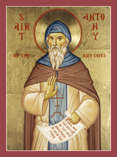 The renewer and father of monasticism in
Russia, he was born in a little place called Lubetch, near Chernigov. He left his home while
still a boy and went to the Holy Mountain, where he became a monk and lived in asceticism at
Esphigmenou. In response to a vision, the abbot sent him to Russia, to found the monastic life
there. He chose a cave near Kiev. When a group of men desiring the monastic life settled round
him, he installed Theodosius (Feodosy) as their abbot and himself remained in his cave in
silence. By the grace of God, the monastery grew and became the mother of Russian monasticism.
Anthony endured much evil from men and from demons, but he overcame all by his meekness. He had a
great gift of discernment, and was able to heal the sick. He went to the Lord in 1073 at the age
of ninety, leaving his spiritual nursery, which would, through the ages, yield good fruit for the
Orthodox peoples of Russia.
The renewer and father of monasticism in
Russia, he was born in a little place called Lubetch, near Chernigov. He left his home while
still a boy and went to the Holy Mountain, where he became a monk and lived in asceticism at
Esphigmenou. In response to a vision, the abbot sent him to Russia, to found the monastic life
there. He chose a cave near Kiev. When a group of men desiring the monastic life settled round
him, he installed Theodosius (Feodosy) as their abbot and himself remained in his cave in
silence. By the grace of God, the monastery grew and became the mother of Russian monasticism.
Anthony endured much evil from men and from demons, but he overcame all by his meekness. He had a
great gift of discernment, and was able to heal the sick. He went to the Lord in 1073 at the age
of ninety, leaving his spiritual nursery, which would, through the ages, yield good fruit for the
Orthodox peoples of Russia.
3. The Translation of the Precious Vesture of our Lord Jesus Christ.
At the time of our Lord’s suffering for the human race, there was to be found in the ranks of the Roman army in Jerusalem a Georgian, Elias, from the town of Mtskheta. His mother had heard of Christ, and believed in Him in her heart. Sending her son into the army in Palestine, she exhorted him to do nothing against Christ. When the Lord was nailed to the Cross, the sound of the hammering on Golgotha came to the ears of Elias’ mother in Mtskheta. Hearing this sound, she cried out: ‘Woe is me that I did not die before this hour, that death might deliver me from this terrible sound!’ And, thus saying, she fell dead. Elias was at that time underneath the Cross, and with the other soldiers, was casting lots for Christ’s vesture. The vesture fell to him, and he took it to Mtskheta, making a gift of it to his sister Sidonia. She, hearing of the Lord’s death and learning that her brother had a hand in the shedding of innocent blood, fell dead with the Lord’s vesture in her hands, in such a way that no one could take it from her and they were constrained to bury it with her. A cedar grew up over her grave, from which flowed a healing myrrh. In time, the cedar fell and the place was forgotten. St. Nina found it by the aid of a pillar of fire on that spot, in response to her prayers. King Mirian, when he had been baptized, built a church there to the Holy Apostles. In 1625, Shah Abbas took this vesture and sent it to Moscow as a gift to Prince Michael Feodorovich and Patriarch Philaret. The vesture was then placed in the Cathedral of the Dormition in Moscow.
FOR CONSIDERATION
The thought of death is like a cold shower that quenches the coals of passion. The psalmist says: ‘For when he dieth he shall carry nothing away for himself, nor shall his glory descend with him (Ps. 48:17)’. Who would not be ashamed, seeing that unbelievers often have a better grasp of our earthly nothingness than do some Christians? When Caliph Saladin died, the herald, acting on the caliph’s instructions, came out before the coffin with a spear, to which was affixed one of the imperial shirts, in his hand, and he cried: ‘Great Saladin, who conquered the whole of Asia and caused many nations to go in fear of him, and conquered kings; lo, of all his glory and all his servants, there remains to him nothing but this poor shirt!’
Daily Scripture Readings taken from The Orthodox New Testament, translated and published by Holy Apostles Convent, Buena Vista, Colorado, copyright © 2000, used with permission, all rights reserved.
Daily Prologue Readings taken from The Prologue of Ochrid, by Bishop Nikolai Velimirovic, translated by Mother Maria, published by Lazarica Press, Birmingham, England, copyright © 1985, all rights reserved. Edited by Dormition Skete.