

Daily Devotional
Friday, July 11, 2025 (NS), June 28, 2025 (OS)
Fast Day. No Meat, Fish, Dairy, Eggs, Alcohol or Olive Oil Allowed.
Friday of the Fifth Week
The commemoration of the translation of the relics of the holy Wonder-workers and Unmercenaries Kyros (Cyrus) and John, and our venerable Fathers Sergius and Herman, Wonder-workers and Abbots of Valaam.
Scripture Readings
Paschalion — Movable Calendar
Friday of the Fifth Week
Epistle
The Reading is from the Epistle of Saint Paul to the Romans [§ 120]. Brethren:
16 1I commend to you Phœbe our sister, who is a deaconess of the Church in Cenchrea, 2that you should receive her in the Lord, in a manner worthy of saints, and stand by her in whatsoever matter she may have need of you; for also she became a protectress of many, and of myself.
3Greet Priscilla and Aquila, my fellow workers in Christ Jesus, 4who for my life laid down their own necks, to whom not only I give thanks, but also all the churches of the nations. 5And greet the church in their house. Greet my beloved Epænetos, who is the firstfruits of Achaia for Christ. 6Greet Mary, who labored much for us. 7Greet Andronikos and Junia, my kinfolk and my fellow prisoners, who are notable among the apostles, and who have been in Christ before me. 8Greet Amplias, my beloved in the Lord. 9Greet Urbanos, our fellow worker in Christ, and Stachys, my beloved. 10Greet Apelles, the approved in Christ. Greet those of the household of Aristoboulos. 11Greet Herodion, my kinsman. Greet those of the household of Narcissus, who are in the Lord. 12Greet Tryphæna and Tryphosa, who labor in the Lord. Greet the beloved Persis, who labored much in the Lord. 13Greet Rufus, the chosen in the Lord, and his mother and mine. 14Greet Asynkritos, Phlegon, Hermas, Patrobas, Hermes, and the brethren with them. 15Greet Philologos and Julia, Nereos and his sister, and Olympas, and all the saints with them. 16Greet one another with a holy kiss. The churches of the Christ greet you.
Gospel
The Reading is from the Holy Gospel according to Saint Matthew [§ 50]. The Lord said this parable:
13 3“Behold, the one who soweth went out to sow. 4“And as he was sowing, some seeds indeed fell by the wayside, and the birds came and devoured them. 5“And other seed fell upon the rocky places, where it had not much earth; and straightway it sprang up, because it had no depth of earth. 6“But after the sun rose, it was scorched; and because it had no root, it was dried up. 7“And other seed fell upon the thorns; and the thorns shot up, and choked them. 8“But other seed fell upon the good ground, and it kept on yielding fruit: some indeed a hundredfold, but some sixty, and some thirty. 9“The one who hath ears to hear, let him hear.”
Menaion — Fixed Calendar
The commemoration of the translation of the relics of the holy Wonder-workers and Unmercenaries Kyros (Cyrus) and John, and our venerable Fathers Sergius and Herman, Wonder-workers and Abbots of Valaam.
Epistle
For the Unmercenaries:
The Reading is from the First Epistle of Saint Paul to the Corinthians [§ 151]. Brethren:
12 7To each one the manifestation of the Spirit is given to the profit of all: 8for to one is given by the Spirit a word of wisdom; and to another a word of knowledge according to the same Spirit; 9and to another faith in the same Spirit; and to another free gifts of healings in the same Spirit; 10and to another operations of works of power; and to another prophecy; and to another discerning of spirits; and to another kinds of tongues; and to another interpretation of tongues; 11but the one and the same Spirit energizeth all these things, distributing to each separately as He will.
for Sl. usage, see [1 Cor. 12:27-13:8].
For the venerable Fathers:
The Reading is from the Epistle of Saint Paul to the Galatians [§ 213]. Brethren:
5 22The fruit of the Spirit is love, joy, peace, long-suffering, kindness, goodness, faith, 23meekness, self-control; against such things there is no law. 24But they who are of the Christ crucified the flesh with the passions and the lusts. 25If we live by the Spirit, let us also be walking by the Spirit. 26Let us not become vainglorious, provoking one another, envying one another.
6 1Brethren, even if a man should be overtaken in some transgression, ye, the spiritual ones, be restoring such a one in the spirit of meekness, looking out for thyself, lest thou also be tempted. 2Keep on bearing one another’s burdens, and thus fill up the law of the Christ.
Gospel
For the Unmercenaries:
The Reading is from the Holy Gospel according to Saint Matthew [§ mid 34]. At that time:
10 1After Jesus called to Himself His twelve disciples, He gave to them authority over unclean spirits, so as to cast them out, and to cure every disease and every weakness.... 5These twelve Jesus sent forth, and commanded them, saying, “Do not begin to go into the way of the nations, and do not begin to enter into a city of the Samaritans. 6“But go rather to the sheep, the lost of the house of Israel. 7“And as ye go, be preaching, saying, ‘The kingdom of the heavens hath drawn near.’ 8“Be healing the sick, cleansing lepers, raising the dead, casting out demons; freely ye received, freely give.”
For the venerable Fathers:
The Reading is from the Holy Gospel according to Saint Luke [§ 24]. At that time:
6 17Jesus stood upon a level place. And there was a crowd of
His disciples, and a great multitude of the people from all of Judæa and Jerusalem and the
seacoast of Tyre and Sidon, who came to hear Him, and to be healed of their diseases—
18even those who were troubled by unclean spirits; and they were cured.
19And all the crowd was seeking to touch Him, for power was coming forth from Him and
healing all. 20And He lifted up His eyes to His disciples, and began to say:
“Blessed are the poor, for yours is the kingdom of God.
21“Blessed are ye who hunger now, for ye shall be
filled.
Blessed are ye who weep now, for ye shall laugh.
22“Blessed are ye whenever men hate you, and whenever they
separate you, and reproach you, and cast out your name as evil, on account of the Son of
Man.
23“Rejoice in that day and leap for joy, for behold, your
reward is great in the heavens.”
Lives of the Saints (Prologue)
July 11th – Civil Calendar
June 28th – Church Calendar
1. The Holy Martyrs Cyrus and John.
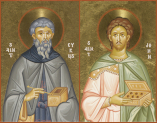 These holy martyrs are commemorated on
January 31st, and their lives and sufferings are described under that date. Today we commemorate
the translation of their relics from Canopus to Menuthis, and the numerous miracles associated
with them. St. Kyril, the Patriarch of Alexandria, prayed fervently for the extermination of the
abominable idolatrous practices at Menuthis, where there was a temple and where the demonic
powers held sway. An angel of God appeared to the patriarch and told him that Menuthis would be
cleansed of its impurity if he brought the relics of Ss. Cyrus and John to the town. The
patriarch did this at once. He brought the relics of the holy martyrs to Menuthis and had a
church built there in their honor. Ammonius, the son of the governor of Alexandria, Julian, was
healed of scrofula through the martyrs’ relics, and a certain Theodore was healed of
blindness. Isidore of Maiuma was healed of a wasting disease of the liver, Theodore’s wife
of the effects of poison, a certain Evgenia of dropsy, and a great many others of various
diseases and torments. All this took place in the year 412.
These holy martyrs are commemorated on
January 31st, and their lives and sufferings are described under that date. Today we commemorate
the translation of their relics from Canopus to Menuthis, and the numerous miracles associated
with them. St. Kyril, the Patriarch of Alexandria, prayed fervently for the extermination of the
abominable idolatrous practices at Menuthis, where there was a temple and where the demonic
powers held sway. An angel of God appeared to the patriarch and told him that Menuthis would be
cleansed of its impurity if he brought the relics of Ss. Cyrus and John to the town. The
patriarch did this at once. He brought the relics of the holy martyrs to Menuthis and had a
church built there in their honor. Ammonius, the son of the governor of Alexandria, Julian, was
healed of scrofula through the martyrs’ relics, and a certain Theodore was healed of
blindness. Isidore of Maiuma was healed of a wasting disease of the liver, Theodore’s wife
of the effects of poison, a certain Evgenia of dropsy, and a great many others of various
diseases and torments. All this took place in the year 412.
2. Our Holy Father Sennuphius the Standard-Bearer.
A great ascetic and wonder-worker of the Egyptian desert, he was a contemporary of Patriarch Theophilus and the Emperor Theodosios the Great. He is called ‘the Standard-Bearer’ because he once helped the Emperor Theodosios to gain a victory over enemy forces by his prayers. When the emperor summoned him to Constantinople, he replied that he was unable to go, but sent his torn and patched monastic schema and his staff. Going out to battle, the emperor put on Sennuphius’ habit and carried his staff in his hand, and returned victorious from the battle.
3. Our Holy Father Paul the Physician.
He was born in Corinth. After completing his studies, he went to a monastery and became a monk. He had a very difficult struggle with the spirit of fornication, and when he had driven it from himself by the power of the Cross, a malicious spirit was angered at his victory and sent a harlot to say that she had borne a child to Paul. Then some heretics came and took him from the monastery, thrust the child into his arms and drove him around the city for the people to spit upon. The child was only a few days old. St. Paul prayed fervently to God, and said to the people: ‘Here, let the child tell you who its father is!’ The child pulled its hand out from the swaddling clothes and pointed to a certain blacksmith, saying: ‘That man is my father, not Paul the monk!’ Paul’s opponents were shamed and repented. God gave to Paul great power of healing, so that he had merely to place his hands on the sick for them to recover. He entered peacefully into rest in great old age, having been pleasing to God in his life on earth. He lived in the seventh century.
FOR CONSIDERATION
The Protestants have rejected God’s power to work miracles through created matter. They have thought to spiritualise the Christian Faith thereby, but have merely impoverished and deformed it. They have rejected the action of God’s power through icons, through the relics of the saints, through the Cross, and have even, some of them, rejected the power of holy Communion. If we were to follow along this twisted and false path, then we should have to reject the miracles which the Lord Jesus worked through His living body, because His body was also material. Likewise, we would have to reject the miracles performed by the apostles and saints, because these hands were also material; and heaven forbid that we should even talk about the rod of Moses, the robe and girdle of the most holy Mother of God, the towel of St. Paul and so forth. In their rejection of all this, the Protestants stand in opposition to the entire ancient Church. Here is one proof from among thousands that God acts through material things, particularly whenever He wishes to glorify His saints: a tall pillar was erected in Alexandria, carrying a statue of the Emperor Theodosios clad in a monk’s habit and with a monk’s staff in his hand. This was a memorial to the emperor’s victory over the enemy when dressed in St. Sennuphius’ habit and carrying his staff. When God so desires, the simple habit of a saint is sufficient to conquer the mighty forces of the unbelievers. Who would dare to limit the action or the methods by which the almighty Lord acts?
Daily Scripture Readings taken from The Orthodox New Testament, translated and published by Holy Apostles Convent, Buena Vista, Colorado, copyright © 2000, used with permission, all rights reserved.
Daily Prologue Readings taken from The Prologue of Ochrid, by Bishop Nikolai Velimirovic, translated by Mother Maria, published by Lazarica Press, Birmingham, England, copyright © 1985, all rights reserved. Edited by Dormition Skete.