

Daily Devotional
Wednesday, June 25, 2025 (NS), June 12, 2025 (OS)
Fast Day. No Meat, Fish, Dairy, Eggs, Alcohol or Olive Oil Allowed.
Wednesday of the Third Week
12. The commemoration of our venerable Fathers Onouphrios of Egypt and Peter the Athonite.
Scripture Readings
Paschalion — Movable Calendar
Wednesday of the Third Week
Epistle
The Reading is from the Epistle of Saint Paul to the Romans [§ 96]. Brethren:
8 2The law of the Spirit of life in Christ Jesus freed me from the law of sin and death. 3Because of the impossibility of the law, in that it was weak through the flesh, God sent His own Son in the likeness of the flesh of sin—and in regard to sin, condemned sin in the flesh— 4in order that the ordinance of the law might be fulfilled in us, who walk not according to the flesh, but according to the spirit. 5For they that are according to the flesh mind the things of the flesh, but they that are according to the Spirit, the things of the Spirit. 6For the mind of the flesh is death, but the mind of the spirit is life and peace. 7Because the mind of the flesh is enmity toward God; for it is not subject to the law of God, for neither can it be. 8And they that are in the flesh are not able to please God. 9But ye are not in the flesh, but in the spirit, if indeed the Spirit of God dwell in you. Now if anyone doth not have the Spirit of Christ, this same one is not of Him. 10And if Christ is in you, on the one hand the body is dead on account of sin, but on the other hand the Spirit is life on account of righteousness. 11But if the Spirit of the One Who raised Jesus from the dead dwell in you, the One Who raised Christ from the dead shall also make alive your mortal bodies on account of the indwelling of His Spirit in you.
12So then, brethren, we are debtors not to the flesh, to live according to the flesh. 13For if ye are living according to the flesh, ye are on the point of dying; but if ye by the Spirit put to death the doings of the body, ye shall live.
Gospel
The Reading is from the Holy Gospel according to Saint Matthew [§ 36]. The Lord said to His disciples:
10 16“Behold, I send you forth as sheep in the midst of wolves. Become therefore wise as the serpents and guileless as the doves. 17“But continue being on guard against men; for they will deliver you up to councils, and they will scourge you in their synagogues. 18“And also ye shall be brought before governors and kings on account of Me, for a testimony to them and to the nations. 19“But whenever they deliver you up, do not become anxious about how or what ye should speak; for it shall be given to you in that hour what ye shall speak. 20“For ye are not the ones who are speaking, but the Spirit of your Father Who is speaking in you. 21“Now a brother shall deliver up a brother to death, and a father a child; and children shall rise up against parents and shall put them to death. 22“And ye shall be hated by all for My name’s sake; but the one who endureth to the end, this one shall be saved.”
Menaion — Fixed Calendar
12. The commemoration of our venerable Fathers Onouphrios of Egypt and Peter the Athonite.
Epistle
The Reading is from the Acts of the Apostles [§ 37]. In those days:
15 35Paul and Barnabas were spending time in Antioch, teaching and preaching as good tidings the word of the Lord, with many others also. 36And after some days Paul said to Barnabas, “Let us return now and visit our brethren in every city in which we proclaimed the word of the Lord, and see how they are holding fast.” 37And Barnabas determined to take with them John, who is called Mark. 38But Paul kept on thinking it not meet to take along that one, since he withdrew from them from Pamphylia, and went not with them to the work. 39Then a sharp contention arose, so as to separate them from one another: and Barnabas, having taken Mark, sailed away to Cyprus; 40and Paul, having chosen for himself Silas, went forth, having been commended to the grace of God by the brethren. 41And he passed through Syria and Cilicia, rendering more firm the churches.
for Sl. usage, see [Gal. 5:22-6:2].
Gospel
The Reading is from the Holy Gospel according to Saint Matthew [§ 43]. The Lord said to His disciples:
11 27“All things were delivered to Me by My Father. And no one doth fully know the Son, except the Father; nor doth anyone fully know the Father, except the Son, and he to whomsoever the Son is willing to reveal Him. 28“Come to Me, all ye who labor and are burdened, and I will give you rest. 29“Take up My yoke upon you and learn from Me, for I am meek and humble in heart; and ye shall find rest to your souls. 30“For My yoke is good and My burden is light.”
Lives of the Saints (Prologue)
June 25th – Civil Calendar
June 12th – Church Calendar
1. Our Holy Father Onuphrius the Great.
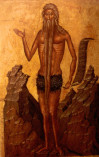 This holy ascetic had been living a
whole sixty years in the desert when the monk Paphnutios visited him. His hair and beard reached
down to the ground, and long hair, as white as snow, had grown all over his body during his years
of nakedness. His appearance was ascetical, unearthly and awe-inspiring. Seeing Paphnutios, he
called him by name and then recounted to him his life in the desert. His guardian angel had
appeared to him and taken him to that place. When he had survived an intensive struggle with
diabolical temptations and when his heart had become utterly established in love for God, an
angel had brought him bread to eat. And besides that, through God’s gracious providence, a
palm tree grew up at one side of his cell, that gave good dates, and a spring of water began to
flow there. ‘But especially,’ said Onuphrius, ‘my food and drink are the sweet
words of God.’ To Paphnutios’ question about his receiving of Communion, the hermit
answered that the angel of God brought him Communion every Sunday. On the next day, the old man
told Paphnutios that it was the day of his departure from this world; then he knelt down, prayed
to God and gave his spirit into God’s hands. Then Paphnutios saw a heavenly light that
illumined the body of the departed saint, and heard a choir of the angelic hosts. He buried
Onuphrius’ body with honor and returned to his own monastery, there as a living witness to
narrate to the brethren, for their edification, the wonderful life of the man of God and the
greatness of God’s providence towards those who give themselves wholly to His service.
Onuphrius died in the year 400.
This holy ascetic had been living a
whole sixty years in the desert when the monk Paphnutios visited him. His hair and beard reached
down to the ground, and long hair, as white as snow, had grown all over his body during his years
of nakedness. His appearance was ascetical, unearthly and awe-inspiring. Seeing Paphnutios, he
called him by name and then recounted to him his life in the desert. His guardian angel had
appeared to him and taken him to that place. When he had survived an intensive struggle with
diabolical temptations and when his heart had become utterly established in love for God, an
angel had brought him bread to eat. And besides that, through God’s gracious providence, a
palm tree grew up at one side of his cell, that gave good dates, and a spring of water began to
flow there. ‘But especially,’ said Onuphrius, ‘my food and drink are the sweet
words of God.’ To Paphnutios’ question about his receiving of Communion, the hermit
answered that the angel of God brought him Communion every Sunday. On the next day, the old man
told Paphnutios that it was the day of his departure from this world; then he knelt down, prayed
to God and gave his spirit into God’s hands. Then Paphnutios saw a heavenly light that
illumined the body of the departed saint, and heard a choir of the angelic hosts. He buried
Onuphrius’ body with honor and returned to his own monastery, there as a living witness to
narrate to the brethren, for their edification, the wonderful life of the man of God and the
greatness of God’s providence towards those who give themselves wholly to His service.
Onuphrius died in the year 400.
2. Our Holy Father Peter the Athonite.
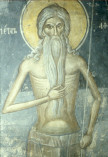 He was a Greek by birth, and a
soldier by profession. Being once engaged in battle against the Arabs, he was captured, chained
and thrown into prison. Peter spent a long time in imprisonment in the town of Samara on the
Euphrates, and prayed God with all his being to free him and take him to some desert place where
he could devote himself to prayerful asceticism. St. Simeon the God-receiver appeared to him in
the prison, together with St. Nicholas, and touched the iron of his chains which melted like wax.
Peter suddenly found himself in the open outside the city. He immediately set out on the road for
Rome, where he was tonsured as a monk by the pope at the tomb of St. Peter. He then set out by
ship to return to the East. The most holy Mother of God appeared to him in a dream, talking with
St. Nicholas, and she told St. Nicholas that she had set Mount Athos apart for Peter to live on
in asceticism. Peter had at that time not heard of Mount Athos. Disembarking, then, at the Holy
Mountain, Peter settled in a cave, where he spent fifty-three years in strict asceticism, in
struggles with hunger and thirst, with heat and cold and especially with diabolical powers, until
he had overcome them all by the help of God. When he had undergone the first temptations and
succeeded in the first test before God, an angel of God began to bring him bread every forty
days. The tempter appeared to him several times in the guise of an angel of light, but Peter
drove him away with the sign of the Cross and the name of the most holy Mother of God. A year
before his death, a deer-hunter passed that way and learned of the saint’s life from his
lips. He died in 734, and his relics were taken to Macedonia.
He was a Greek by birth, and a
soldier by profession. Being once engaged in battle against the Arabs, he was captured, chained
and thrown into prison. Peter spent a long time in imprisonment in the town of Samara on the
Euphrates, and prayed God with all his being to free him and take him to some desert place where
he could devote himself to prayerful asceticism. St. Simeon the God-receiver appeared to him in
the prison, together with St. Nicholas, and touched the iron of his chains which melted like wax.
Peter suddenly found himself in the open outside the city. He immediately set out on the road for
Rome, where he was tonsured as a monk by the pope at the tomb of St. Peter. He then set out by
ship to return to the East. The most holy Mother of God appeared to him in a dream, talking with
St. Nicholas, and she told St. Nicholas that she had set Mount Athos apart for Peter to live on
in asceticism. Peter had at that time not heard of Mount Athos. Disembarking, then, at the Holy
Mountain, Peter settled in a cave, where he spent fifty-three years in strict asceticism, in
struggles with hunger and thirst, with heat and cold and especially with diabolical powers, until
he had overcome them all by the help of God. When he had undergone the first temptations and
succeeded in the first test before God, an angel of God began to bring him bread every forty
days. The tempter appeared to him several times in the guise of an angel of light, but Peter
drove him away with the sign of the Cross and the name of the most holy Mother of God. A year
before his death, a deer-hunter passed that way and learned of the saint’s life from his
lips. He died in 734, and his relics were taken to Macedonia.
3. Our Holy Father Timothy, an Egyptian hermit.
He lived the ascetic life first in the Thebaid, then went off into the desert, where he spent thirty years. Being pleasing to God, he died peacefully.
4. Our Holy Fathers Bassian and Jonah.
Monks of the monastery of Solovki, they were drowned and cast onto the shore in 1651. A sign appeared over their graves, and a church was built there. Later, the monastery of Petrominsk was founded on the site. Once Tsar Peter I, sheltering from a storm at sea, spent three days there and made a cross, which he erected on the shore.
FOR CONSIDERATION
Communion is a great and wonderful mystery. Even solitaries and hermits sought opportunities to receive holy Communion. St. Mary of Egypt begged St. Zosimas to bring the Holy Mysteries to the Jordan and give her Communion. Our holy father Paphnutios, returning from his visit to St. Onuphrius, found four young men living the ascetic life in a very humble community. When Paphnutios asked them if they had any chance of receiving Communion, they replied that an angel of God came to them every Sunday and brought them Communion. Paphnutios remained until the following Sunday and personally witnessed this. When the Sunday dawned, the whole monastery was filled with an indescribable, heavenly fragrance. While they were at prayer, an angel of God in the form of a handsome young man, bright as lightning, appeared with the Holy Gifts. Paphnutios was terrified and fell to the ground in fear, but they raised him up, and he also received Communion at the angel’s hands. St. Onuphrius received Communion at the hands of an angel, according to his own testimony, as did many other solitaries and hermits. It is therefore a completely mistaken idea to think that solitaries and hermits did not receive Communion. God, Who provided for their bodily sustenance, did not leave them without the life-giving food of the body and blood of Christ the Lord.
Daily Scripture Readings taken from The Orthodox New Testament, translated and published by Holy Apostles Convent, Buena Vista, Colorado, copyright © 2000, used with permission, all rights reserved.
Daily Prologue Readings taken from The Prologue of Ochrid, by Bishop Nikolai Velimirovic, translated by Mother Maria, published by Lazarica Press, Birmingham, England, copyright © 1985, all rights reserved. Edited by Dormition Skete.