

Daily Devotional
Saturday, June 14, 2025 (NS), June 1, 2025 (OS)
No Fasting.
Saturday of the First Week or Saturday After the Pentecost or Apodosis of Pentecost
The commemoration of the holy Martyr Justin the Philosopher and those with him, and our venerable Father Dionysios, Abbot and Wonder-worker of Glushetsk in Vologda.
Scripture Readings
Paschalion — Movable Calendar
Saturday of the First Week or Saturday After the Pentecost or Apodosis of Pentecost
Epistle
The Reading is from the Epistle of Saint Paul to the Romans [§ mid 79]. Brethren:
1 7Grace to you and peace from God our Father and Lord Jesus Christ.
8First, indeed, I thank my God through Jesus Christ for you all, that your faith is being proclaimed in all the world. 9For God is my witness, Whom I worship in my spirit in the Gospel of His Son, how unceasingly I make mention of you, 10always entreating in the time of my prayers, if by any means now at length I shall be prospered by the will of God to come to you. 11For I long to see you, that I might impart to you some spiritual gift of grace, to the end that ye may be established, 12that is, that I may be comforted together with you by the mutual faith, both of yours and of mine.
Gospel
The Reading is from the Holy Gospel according to Saint Matthew [§ 15]. The Lord said:
5 42“Be giving to him who asketh of thee, and turn not thyself away from him who doth wish to borrow from thee. 43“Ye heard that it was said, ‘Thou shalt love thy neighbor and hate thine enemy [Lev. 19:18].’ 44“But I say to you, keep on loving your enemies, blessing those who curse you, doing well to those who hate you, and keep on praying for those who despitefully use you and are persecuting you, 45“so that ye might become sons of your Father Who is in the heavens; for He maketh His sun to rise on the evil and the good, and sendeth rain on the just and on the unjust. 46“For if ye love those who love you, what reward are ye having? Even the tax collectors are doing the same, are they not? 47“And if ye greet your brethren only, what extraordinary thing are ye doing? Even the tax collectors are so doing, are they not? 48“Ye shall be perfect, even as your Father Who is in the heavens is perfect.”
Menaion — Fixed Calendar
The commemoration of the holy Martyr Justin the Philosopher and those with him, and our venerable Father Dionysios, Abbot and Wonder-worker of Glushetsk in Vologda.
Epistle
For the Martyr:
The Reading is from the First Epistle of Saint Paul to the Corinthians [§ 125]. Brethren:
1 18The word, that of the Cross, on the one hand, to those who are perishing is foolishness, but on the other hand, to us who are being saved, it is the power of God. 19For it hath been written: “I will destroy the wisdom of the wise, and will set at nought the comprehension of the intelligent [cf. Is. 29:14].” 20Where is the wise? Where is the scribe? Where is the disputer of this age? Did not God make foolish the wisdom of this world? 21For since, in the wisdom of God, the world knew not God through its wisdom, it pleased God through the foolishness of the preaching to save those who believe. 22For indeed, Jews ask for a sign, and Greeks seek wisdom; 23but we proclaim Christ Who hath been crucified, to Jews, on the one hand, a stumbling block, and to Greeks, on the other hand, foolishness, 24but to those who are called, both Jews and Greeks, Christ, God’s power and God’s wisdom.
For the venerable Father:
The Reading is from the Epistle of Saint Paul to the Galatians [§ 213]. Brethren:
5 22The fruit of the Spirit is love, joy, peace, long-suffering, kindness, goodness, faith, 23meekness, self-control; against such things there is no law. 24But they who are of the Christ crucified the flesh with the passions and the lusts. 25If we live by the Spirit, let us also be walking by the Spirit. 26Let us not become vainglorious, provoking one another, envying one another.
6 1Brethren, even if a man should be overtaken in some transgression, ye, the spiritual ones, be restoring such a one in the spirit of meekness, looking out for thyself, lest thou also be tempted. 2Keep on bearing one another’s burdens, and thus fill up the law of the Christ.
Gospel
The Reading is from the Holy Gospel according to Saint John [§ 52]. The Lord said to His disciples:
15 17“These things I command you, that ye be loving one another.
18“If the world hate you, ye know that it hath hated Me before it hath hated you. 19“If ye were of the world, the world would love its own; but because ye are not of the world—but I chose you for Myself out of the world—therefore the world hateth you. 20“Keep on remembering the word which I said to you, ‘A slave is not greater than his lord.’ If they persecuted Me, they will also persecute you; if they kept My word, they will keep yours also. 21“But all these things they will do to you for My name’s sake, because they know not the One Who sent Me. 22“If I had not come and spoken to them, they would not have sin, but now they have no pretext for their sin. 23“The one who hateth Me hateth My Father also. 24“If I did not do the works among them which no other one hath done, they would not have sin; but now they have both seen and hated both Me and My Father. 25“But this cometh to pass that the word might be fulfilled which hath been written in their law: ‘They hated Me without a cause [cf. Ps. 34(35):22, 68(69):5(4)].’ 26“But whenever the Paraclete should come, Whom I shall send to you from the Father, the Spirit of the truth Who proceedeth from the Father, that One shall bear witness concerning Me. 27“And ye also are bearing witness, because ye have been with Me from the beginning.
16 1“These things I have spoken to you, in order that ye should not be made to stumble. 2“They shall put you out of the synagogues; yea moreover, there cometh an hour that everyone who killeth you should think that he offereth God a service.”
Lives of the Saints (Prologue)
June 14th – Civil Calendar
June 1st – Church Calendar
1. The Holy Martyr Justin the Philosopher.
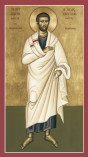 He was born of Greek parents in the Samaritan town
of Shechem (formerly called Nablus), about a hundred and five years after Christ. He sought
wisdom and philosophy with his whole heart, first with the Stoics, then with the Peripatetics,
the Pythagoreans and finally with the Platonists. Although Platonic philosophy did not content
him, it held him the longest, until he found something higher to attract him. By God’s
providence, he encountered a remarkable old man who began to undermine his Platonic philosophy,
reminding him that a man cannot fully know the truth about God till God reveals it to him, and
telling him that God had revealed the truth about Himself in the books of holy Scripture. Justin
began to read the Scriptures, and became an utterly convinced Christian, but he would not be
baptized or call himself a Christian until he had convinced himself of the falseness of the
accusations that pagans found to bring against Christians. Going to Rome for a philosophical
gathering, he quickly gained much respect there, and many followers. He witnessed the martyrdom
of St. Ptolemy and St. Lucian, and seeing the tortures of these innocent Christians, wrote an
Apologia for Christians and Christian teaching and gave it to the Emperor Antoninus and the
Senate. The emperor read it carefully and ordered that the persecution of Christians cease.
Justin took a copy of the emperor’s decree and went off to Asia, where he saved many
persecuted Christians by its aid. After that, he returned again to Rome. When a persecution arose
under the Emperor Marcus Aurelius, he wrote a second Apologia and addressed it to the emperor.
Some disreputable philosopher, Crescens, a Cynic, denounced him as a Christian because Justin was
getting the better of him in every dispute, and Justin was thrown into prison. Desiring his
death, and fearing that judgement would not be given against him, Crescens took the opportunity
to administer poison to him in the prison. Thus this great defender of the Christian Faith
finished his earthly course and went to the blessedness of eternity, in the year 166.
He was born of Greek parents in the Samaritan town
of Shechem (formerly called Nablus), about a hundred and five years after Christ. He sought
wisdom and philosophy with his whole heart, first with the Stoics, then with the Peripatetics,
the Pythagoreans and finally with the Platonists. Although Platonic philosophy did not content
him, it held him the longest, until he found something higher to attract him. By God’s
providence, he encountered a remarkable old man who began to undermine his Platonic philosophy,
reminding him that a man cannot fully know the truth about God till God reveals it to him, and
telling him that God had revealed the truth about Himself in the books of holy Scripture. Justin
began to read the Scriptures, and became an utterly convinced Christian, but he would not be
baptized or call himself a Christian until he had convinced himself of the falseness of the
accusations that pagans found to bring against Christians. Going to Rome for a philosophical
gathering, he quickly gained much respect there, and many followers. He witnessed the martyrdom
of St. Ptolemy and St. Lucian, and seeing the tortures of these innocent Christians, wrote an
Apologia for Christians and Christian teaching and gave it to the Emperor Antoninus and the
Senate. The emperor read it carefully and ordered that the persecution of Christians cease.
Justin took a copy of the emperor’s decree and went off to Asia, where he saved many
persecuted Christians by its aid. After that, he returned again to Rome. When a persecution arose
under the Emperor Marcus Aurelius, he wrote a second Apologia and addressed it to the emperor.
Some disreputable philosopher, Crescens, a Cynic, denounced him as a Christian because Justin was
getting the better of him in every dispute, and Justin was thrown into prison. Desiring his
death, and fearing that judgement would not be given against him, Crescens took the opportunity
to administer poison to him in the prison. Thus this great defender of the Christian Faith
finished his earthly course and went to the blessedness of eternity, in the year 166.
2. The Holy Martyrs Justin, Chariton, Evelpistus, Hierax, Peon, Liverianus and Justus.
These all suffered in Rome in the time of Marcus Aurelius and the Eparch Rusticus. When Rusticus asked: ‘Do you think that, if you die for Christ, you will receive a reward in heaven?’ Justin replied: ‘We do not think it; we know!’ They were all then beheaded, in 163, and went to the kingdom of Christ our God.
3. Our Holy Father Agapitus of the Kiev Caves.
A natural doctor, he was a disciple of St. Anthony of Kiev. He healed people by prayer and the prescribing of cabbage, which they made into a sort of bread. Prince Vladimir Monomachus was healed in this way, and this made Agapitus famed on all sides. The prince’s doctor, an Armenian, hearing of this, began to spread slander about him. When Agapitus became ill, the Armenian came, and looking at him, said that he would die in three days and that, if he did not do so, then he, the Armenian, would become a monk. Agapitus told him that it had been revealed to him by God that he would die, not in three days but in three months. And so it came to pass. After Agapitus’ death, the Armenian went to the abbot of the Monastery of the Caves and asked him to make him a monk. He explained that Agapitus had appeared to him from the other world and reminded him of his promise. And so the one-time envier became a humble monk, by the providence of God Whose care it is that all men be saved. St. Agapitus entered into rest in about 1095.
FOR CONSIDERATION
There is a passage in the ‘Antiquities of the Jews’ by Flavius Josephus, a distinguished Jewish historian who lived at the end of the first century, which refutes the slander and malice that has at times been directed against Christ the Lord by the Jews. He writes: ‘At that time there lived one Jesus, a wise man, who was scarcely able to be called a man because of the marvellous works that he performed. He was a teacher of men, who received the truth with joy, and drew many followers to himself, both Jews and Greeks. He was the Christ. After that, when Pilate, at the deposition of the most eminent of our race, condemned him to death by crucifixion, those who had loved him did not forsake him. He showed himself to them alive after three days, as had been divinely prophesied concerning this and many other of his works. And the Christian sect, called after him, remains to this day.’ Thus wrote a man who did not believe in Christ—a writer free of bias and evil intent.
Daily Scripture Readings taken from The Orthodox New Testament, translated and published by Holy Apostles Convent, Buena Vista, Colorado, copyright © 2000, used with permission, all rights reserved.
Daily Prologue Readings taken from The Prologue of Ochrid, by Bishop Nikolai Velimirovic, translated by Mother Maria, published by Lazarica Press, Birmingham, England, copyright © 1985, all rights reserved. Edited by Dormition Skete.