

Daily Devotional
Wednesday, June 4, 2025 (NS), May 22, 2025 (OS)
Fast Day, but Wine and Olive Oil Allowed.
Wednesday of the Seventh Week
The commemoration of the holy Martyr Vasiliskos of Comana.
Scripture Readings
Paschalion — Movable Calendar
Wednesday of the Seventh Week
Epistle
The Reading is from the Acts of the Apostles [§ 47]. In those days:
23 1Paul, having looked intently on the sanhedrin, said, “Men, brethren, I, in all good conscience, have conducted myself as a citizen to God even to this day.” 2But the high priest Ananias ordered those standing by him to smite his mouth. 3Then Paul said to him, “God is about to smite thee, thou whitewashed wall. And thou sittest judging me according to the law, and acting contrary to the law thou commandest me to be smitten!” 4And those having stood by said, “Revilest thou the high priest of God?” 5And Paul said, “I did not know, brethren, that he is high priest; for it hath been written, ‘Thou shalt not speak ill of a ruler of thy people [cf. Ex. 22:28].’” 6But Paul, having perceived that the one part was made up of Sadducees and the other of Pharisees, cried out in the sanhedrin, “Men, brethren, I am a Pharisee, a son of a Pharisee; I am being judged concerning the hope and resurrection of the dead.” 7And after he spoke thus, there arose a dissension between the Pharisees and the Sadducees; and the multitude was divided. 8For Sadducees indeed say there is no resurrection, neither angel nor spirit, but Pharisees confess both. 9And there arose a great cry; and the scribes of the part of the Pharisees rose up and were contending, saying, “We find nothing evil in this man; but if a spirit or an angel spoke to him, let us not fight against God.” 10And after a great dissension arose, the tribune, fearing lest Paul should be torn in pieces, commanded the troops to go down, and to snatch him up out of their midst, and to bring him into the barracks. 11And on the coming night, the Lord stood by him and said, “Be of good courage, Paul; for as thou didst testify concerning the things of Me in Jerusalem, so also it is necessary for thee to bear witness in Rome.”
Gospel
The Reading is from the Holy Gospel according to Saint John [§ 54]. The Lord said to His disciples:
16 15“All things whatsoever the Father hath are Mine; on this account I said that He shall receive of Mine and shall announce it to you. 16“A little while, and ye behold Me not; and again, a little while, and ye shall see Me, because I go away to the Father.” 17Then some of the disciples said to one another, “What is this which He saith to us, ‘A little while, and ye behold Me not; and again, a little while, and ye shall see Me’; and ‘because I go away to the Father’?” 18They were saying therefore, “What is this which He saith, ‘A little while’? We know not what He speaketh.” 19Now Jesus knew that they were wishing to question Him, and He said to them, “Concerning this do ye inquire among one another, because I said, ‘A little while and ye behold Me not, and again, a little while and ye shall see Me’? 20“Verily, verily, I say to you that ye shall weep and lament, but the world shall be glad; and ye shall be grieved, but your grief shall become joy. 21“The woman, whenever she is about to bring forth, hath grief, because her hour is come; but whenever she should bear the child, she no longer remembereth the affliction, on account of the joy that a man is born into the world. 22“And therefore ye now on the one hand have sorrow; but on the other hand I will see you again and your heart shall be glad, and your joy no one taketh away from you. 23“And in that day ye shall ask Me for nothing. Verily, verily, I say to you that whatsoever ye shall ask the Father in My name, He will give it to you.”
Menaion — Fixed Calendar
The commemoration of the holy Martyr Vasiliskos of Comana.
No readings given.
Lives of the Saints (Prologue)
June 4th – Civil Calendar
May 22nd – Church Calendar
1. The Holy Martyr Vasiliskos.
A kinsman of St. Theodore the Tyro, he was martyred together with Eftropios and Kleonikos (March 3rd). When these two were crucified and gave up the spirit, Vasiliskos was taken back to prison. A change of governors occurring at this time, Vasiliskos remained a long time confined in prison. He besought God with tears that He would not deprive him of a martyr’s death for His sake. After he had prayed at length, the Lord Jesus appeared to him and promised to fulfill his desire, sending him to his village to say farewell to his mother and brothers. Thereupon the new governor, Agrippa, arrived and sent to have Vasiliskos brought from the village immediately. On the way to the city of Amaseia, the Lord worked great wonders through His martyr, bringing many of the people to faith in Christ. Agrippa ordered the martyr to offer sacrifice to Apollyon. ‘“Apollyon” means “Destroyer”,’ said Vasiliskos, and with fervent prayer, he knocked the idol to dust and burned the temple with fire from heaven. The terrified Agrippa attributed this all to magic, and ordered that Vasiliskos be beheaded with the sword. Agrippa immediately became insane, and in his madness, went to the place of execution, found a little of the martyr’s blood in the dust and smeared it on himself under his belt, being restored to health by it. Having come to his senses, he was baptized. Later, a certain Marinus, a citizen of Comana (the place of Vasiliskos’ execution) built a church over the martyr’s relics, and many of the sick found healing there.
2. The Holy Martyr John (Jovan) Vladimir, King of Serbia.
He came of a princely family from Zahumlje. His grandfather was named Hvalimir and his father Petrislav. He was a wise ruler—merciful, meek, chaste and courageous. He was fervent in prayer and a devoted builder and benefactor of churches. But he had major battles to fight, both inside and outside his realm; internally with heretics and Bogomils, and externally with invaders, with King Samuel of Bulgaria and the Emperor Basil. Samuel captured him by guile and threw him into prison. While he was in prison, an angel of God appeared to him and foretold that he would soon be released from prison, but that he would die a martyr’s death. Getting to know Vladimir better, Samuel became attached to him and gave him his daughter Kosara in marriage. When Samuel died, his son Radomir became king, but his twin brother Radislav killed him and then summoned Vladimir on some pretext and beheaded him as well, in 1015. The relics of this holy martyr-king are preserved incorrupt in his monastery near Elbasan, and numerous wonders have been worked over them through the ages and to this day. In 1925, a church was built to this royal martyr near the monastery of St. Naum, which famous monastery he founded.
3. The Second Ecumenical Council.
This council was held in Constantinople in 381, in the time of the Emperor Theodosios the Great. Its purpose was to confirm the teaching of the Orthodox Church about the Holy Spirit. Makedonios (Macedonius), Bishop of Constantinople (d. 362), had taught wrongly that the Holy Spirit is God’s creature and not a divine Person, equal to the Persons of the Father and the Son and one in being with Them. Makedonios was condemned by this council and the Nicene Creed was amplified with teaching on the Holy Spirit.
4. Holy and Righteous Melchisedek, King of Salem.
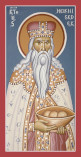 He was a contemporary of our
forefather Abraham. According to the Apostle Paul, he was, as king and priest, a type of
the Lord Jesus (Heb. 7). He was a contemporary of our
forefather Abraham. According to the Apostle Paul, he was, as king and priest, a type of
the Lord Jesus (Heb. 7).
|
FOR CONSIDERATION
How was Moses able to fast for forty days? How were many Christian ascetics able to live, and live long, with prolonged periods of abstinence from food and drink? A carnal man, unacquainted with the spiritual life, finds this impossible to believe. It is impossible to prove it to him, for it can be understood only from experience. When St. Vasiliskos’ torturers left him for three days without food or water, and then urged him to eat, he refused, saying that he was not hungry. ‘I am,’ he said, ‘filled with immortal nourishment and will not receive mortal food. Earthly bread feeds you, but I am fed by the heavenly word of God; the universe gives you wine, but I receive the grace of the Holy Spirit. You are nourished by meat, but I by fasting; bodily power strengthens you, but me the Cross of Christ; gold enriches you, but me the love of Christ; clothing beautifies you, but me good works. You are made merry by laughter, but I am comforted in my spirit through prayer.’ Behold this man, one of many, in whom the words of Christ are confirmed: ‘Man does not live by bread alone, but by every word that proceedeth out of the mouth of God’ (Matt. 4:4).
Daily Scripture Readings taken from The Orthodox New Testament, translated and published by Holy Apostles Convent, Buena Vista, Colorado, copyright © 2000, used with permission, all rights reserved.
Daily Prologue Readings taken from The Prologue of Ochrid, by Bishop Nikolai Velimirovic, translated by Mother Maria, published by Lazarica Press, Birmingham, England, copyright © 1985, all rights reserved. Edited by Dormition Skete.