

Daily Devotional
Thursday, May 29, 2025 (NS), May 16, 2025 (OS)
No Fasting.
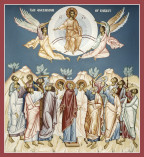
| The Thursday of the Ascension |
The commemoration of our venerable Father Theodore the Sanctified, disciple of St. Pachomios the Great.
Scripture Readings
Paschalion — Movable Calendar
The Thursday of the Ascension
Epistle
The Reading is from the Acts of the Apostles [§ 1].
1 1The first account indeed I made for myself concerning all which, O Theophilos, Jesus began both to do and teach, 2until the day in which He was taken up, after He gave command to the apostles whom He chose for Himself through the Holy Spirit, 3to whom also He presented Himself alive after He had suffered by many proofs, being seen by them during forty days and speaking the things concerning the kingdom of God. 4And being assembled together with them, He ordered them not to depart from Jerusalem, but to wait for the promise of the Father, “which,” He said, “ye heard of Me; 5“for John indeed baptized with water, but ye shall be baptized in the Holy Spirit not many days after these.” 6Indeed therefore, after they came together, they kept on questioning, saying, “Lord, dost Thou at this time restore the kingdom to Israel?” 7And He said to them, “It is not yours to know times or seasons which the Father Himself put in His own authority. 8“But ye shall receive power, after the Holy Spirit is come upon you; and ye shall be witnesses to Me both in Jerusalem, and in all Judæa and Samaria, and unto the ends of the earth.” 9And having said these things, while they looked, He was taken up; and from before their eyes, a cloud took Him up from under. 10And while they were gazing intently into the heaven as He went, then behold, two men stood by them in white raiment, 11who also said, “Men, Galilæans, why do ye stand looking into the heaven? This Jesus, the One Who was taken up from you into the heaven, so shall He come in the manner ye beheld Him going into the heaven.” 12Then they returned to Jerusalem from the mount which is called the Mount of Olives, which is near Jerusalem, being a sabbath’s day journey.
Gospel
In the Orthros
The Reading is from the Holy Gospel According to Saint Mark. [§ 71]. At that time:
16 9After Jesus rose early the first day of the week, He appeared first to Mary Magdalene, from whom He had cast out seven demons. 10She went and brought tidings to those who had been with Him, who were mourning and weeping. 11And they, having heard that He liveth and was seen by her, disbelieved. 12And after these things He was made manifest in a different form to two of them as they were walking and went into the country. 13And they went and brought tidings to the rest; neither did they believe them. 14Afterwards He was made manifest to the eleven themselves as they reclined at table; and He reproached their unbelief and hardness of heart, because they believed not those who saw Him after He was raised. 15And He said to them, “Go into all the world and proclaim the Gospel to the whole creation. 16“The one who believeth and is baptized shall be saved; but the one who believeth not shall be condemned. 17“And these signs shall accompany those who believe: In My name they shall cast out demons; they shall speak in new tongues; 18“they shall take up serpents; and if they should drink anything deadly, in no wise shall it harm them; they shall lay hands on the sick, and they shall be well.”
19Then indeed, after speaking to them, the Lord was taken up into the heaven, and sat on the right of God. 20And they went forth and preached everywhere, the Lord working with them, and confirming the word by the accompanying signs. Amen.
In the Liturgy
The Reading is from the Holy Gospel according to Saint Luke [§ 114]. At that time:
24 36After Jesus rose from the dead, He stood in the midst of His disciples, and saith to them, “Peace be to you.” 37But they were terrified and affrighted, and kept on thinking that they saw a spirit. 38And He said to them, “Why are ye troubled? And why do reasonings come up in your hearts? 39“Behold My hands and My feet, that I am He. Touch Me and see, for a spirit hath not flesh and bones, even as ye see Me having.” 40And having said this, He showed them His hands and His feet. 41And while they yet disbelieved from the joy, and wondered, He said to them, “Have ye anything to eat here?” 42And they gave Him a portion of a broiled fish and of a honeycomb. 43And He took these and ate in their presence. 44And He said to them, “These are the words which I spoke to you while I was yet with you, that it is needful for all the things to be fulfilled, which were written in the law of Moses, and in the prophets, and in the psalms concerning Me.” 45Then He thoroughly opened their mind to understand the Scriptures, 46and said to them, “Thus it hath been written, and thus it was needful for the Christ to have suffered, and to have risen from the dead the third day, 47“and repentance and forgiveness of sins to have been preached in His name to all the nations, beginning from Jerusalem. 48“And ye are witnesses of these things. 49“And behold, I send forth the promise of My Father upon you; but sojourn in the city of Jerusalem, until ye are clothed with power from on high.”
50And He led them out as far as to Bethany. And having lifted up His hands, He blessed them. 51And it came to pass, as He was blessing them, He stood apart from them and was carried up into the heaven. 52And they made obeisance to Him, and returned to Jerusalem with great joy. 53And they were continually in the temple, praising and blessing God. Amen.
Menaion — Fixed Calendar
The commemoration of our venerable Father Theodore the Sanctified, disciple of St. Pachomios the Great.
No readings given.
Lives of the Saints (Prologue)
May 29th – Civil Calendar
May 16th – Church Calendar
1. Our Holy Father Theodore the Sanctified.
He was a disciple of St. Pachomios, being born and growing up an unbeliever. Coming to the true Faith as a young man, he was baptized, and having heard of St. Pachomios, fled to him in his monastery, unknown to his parents. St. Pachomios made him a monk and came to love him for his rare zeal and his obedience. When his mother came to fetch him back home, he would not let her see him, but prayed to God to enlighten her with the truth. And indeed, his mother not only did not take her son back home, but herself did not return. Seeing a women’s monastery close by, ruled by Pachomios’ sister, she entered it and was tonsured. After a certain time, Paphnutios, Theodore’s brother, also came to the monastery and was tonsured. It once happened that the Bishop of Panopolis invited Pachomios to build a monastery for the many people who were desirous of the monastic life. Pachomios took Theodore with him, and entrusted to him the duty of building the monastery. Upon Pachomios’ death, Theodore became abbot of all Pachomios’ monasteries and lived until great old age, guiding a multitude of monks on the way of salvation. He entered peacefully into rest and went to the kingdom of eternal light in the year 368.
2. The Blessed Maiden Musa.
St. Gregory the Dialogist relates of her that she was a mere nine years old when the most holy Mother of God appeared to her on two occasions, surrounded by virgins bathed in light. When Musa expressed her desire to be included in the resplendent company of the Queen of heaven, the Mother of God told her that she would come for her and take her within a month, outlining for her how she should spend those thirty days. On the twenty-fifth day, Musa took to her bed and on the thirtieth day the most pure and holy Mother again appeared to her, calling to her in a quiet voice, to which Musa replied: ‘Here I am waiting, my Lady! I’m ready!’ and she breathed forth her spirit. She passed from this life to life eternal in the fifth century.
3. St. Nicholas Mystikos, Patriarch of Constantinople.
‘Mystikos’ signifies the senior member of the imperial council. This saint was such at first, then a high-ranking courtier, but after this he forsook the vanity of the world and was tonsured. He was renowned for the rare austerity of his life. The Emperor Leo VI had married four times, and the patriarch therefore forbade him entry to the church, and the priests who had married him were defrocked. The emperor cast the patriarch out and drove him into a monastery. The delegates of the Roman Pontiff, Sergius III, gave their approval to the emperor’s fourth marriage, but when the emperor died, Nicholas was restored to the patriarchal throne and called a council in 925, at which fourth marriages were in general forbidden to Christians. He died peacefully in 930.
4. The Holy New-Martyr Nicholas.
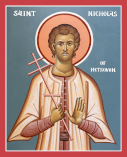 He was born in Metsovon of Epirus,
of pious parents. He left home while quite young and traveled to Trikala, where he found
employment with a Turkish baker. There he denied the Faith and embraced Islam. He then returned
home and repented. A neighbor of his former employer came upon Nicholas one day and discovered
his return to Christianity. He blackmailed Nicholas for several years. Finally, Nicholas decided
that his succumbing to this blackmail was tantamount to further denying Christ, and he became
determined to become a martyr to correct his denial of Christ. He confessed his intentions to his
parish priest, who advised him not to proceed with his plan, lest he be unable to endure their
tortures and fall a second time. Nicholas was determined, however, and his priest blessed and
strengthened him for his ordeal. Nicholas then traveled back to Trikala, where he refused to pay
his blackmailer any further. He was brought before the Turkish judge for having embraced and then
renounced Islam. He was beaten with rods, and finally burned alive in Trikala on May 16, 1617. He
was twenty-six years old. A pious Christian secretly recovered his skull from the ashes, and hid
it in the wall of a house he was building at the time. Later, a man named Melandros bought the
house. Every year, for several years, on the day of Nicholas’ martyrdom, Melandros beheld a
strange light emanating from the wall of the house. He received a divine revelation in his sleep,
disclosing that at the place the light appeared was hidden the holy skull of Nicholas the Martyr.
Melandros dug into the wall where he had beheld the light, and found the martyr’s relics. Feeling
himself unworthy to possess such a treasure, he turned it over to his brother, a monk at a
monastery of Meteora. The martyr’s head is preserved to this day in one of the monasteries
of the Meteora in Thessaly, and performs many miracles, heals the gravest sicknesses and is
particularly renowned for driving locusts from crops.
He was born in Metsovon of Epirus,
of pious parents. He left home while quite young and traveled to Trikala, where he found
employment with a Turkish baker. There he denied the Faith and embraced Islam. He then returned
home and repented. A neighbor of his former employer came upon Nicholas one day and discovered
his return to Christianity. He blackmailed Nicholas for several years. Finally, Nicholas decided
that his succumbing to this blackmail was tantamount to further denying Christ, and he became
determined to become a martyr to correct his denial of Christ. He confessed his intentions to his
parish priest, who advised him not to proceed with his plan, lest he be unable to endure their
tortures and fall a second time. Nicholas was determined, however, and his priest blessed and
strengthened him for his ordeal. Nicholas then traveled back to Trikala, where he refused to pay
his blackmailer any further. He was brought before the Turkish judge for having embraced and then
renounced Islam. He was beaten with rods, and finally burned alive in Trikala on May 16, 1617. He
was twenty-six years old. A pious Christian secretly recovered his skull from the ashes, and hid
it in the wall of a house he was building at the time. Later, a man named Melandros bought the
house. Every year, for several years, on the day of Nicholas’ martyrdom, Melandros beheld a
strange light emanating from the wall of the house. He received a divine revelation in his sleep,
disclosing that at the place the light appeared was hidden the holy skull of Nicholas the Martyr.
Melandros dug into the wall where he had beheld the light, and found the martyr’s relics. Feeling
himself unworthy to possess such a treasure, he turned it over to his brother, a monk at a
monastery of Meteora. The martyr’s head is preserved to this day in one of the monasteries
of the Meteora in Thessaly, and performs many miracles, heals the gravest sicknesses and is
particularly renowned for driving locusts from crops.
5. Our Holy Fathers, the Martyrs of St. Sava’s.
In the time of the Emperor Herakleios, in about 610, forty-four monks of the community of St. Sava the Sanctified suffered for the Christian Faith. Their heroism and sufferings were recorded by St. Antiochus (Dec. 24th).
FOR CONSIDERATION
When Theodore the Sanctified was in Panopolis with his spiritual father, St. Pachomios, a philosopher came to him and sought to dispute with him about faith. The philosopher posed these three questions to Theodore: ‘Who was not born, but died? Who was born, but did not die? And who died, but did not decay?’ To those questions, St. Theodore made answer: ‘Adam was not born, but died. Enoch was born, but did not die. Lot’s wife died, but did not decay.’ The saint added this advice to the philosopher: ‘Take note of this sound advice of ours: shun vain questionings and scholastic syllogisms; draw near to Christ, Whom we serve, and you will receive the forgiveness of your sins.’ The philosopher was rendered speechless by such a shrewd answer, and went away ashamed. From this, one sees clearly the difference between a pagan philosopher and a Christian saint. The one loses himself in abstractions, in skilful juggling with words, in contests of logic and mental gymnastics, while the other centers his whole mind on the living God and on the salvation of his soul. The one is abstract and dead; the other is practical and alive.
Daily Scripture Readings taken from The Orthodox New Testament, translated and published by Holy Apostles Convent, Buena Vista, Colorado, copyright © 2000, used with permission, all rights reserved.
Daily Prologue Readings taken from The Prologue of Ochrid, by Bishop Nikolai Velimirovic, translated by Mother Maria, published by Lazarica Press, Birmingham, England, copyright © 1985, all rights reserved. Edited by Dormition Skete.