

Daily Devotional
Friday, May 16, 2025 (NS), May 3, 2025 (OS)
Fast Day, but Wine and Olive Oil Allowed.
Friday of the Fourth Week
The commemoration of the holy Martyrs Timothy the Reader and Mavra of Antinoe in Egypt, and our venerable Father Theodosios, Abbot of the Monastery of the Caves, initiator of the cnobitic monastic life in Russia.
Scripture Readings
Paschalion — Movable Calendar
Friday of the Fourth Week
Epistle
The Reading is from the Acts of the Apostles [§ 27]. In those days:
10 44While Peter still spoke these words, the Holy Spirit fell upon all those hearing the word. 45And the faithful who were of the circumcision were amazed, as many as came with Peter, because also upon the Gentiles was poured out the gift of the Holy Spirit. 46For they were hearing them speaking with tongues and magnifying God. Peter then answered, 47“No one is able to forbid the water, is he, so that these should not be baptized who received the Holy Spirit even as we?” 48And he commanded them to be baptized in the name of the Lord. Then they asked him to tarry some days.
11 1And the apostles and the brethren who were in Judæa heard that the Gentiles also received the word of God. 2And when Peter went up to Jerusalem, they who were of the circumcision were taking issue with him, 3saying, “Thou wentest to men having uncircumcision, and thou didst eat with them.” 4But Peter, having made a beginning, was expounding the matter to them in order, saying, 5“I was in the city of Joppa praying; and I saw in a state of ecstasy a vision, a certain vessel descending as a great sheet being let down by four corners from out of the heaven—and it came even to me— 6“into which, after I looked intently, I was considering, and saw the quadrupeds of the earth, and the beasts, and the creeping things, and the birds of the heaven. 7“And I heard a voice saying to me, ‘Rise up, Peter, slay and eat.’ 8“But I said, ‘Not at all, Lord; for never did anything common or unclean enter into my mouth.’ 9“And a voice answered me for the second time out of the heaven, ‘What God cleansed, cease thou making common.’ 10“And this took place thrice; and all were drawn up again into the heaven.”
Gospel
The Reading is from the Holy Gospel according to Saint John [§ 30]. The Lord said to the Jews who had come to Him:
8 21“I am going away, and ye shall seek Me, and shall die in your sin. Where I am going, ye are not able to come.” 22Then the Jews were saying, “He will not kill Himself, will He, because He saith, ‘Where I am going, ye are not able to come’?” 23And He said to them, “Ye are from beneath; I am from above. Ye are of this world; I am not of this world. 24“I said therefore to you that ye shall die in your sins; for if ye do not come to believe that I am, ye shall die in your sins.” 25Then they were saying to Him, “Thou, Who art Thou?” And Jesus said to them, “Altogether that which even I am saying to you. 26“I have many things to say and to judge concerning you, but the One Who sendeth Me is true; and what I heard from Him, these things I speak to the world.” 27They knew not that He was speaking to them of the Father. 28Then Jesus said to them, “Whenever ye lift up the Son of Man, then ye shall know that I am, and I do nothing of Myself; but even as the Father taught Me, these things I speak. 29“And the One Who sent Me is with Me. The Father did not leave Me alone, for I always do the things pleasing to Him.” 30As He spoke these things, many believed in Him.
Menaion — Fixed Calendar
The commemoration of the holy Martyrs Timothy the Reader and Mavra of Antinoe in Egypt, and our venerable Father Theodosios, Abbot of the Monastery of the Caves, initiator of the cnobitic monastic life in Russia.
Epistle
For the venerable Father:
The Reading is from the Epistle of Saint Paul to the Hebrews [§ 334]. Brethren:
13 7Be remembering those who lead you, who spoke to you the word of God, whose faith keep on imitating, observing attentively the end of their conduct: 8Jesus Christ, the same yesterday and today and to the ages. 9Cease being carried about by various and strange teachings. For it is good for the heart to be confirmed by grace, not by foods, in which those walking therein were not profited. 10We have an altar from which those serving the tabernacle have no authority to eat; 11for the bodies of those animals, “whose blood is being brought into the holies for sins” by the high priest, “are being burned outside of the encampment [cf. Lev. 16:27].” 12Wherefore Jesus also, that He might sanctify the people by His own blood, suffered outside of the gate. 13Let us be going forth therefore to Him outside of the encampment, bearing His reproach; 14for we have no abiding city here, but we seek the coming one. 15Through Him, then, let us be offering up a “sacrifice of praise [Lev. 7:2(12)]” continually to God, that is, “the fruit of the lips [cf. Hos. 14:3(2); Is. 57:19],” giving thanks to His name. 16But cease being forgetful of doing good and of contributing; for God is well pleased with such sacrifices.
Gospel
The Reading is from the Holy Gospel according to Saint Matthew [§ 43]. The Lord said to His disciples:
11 27“All things were delivered to Me by My Father. And no one doth fully know the Son, except the Father; nor doth anyone fully know the Father, except the Son, and he to whomsoever the Son is willing to reveal Him. 28“Come to Me, all ye who labor and are burdened, and I will give you rest. 29“Take up My yoke upon you and learn from Me, for I am meek and humble in heart; and ye shall find rest to your souls. 30“For My yoke is good and My burden is light.”
Lives of the Saints (Prologue)
May 16th – Civil Calendar
May 3rd – Church Calendar
1. The Holy Martyrs Timothy and Mavra.*
Strange was the destiny of these wonderful martyrs, husband and newly-wedded wife. Twenty days after their wedding, they were taken for trial for their Christian Faith before Arrianos, the pagan governor of the Thebaid, in the time of the Emperor Diocletian. Timothy was a reader in the church where he lived. ‘Who are you?’ the governor asked him. Timothy replied: ‘I am a Christian and a reader in the Church of God.’ The governor said to him further: ‘You see, don’t you, the instruments prepared for torture?’ Timothy replied: ‘But you don’t see the angels of God, which are strengthening me.’ Then the governor commanded that he be pierced through the ears with iron rods, so that the pupils of his eyes leapt out with the pain. They then suddenly hanged him by the feet and stuffed his mouth with wood. Mavra was at first afraid of torture, but when her husband gave her courage, she also confessed her steadfast faith before the governor. He commanded that, first, her hair be torn out, then all her fingers cut off. After many other tortures, to which they would quickly have succumbed had they not been strengthened by the grace of God, they were both crucified, one in sight of the other. And thus, hanging on their crosses, they remained alive for nine full days, counseling each other and encouraging each other in endurance. On the tenth day they gave their spirits into God’s hands, the God for Whom they had suffered crucifixion, and thus became worthy of His kingdom. They suffered with honor for Christ in 286.
* Author’s note: ‘Mavra’ means ‘black,’ from which it comes that in Macedonia the day of these saints is known as ‘Black Day’. On the island of Zakynthos there is a church of Saints Timothy and Mavra, in which many miraculous healings have taken place.
2. Our Holy Father Theodosius (Feodosy) of the Kiev Caves.
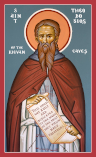 From his earliest youth, he fled from laughter and merriment and gave himself to pondering on
God and prayer. Because of this, he was often beaten by his mother, and especially when she saw
one day an iron belt around his naked body, from which his shirt was stained with blood. Reading
one day in the Gospel the words of the Lord: ‘He who loves father or mother more than Me,
is not worthy of Me,’ he left his parents’ home and fled to Kiev, to the cave of our
holy father Anthony. Anthony received him and quickly made him a monk. When his mother found him,
and called him to return home, he spoke with her and she then became a nun in a women’s
monastery. By his asceticism, his meekness and his goodness, Theodosius quickly outstripped all
the other monks and became very dear to Anthony, who made him abbot of the monastery. In his
time, the number of brethren in the monastery grew very rapidly, churches and cells were built,
and the Rule of the Studion was introduced in its fullness. God endowed Theodosius with great
grace in response to his virginal purity, labors in prayer and love for his neighbor, and so this
man of God had great power over unclean spirits and healed sicknesses and had insight into the
destinies of men. With St. Anthony, St. Theodosius is regarded as the restorer and organizer of
Russian monasticism. He entered peacefully into rest in 1074, and his healing relics rest beside
those of St. Anthony.
From his earliest youth, he fled from laughter and merriment and gave himself to pondering on
God and prayer. Because of this, he was often beaten by his mother, and especially when she saw
one day an iron belt around his naked body, from which his shirt was stained with blood. Reading
one day in the Gospel the words of the Lord: ‘He who loves father or mother more than Me,
is not worthy of Me,’ he left his parents’ home and fled to Kiev, to the cave of our
holy father Anthony. Anthony received him and quickly made him a monk. When his mother found him,
and called him to return home, he spoke with her and she then became a nun in a women’s
monastery. By his asceticism, his meekness and his goodness, Theodosius quickly outstripped all
the other monks and became very dear to Anthony, who made him abbot of the monastery. In his
time, the number of brethren in the monastery grew very rapidly, churches and cells were built,
and the Rule of the Studion was introduced in its fullness. God endowed Theodosius with great
grace in response to his virginal purity, labors in prayer and love for his neighbor, and so this
man of God had great power over unclean spirits and healed sicknesses and had insight into the
destinies of men. With St. Anthony, St. Theodosius is regarded as the restorer and organizer of
Russian monasticism. He entered peacefully into rest in 1074, and his healing relics rest beside
those of St. Anthony.
FOR CONSIDERATION
Abba John Kolovos asked his monks: ‘Who or what sold Joseph?’ One of them answered: ‘His brethren.’ To this the elder said: ‘Not his brothers, but his humility.’ Joseph could have revealed that he was their brother, and thus oppose the sale. But he kept silent about that. By humility, then, was he sold, and this same humility later made him ruler of Egypt. We guard ourselves too carefully from the outward difficulties encountered in giving ourselves over to the will of God, and so we lose the good fruits that are reaped in difficult circumstances endured with humility. Abba Poemen spoke wisely thus: ‘We have set aside the light yoke; that is, self-instruction, and loaded ourselves with the heavy one; that is, self-righteousness.’ Christians accept every difficulty as payment for past or present sins, seeking the will of God with faith in all things, and looking to the end with hope.
Daily Scripture Readings taken from The Orthodox New Testament, translated and published by Holy Apostles Convent, Buena Vista, Colorado, copyright © 2000, used with permission, all rights reserved.
Daily Prologue Readings taken from The Prologue of Ochrid, by Bishop Nikolai Velimirovic, translated by Mother Maria, published by Lazarica Press, Birmingham, England, copyright © 1985, all rights reserved. Edited by Dormition Skete.