

Daily Devotional
Sunday, May 4, 2025 (NS), April 21, 2025 (OS)
No Fasting.
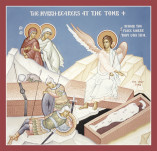
| Third Sunday of Pascha, Sunday of the Myrrh-Bearers Mode Two — Fourth Eothinon |
The commemoration of our holy father among the saints, Januarius, Bishop of Benevento, and those with him, and Hieromartyr Theodore of Perge in Pamphylia and those with him, and our venerable Father Anastasios of Sinai (commemorated on Sl. calendar on the 20th of April).
Scripture Readings
Paschalion — Movable Calendar
Third Sunday of Pascha, Sunday of the Myrrh-Bearers
Mode Two — Fourth Eothinon
Epistle
The Reading is from the Acts of the Apostles [§ 16].
6 1In those days, when the disciples were multiplying, there arose a murmuring of the Hellenists against the Hebrews, because their widows were being overlooked in the daily ministration. 2And the twelve summoned the multitude of the disciples, and said, “It is not pleasing to us to leave behind the word of God to serve tables. 3“Therefore, brethren, look out for seven men from among yourselves, whose character is approved by testimony, full of the Holy Spirit and wisdom, whom we shall appoint over this business; 4“but we will persevere in prayer and the ministry of the word.” 5And the saying was pleasing before the whole multitude. And they chose for themselves Stephen (a man full of faith and of the Holy Spirit), and Philip, and Prochoros, and Nicanor, and Timon, and Parmenas, and Nicholas (a proselyte of Antioch), 6whom they set before the apostles; and having prayed, they laid their hands on them. 7And the word of God kept on increasing, and the number of the disciples was being multiplied in Jerusalem exceedingly, and great numbers of the priests were obedient to the faith.
Gospel
The Reading is from the Holy Gospel according to Saint Mark [§ 69]. At that time:
15 43Joseph, a noble counselor, who was from Arimathea, and who himself also was waiting for the kingdom of God, came; and having become bold, he went in to Pilate and asked for the body of Jesus for himself. 44And Pilate wondered if He were already dead; and having summoned the centurion, he questioned him if He died not long ago. 45And having come to know it from the centurion, he granted the body to Joseph. 46And he bought a linen cloth, and took Him down, and wrapped Him in the linen, and laid Him in a sepulcher which was hewn out of a rock, and rolled a stone against the door of the sepulcher. 47And Mary Magdalene and Mary the Mother of Joses were beholding where He was laid.
16 1And the sabbath having passed, Mary Magdalene, and Mary the Mother of Iakovos, and Salome bought aromatic spices, that they might come and anoint Him. 2And very early in the morning on the first day of the week they came to the sepulcher, after the sun rose. 3And they were saying among themselves, “Who shall roll away the stone from the door of the sepulcher for us?” 4And they looked up and saw that the stone had been rolled away, for it was exceedingly great. 5And after they entered into the sepulcher, they saw a young man sitting on the right, clothed in a white robe, and they were amazed. 6And he saith to them, “Cease being amazed. Ye are seeking Jesus the Nazarene Who hath been crucified. He was raised, He is not here. Behold the place where they laid Him. 7“But go and say to His disciples, and to Peter, that He goeth before you into Galilee; there shall ye see Him, even as He told you.” 8And they went out and fled from the sepulcher. And trembling and ecstasy held them fast, and to no one did they say anything, for they were afraid.
Menaion — Fixed Calendar
The commemoration of our holy father among the saints, Januarius, Bishop of Benevento, and those with him, and Hieromartyr Theodore of Perge in Pamphylia and those with him, and our venerable Father Anastasios of Sinai (commemorated on Sl. calendar on the 20th of April).
No readings given.
Lives of the Saints (Prologue)
May 4th – Civil Calendar
April 21st – Church Calendar
1. The Hieromartyr Januarius, and those with him.
This saint was Bishop of Benevento in Italy. In the time of a persecution under Maximian, he was brought before the judge and tormented with various tortures, which he endured patiently. When they threw him into the flames, they were cooled by an invisible dew and the martyr stood uninjured in it and sang the praises of God. Then they flayed his body with iron flails until the bones showed white, but the martyr patiently endured all. His deacon, Faustus, and his reader, Desiderius, were watching the torture and wept for their spiritual father. Then they too were bound and taken with their bishop to the town of Puteoli (Pozzuoli), and cast into prison. There were in the same prison for the sake of Christ the Puteolian deacons Proclus and Sossus and two simple, Christian men, Eutychius and Acutius. All seven were thrown next day to the wild beasts, but the beasts would not touch them. They were all then beheaded, and the Christians of the city of Naples secretly took the body of St. Januarius to their city and buried it in the church where they work miracles to those who approach with faith. One among many remembered is this: a poor widow, whose only son had died, took the icon of St. Januarius out of the church and laid it on her dead son, weeping and imploring the saint’s aid, and her son was restored to life. St. Januarius suffered with honor in 305.
2. The Holy Martyr Theodore, and others with him.
He suffered for the Christian Faith in Perga of Pamphylia in the time of the Emperor Antoninus. Theodore was young and fair of face. When the governor of that district chose him, along with several other young men, for service at the imperial court, Theodore refused and declared himself to be a Christian. Because of this, he was tortured in various ways and then thrown into the flames, but water gushed from the earth and put out the fire. The governor ascribed this to some magic of Theodore’s, but the martyr said to him: ‘This is not the work of any power of mine, but of Christ my God; and if you want to test the power of your gods, light another fire and throw in one of your soldiers—then I hope you will understand the strength and almighty power of my God.’ The governor really wanted to throw in one of the soldiers, but they, in terror, begged him to throw in the pagan priest, Dioscoros, in their place. The priest begged him to throw in only the idol of Zeus and the other idols, for, he said, if they were gods they would easily save themselves. Dioscoros spoke thus because he had already in his heart turned to Christ, having seen the marvel wrought concerning Theodore. Discovering this, the governor condemned Dioscoros to death by burning. He also delivered Theodore and two soldiers, Socrates and Dionysius, and Theodore’s mother Philippa, to death. Theodore was crucified, and breathed his last on the cross only on the third day. Socrates and Dionysius were run through with spears and Philippa was beheaded. They were all crowned with wreaths of glory in the kingdom of Christ.
FOR CONSIDERATION
‘Guard your hearts!’—said experienced ascetics of old. And Saint John of Kronstadt, in our day, says the same: ‘The heart is fine, spiritually light and heavenly in nature. Guard it; do not burden it; do not bring it low; be extremely abstinent in eating and drinking and especially in bodily comforts. The heart is the temple of God, and “he who defiles the temple of God, him shall God destroy” (I Cor. 3:17).’ Spiritual experience in olden times and spiritual experience in our day are identical—on the condition that the confession of faith is identical. The heavenly knowledge to which the ancient ascetics came, in no way differs from the heavenly knowledge to which modern ascetics come. For, as Christ is the same today as yesterday, so also is human nature. And, what is most important, the heart of man is the same, and nothing can satisfy it but the glory and power and richness of God.
Daily Scripture Readings taken from The Orthodox New Testament, translated and published by Holy Apostles Convent, Buena Vista, Colorado, copyright © 2000, used with permission, all rights reserved.
Daily Prologue Readings taken from The Prologue of Ochrid, by Bishop Nikolai Velimirovic, translated by Mother Maria, published by Lazarica Press, Birmingham, England, copyright © 1985, all rights reserved. Edited by Dormition Skete.