

Daily Devotional
Sunday, April 27, 2025 (NS), April 14, 2025 (OS)
No Fasting.
| The Sunday of the Antipascha (The Sunday After Pascha) The Sunday of the Holy Apostle Thomas Mode One — First Eothinon |
The commemoration of the holy Apostles Aristarchos, Pudens, and Trophimos of the Seventy (commemorated on Sl. calendar on the 15th of April), and our holy father among the saints, Martin, Pope of Rome (commemorated on Gk. calendar on the 13th of April), and his fellow bishops, and the holy Martyrs Anthony, John, and Efstathios, slain for the Faith in Vilmius, Lithuania.
Scripture Readings
Paschalion — Movable Calendar
The Sunday of the Antipascha (The Sunday After Pascha)
The Sunday of the Holy Apostle Thomas
Mode One — First Eothinon
Epistle
The Reading is from the Acts of the Apostles [§ 14]. In those days:
5 12Through the hands of the apostles many signs and wonders were being wrought among the people. And they were all with one accord in the porch of Solomon. 13And of the rest not even one was daring to be joined to them, but the people were magnifying them. 14And more believers were being added to the Lord, multitudes both of men and of women, 15insomuch that they carried out the sick into the streets and laid them upon beds and pallets, in order that at least the shadow of Peter as he came might overshadow some of them. 16And also the multitude kept on coming together out of the cities round about to Jerusalem, bearing sick people and those who were troubled by unclean spirits—all of whom were being healed.
17Then the high priest rose up and all those with him (the sect which is of the Sadducees), and were full of jealousy, 18and laid their hands on the apostles and put them in state custody. 19But an angel of the Lord during the night opened the doors of the prison and led them out, and said, 20“Go and take a stand in the temple, and be speaking to the people all the words of this life.”
Gospel
The Reading is from the Holy Gospel according to Saint John [§ 65].
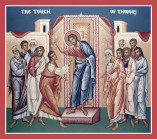
20 19When it was evening on that day, the first of the week—and the doors were closed where the disciples were gathered together for fear of the Jews—Jesus came and stood in the midst, and saith to them, “Peace be to you.” 20And after He said this, He showed them His hands and His side. Then were the disciples glad, after they saw the Lord. 21Then Jesus said to them again, “Peace be to you; even as the Father hath sent Me forth, I also send you.” 22And after He said this, He breathed on them, and saith to them, “Receive ye the Holy Spirit: 23“if ye forgive the sins of any, they are forgiven to them; if ye retain the sins of any, they are retained.” 24But Thomas, one of the twelve, who is called Didymos, was not with them when Jesus came. 25The other disciples therefore were saying to him, “We have seen the Lord.” But he said to them, “Unless I should see in His hands the mark of the nails, and put my finger into the mark of the nails, and put my hand into His side, in no wise will I believe.” 26And after eight days His disciples were again inside, and Thomas with them. Then cometh Jesus, the doors having been shut, and He stood in the midst, and said, “Peace be to you.” 27Then He saith to Thomas, “Bring thy finger here, and behold My hands; and bring thy hand, and put it into My side. And cease being unbelieving, but believing.” 28And Thomas answered and said to Him, “My Lord and my God.” 29Jesus said to him, “Because thou hast seen Me, thou hast believed; blessed are they who did not see, and yet believed.”
30Then indeed Jesus also did many other signs in the presence of His disciples, which are not written in this book; 31but these things have been written that ye might believe that Jesus is the Christ, the Son of God, and that believing ye may have life in His name.
Menaion — Fixed Calendar
The commemoration of the holy Apostles Aristarchos, Pudens, and Trophimos of the Seventy (commemorated on Sl. calendar on the 15th of April), and our holy father among the saints, Martin, Pope of Rome (commemorated on Gk. calendar on the 13th of April), and his fellow bishops, and the holy Martyrs Anthony, John, and Efstathios, slain for the Faith in Vilmius, Lithuania.
Epistle
For the Martyrs:
The Reading is from the Epistle of Saint Paul to the Ephesians [§ 233].
6 10Brethren, keep on being empowered in the Lord and in the strength of His might. 11Put on the full armor of God, for you to be able to stand against the wiles of the devil; 12because for us the wrestling is not against blood and flesh, but against the principalities, against the powers, against the cosmic rulers of the darkness of this age, against spiritual hosts of evil on account of the heavenly things. 13For this cause take up the full armor of God, in order that ye might be able to withstand in the evil day, and having counteracted all things, to stand. 14Stand therefore, having girt your loins with truth, and having put on for yourselves the breastplate of righteousness, 15and having shod your feet in readiness of the Gospel of peace; 16on the whole, take up the shield of faith, with which ye shall be able to quench all the fiery darts of the evil one. 17And take the helmet of salvation, and the sword of the Spirit, which is the word of God.
Gospel
For the Martyrs:
The Reading is from the Holy Gospel according to Saint Matthew [§ 36]. The Lord said to His disciples:
10 16“Behold, I send you forth as sheep in the midst of wolves. Become therefore wise as the serpents and guileless as the doves. 17“But continue being on guard against men; for they will deliver you up to councils, and they will scourge you in their synagogues. 18“And also ye shall be brought before governors and kings on account of Me, for a testimony to them and to the nations. 19“But whenever they deliver you up, do not become anxious about how or what ye should speak; for it shall be given to you in that hour what ye shall speak. 20“For ye are not the ones who are speaking, but the Spirit of your Father Who is speaking in you. 21“Now a brother shall deliver up a brother to death, and a father a child; and children shall rise up against parents and shall put them to death. 22“And ye shall be hated by all for My name’s sake; but the one who endureth to the end, this one shall be saved.”
Lives of the Saints (Prologue)
April 27th – Civil Calendar
April 14th – Church Calendar
1. St. Martin the Confessor, Pope of Rome.
Martin became Pope on July 5th, 649, at the time of a furious quarrel between the Orthodox and the Monothelite heretics. Constans the Second, Herakleios’ grandson, was on the throne at the time, and Paul was Patriarch of Constantinople. To restore peace in the Church, the emperor himself wrote a dogmatic decree, the Typos, which leaned heavily towards heresy. Pope Martin summoned a council of 105 bishops, at which the emperor’s statement was condemned. At the same time, the pope wrote a letter to Patriarch Paul, begging him to uphold the purity of the Orthodox Faith and to counsel the emperor to reject the theories of the heretics. This letter infuriated both the patriarch and the emperor. The emperor sent one of his generals, Olympius, to take the pope to Constantinople in bonds. The general did not dare to bind the pope with his own hands, but instructed one of his soldiers to kill him with the sword in church. But, when the soldier entered the church with his sword concealed, he was instantly blinded. So, by the providence of God, Martin escaped death. At that time, the Saracens fell upon Sicily, and Olympius went off there, where he died. Then, by the intrigues of the heretic Patriarch Paul, the emperor sent a second general, Theodore, to bind and take the pope on the charge that he, the pope, was in collusion with the Saracens and that he did not reverence the most holy Mother of God. When the general arrived in Rome and read the accusation against the pope, he replied that it was libel; that he had no contact of any sort with the Saracens, the opponents of Christianity, ‘and whoever does not confess the most holy Mother of God and do her reverence, let him be damned in this age and in that which is to come’. But this did not affect the general’s decision. The pope was bound and taken to Constantinople, where he lay long in prison in great sickness, tortured by both anxiety and hunger, until he was finally sentenced to exile in Cherson, where he lived for two years before his death. He gave his soul into the hands of the Lord, for Whom he had suffered so greatly, in 655. The evil patriarch, Paul, died two years before him, and when the emperor visited him on his deathbed, he smote his head against the wall, confessing with tears that he had greatly sinned against Pope Martin and asking the emperor to set Martin free.
2. The Holy Martyrs Anthony, John and Eustace.
These three were all at first pagans and fire-worshippers. They were slaves at the court of the Lithuanian Prince Olgard in Vilna. Their former names were Krugletz, Kumetz and Neghilo. All three were baptized by a priest called Nestor. The three of them were hanged, one behind the other, from the same oak tree in 1347. Christians cut down this oak and built a church dedicated to the Holy Trinity, in which they laid the precious relics of these martyrs, making the Holy Table from the stump of the tree. Their relics are preserved in Vilna.
3. The Holy Martyr Ardalion the Actor.
The holy martyr Ardalion lived at the time of Maximian, 298 A.D. By profession he was an actor or a mimic, imitating the sorrows and woes of others. On one occasion he decided to imitate the resistance that Christians display when being martyred by the tyrants. So his friends staged an act where Ardalion was suspended from a height and supposedly mutilated because he would not sacrifice to the idols. The audience was so moved by his performance that they interrupted and gave him a standing ovation. Then Ardalion exclaimed in a great voice, telling the audience to stop their applause, and announced that he was a Christian in reality. The governor of that territory advised him to change his mind, but our martyr would not listen to him, and stayed firm in the Faith. He was cast into a bonfire which was lit on that spot, and thus he met his end and received the laurel of martyrdom.
FOR CONSIDERATION
‘A monk must love God as a son and fear Him as a slave,’ says Evagrius. In fact, this is so of every Christian, even if he is not a monk. It is a great art to unite love for God to fear of Him. Many other of the holy fathers also, when they speak of the love of God, speak at the same time of fear of Him—and vice versa. St. John Chrysostom, in his homily ‘On Perfect Love,’ speaks at the same time of punishment and the torments of hell. Why? Because the greatest love towards God of which man is capable can be turned into pride if it is not accompanied by a sense of fear—and great fear without love leads to despair.
Daily Scripture Readings taken from The Orthodox New Testament, translated and published by Holy Apostles Convent, Buena Vista, Colorado, copyright © 2000, used with permission, all rights reserved.
Daily Prologue Readings taken from The Prologue of Ochrid, by Bishop Nikolai Velimirovic, translated by Mother Maria, published by Lazarica Press, Birmingham, England, copyright © 1985, all rights reserved. Edited by Dormition Skete.