

Daily Devotional
Tuesday, April 22, 2025 (NS), April 9, 2025 (OS)
No Fasting.
Bright Week - No Fasting All Week
Tuesday of the Renewal Week
The commemoration of the Martyr Efpsychios of Cæsarea in Cappadocia.
Scripture Readings
Paschalion — Movable Calendar
Tuesday of the Renewal Week
Epistle
The Reading is from the Acts of the Apostles [§ 4]. In those days:
2 14Peter, having taken his stand with the eleven, lifted up his voice and spoke out to them, “Men, Jews, and all those who inhabit Jerusalem, let this be known to you, and hearken to my words. 15“For these are not drunk, as ye suppose, for it is the third hour of the day. 16“But this is that which hath been spoken by the Prophet Joel, 17“‘And it shall be in the last days,’ saith God, ‘I will pour out of My Spirit upon all flesh; and your sons and your daughters shall prophesy, and your young men shall see visions, and your old men shall dream dreams [cf. Joel 2:28]; 18“‘and even upon My bondmen and upon My bondwomen in those days I will pour out of My Spirit [cf. Joel 2:29],’ and they shall prophesy. 19“‘And I will show wonders in the heaven above, and signs on the earth below, blood and fire and vapor of smoke [cf. Joel 2:30]. 20“‘The sun shall be turned into darkness, and the moon into blood, before that great and notable day of the Lord come [Joel 2:31]. 21“‘And it shall be that everyone, whosoever shall call upon the name of the Lord, shall be saved [Joel 2:32].’”
Gospel
The Reading is from the Holy Gospel according to Saint Luke [§ 113]. At that time:
24 12Peter arose and ran to the sepulcher; and having stooped to look, he saw the linen cloths lying alone, and departed to his home, wondering at that which had come to pass.
13And behold, two of them were going on the same day to a village, being sixty stadia from Jerusalem, which is named Emmaus. 14And they were conversing with one another about all these things which had taken place. 15And it came to pass, while they conversed and discussed, Jesus Himself drew near and was going together with them. 16But their eyes were held, so as not to recognize Him. 17And He said to them, “What words are these which ye exchange with one another, as ye walk and are sad in countenance?” 18And the one whose name was Cleopas answered and said to Him, “Art Thou sojourning alone as a stranger in Jerusalem, and hast not known the things which came to pass in it in these days?” 19And He said to them, “What kind of things?” And they said to Him, “The things concerning Jesus the Nazaræan, Who was a man, a prophet, mighty in deed and word before God and all the people, 20“how both the chief priests and our rulers delivered Him up to a judgment of death, and crucified Him. 21“But we were hoping that He was the One Who was about to redeem Israel; but, beside all these things, this passeth as the third day today since these things took place. 22“Yea, and certain women from among us astonished us, who were early at the sepulcher. 23“And not having found His body, they came, declaring also to have seen a vision of angels who say, ‘He is living.’ 24“And certain of those with us went away to the sepulcher, and found it thus, even as also the women said; but Him they did not see.” 25And He said to them, “O ye without understanding and slow in heart to believe in all things which the prophets spoke! 26“It was needful for the Christ to have suffered these things and to have entered into His glory, was it not?” 27And beginning from Moses and from all of the prophets, He went on interpreting to them in all the Scriptures the things concerning Himself. 28And they drew near to the village where they were going; and He was making as if to be going further. 29And they constrained Him, saying, “Stay with us, for it is toward evening, and the day hath waned.” And He went in to stay with them. 30And it came to pass, as He reclined at table with them, He took bread, and blessed it, and broke it, and was giving it to them. 31And their eyes were opened, and they recognized Him; and He disappeared from them. 32And they said to one another, “Our heart was burning in us as He was speaking to us in the way and as He was opening to us the Scriptures, was it not?” 33And they rose up the same hour and returned to Jerusalem, and found the eleven gathered together, and those with them, 34saying, “The Lord was raised indeed, and appeared to Simon.” 35And they began relating those things that occurred in the way, and how He was known to them in the breaking of the bread.
Menaion — Fixed Calendar
The commemoration of the Martyr Efpsychios of Cæsarea in Cappadocia.
No readings given.
Lives of the Saints (Prologue)
Paschalion — Movable Calendar
Saints Raphael, Nicholas and Irene
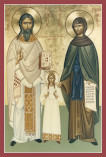 Archimandrite Raphael,
Abbot of the Theotokos Monastery, and Hierodeacon Nicholas, settled on Lesvos (Mytilene) after
the Fall of the City. In 1463, Muslims attacked on Great Friday. Archimandrite Raphael was pulled
and tugged by his hair and beard along the rock-strewn ground. He was struck with clubs, spears,
lances, and swords, while his hands were tied behind his back. He was stabbed all over and cast
down paralyzed. His tongue was severed, and he was then suspended upside down from a large walnut
tree, repeatedly beaten and whipped for 24 hours. He was cut down from the tree and stripped of
his clothing from the waist up. After being positioned on his knees, five savage Muslims took up
a saw and began cutting away his lower jaw. Nearly unconscious, he had his head placed on a
square icon, where they struck him thrice on his mouth, extracting his lower jaw, thus separating
his head from his body on Bright Tuesday, then the 9th of April.
Archimandrite Raphael,
Abbot of the Theotokos Monastery, and Hierodeacon Nicholas, settled on Lesvos (Mytilene) after
the Fall of the City. In 1463, Muslims attacked on Great Friday. Archimandrite Raphael was pulled
and tugged by his hair and beard along the rock-strewn ground. He was struck with clubs, spears,
lances, and swords, while his hands were tied behind his back. He was stabbed all over and cast
down paralyzed. His tongue was severed, and he was then suspended upside down from a large walnut
tree, repeatedly beaten and whipped for 24 hours. He was cut down from the tree and stripped of
his clothing from the waist up. After being positioned on his knees, five savage Muslims took up
a saw and began cutting away his lower jaw. Nearly unconscious, he had his head placed on a
square icon, where they struck him thrice on his mouth, extracting his lower jaw, thus separating
his head from his body on Bright Tuesday, then the 9th of April.
Deacon Nicholas, bound to a smaller walnut tree, witnessed these
terrifying scenes. He, too, was stabbed, but he did not die immediately. It was only after his
terror-stricken tender heart had borne the startling sight of his wounds and the punishments of
the others, that he suffered cardiac arrest.
Twelve-year-old Irene was seized and had boiling water poured into
her mouth. One of her delicate hands was severed, the limb being tossed before the parents. The
stump of her arm was bleeding profusely, as they chopped away one of her little feet. The lass
was then pushed down into an earthen jar, where she was burned alive after being doused with
flammable liquids and torching her bodice. As she stood trapped in the flaming cask, she lifted
up her eyes heavenward and called upon Christ, commending her soul into the hands of the Lord.
In 1959 and in the early 1960’s miraculous visions of the
martyrs were granted to the islanders. The recovery of their relics has been the occasion of
countless miracles and pilgrimages.
Menaion — Fixed Calendar
April 22nd – Civil Calendar
April 9th – Church Calendar
1. The Holy Martyr Efpsychios (Eupsychius).
He was of gentle birth and was reared in faith and devotion. In the time of the Emperor Julian the Apostate, when St. Basil the Great was governing the Church in Caesarea, Efpsychios married a girl of good family. But he was not given even one day to live in wedlock, for, on his wedding day itself, there was a pagan festival with sacrifices to the idol of Fortune. Efpsychios went out with some others and smashed all the idols in the temple, then pulled down the temple itself. Julian was furious, and commanded that the culprits be beheaded, that many Christians be taken into the army, that an enormous levy be imposed on Christians, the proceeds of which were to be used to rebuild the Temple of Fortune, and that the town cease to be called Caesarea (as it had been named by Claudius Caesar), and revert to its former name, Maza. Efpsychios was first bound to a tree and cruelly tortured, and then beheaded, in 362. A little after this time, the wicked Emperor Julian visited that town on his way to Persia, against which he was waging war. St. Basil went to meet him, bearing three barley loaves as a sign of honor and welcome. The emperor ordered that, as a return gift, the saint be given a fistful of hay. Basil said to the Emperor: ‘You ridicule us now, O king; we bring you bread, by which we are fed, and you give us miserable food which you, with all your power, are not able to turn into nourishment for men!’ To this the emperor replied: ‘You can be sure that I will feed you with this hay when I return from Persia!’ But the wicked apostate did not return alive from Persia, but perished there by a fitting and unnatural death.
2. Our Holy Father Vadim the Martyr.
In the time of the Persian King Sapor, Vadim, abbot of a monastery and a man famed for his grace, was thrown into prison with seven of his disciples. With him in prison was a Prince Nirsan, also a Christian. Every day they were taken out and flogged. Prince Nirsan was afraid, and promised to forsake his faith and worship the sun. This was pleasing to Sapor, and he promised Nirsan all the possessions of Vadim’s monastery if he would, with his own hands, behead Vadim. Nirsan agreed to this. With trembling hands, terrified by the dignity of St. Vadim’s face, he let the sword fall several times on the holy man’s neck, barely succeeding in beheading him. But, very quickly after that, he fell into despair and ran himself through with his own sword; thus receiving at his own hands the punishment for slaying a righteous man. St. Vadim suffered in 376.
3. New-martyrs Raphael, Nicholas, and Irene of Mytilene
On the island of Mytilene (Lesbos) in the Aegean Sea,
there was an ancient monastery in the fifteenth century. Its archimandrite was Father Raphael,
and there also lived there the Hierodeacon Nicholas and other monks. During their lifetime, the
city of Constantinople fell to the Turks (in 1453), and the Muslims continued their incursions
into the surrounding areas, and soon they also wrested control of Mytilene away from the
Genovese. In 1463, on this island there was an uprising, and Turkish reprisals against the
Christian islanders were brutal. The mayor of the village of Thermi, Basil, together with his
wife and daughter, and also the teacher Theodore, ran up to the monastery to warn the fathers of
the danger, but were instantly arrested there by a company of Turks. It was Great Thursday, and
the Muslims subjected the inhabitants of the monastery to torments for several days. In order to
force the mayor to reveal the whereabouts of the other rebels, the Turks tortured his
twelve-year-old daughter, Irene, before her parents’ eyes; finally she was burned alive in a
large earthenware jar. Then they slaughtered her parents and beheaded the teacher. Finally, on
the evening of Bright Tuesday, they took Saint Raphael and, tying him to a tree by his hair,
severed his head from his body by cutting through his jaws with a saw. Saint Nicholas, who was
tied to a tree and forced to watch, died of a heart attack when he witnessed this horrific
execution of his beloved elder. The Turks threw the bodies of the saints into the spring, set
fire to the monastery, and left. After many centuries, the locals only had a vague memory of what
had happened at that ruined monastery. But God, Who never forgets the exploits of His saints,
deigned to reveal those holy martyrs in modern times, and when some builders happened to dig up
some of the sacred relics in 1959, the martyrs appeared to many different islanders in visions
for the next several years in order to reveal the location of their relics and tell the story of
what had happened to them. These miraculous revelations sent by the Church Triumphant are a great
consolation to the Orthodox faithful of the last times, manifesting a living connection between
the Faith we hold today and the Faith of those who have gone before.
FOR CONSIDERATION
It is said of Pericles that he was a man of almost perfect human form, except that his head was rather too long and narrow-like, so that he invited ironic smiles whenever he appeared bare-headed. To conceal this shortcoming of this great man of his people, Greek sculptors always portrayed him wearing a helmet. If pagans thus strove to conceal the shortcomings of their fellows, how much more should we Christians do so! ‘In honor preferring one another’ (Rom. 12:10), the apostle commands all who follow Christ. How can we say that we follow Him in meekness and purity if we poison the air every day with our talk of others’ sins and weaknesses? To conceal your own virtues and the shortcomings of others—in that lies the greatest spiritual wisdom.
Daily Scripture Readings taken from The Orthodox New Testament, translated and published by Holy Apostles Convent, Buena Vista, Colorado, copyright © 2000, used with permission, all rights reserved.
Daily Prologue Readings taken from The Prologue of Ochrid, by Bishop Nikolai Velimirovic, translated by Mother Maria, published by Lazarica Press, Birmingham, England, copyright © 1985, all rights reserved. Edited by Dormition Skete.