

Daily Devotional
Wednesday, April 16, 2025 (NS), April 3, 2025 (OS)
Fast Day. No Meat, Fish, Dairy, Eggs, Alcohol or Olive Oil Allowed.
Holy Week
| Holy and Great Wednesday |
The commemoration of our venerable Father Niketas the Confessor, Abbot of Medikion, and our holy Father Joseph the Hymnographer (commemorated on Sl. calendar on the 4th of April).
Scripture Readings
Paschalion — Movable Calendar
Holy and Great Wednesday
Epistle
There is no Epistle Reading this day because of Holy Week.
Gospel
In the Orthros
The Reading is from the Holy Gospel according to Saint John [§ mid 41]. At that time:
12 17The crowd that was with Jesus when He called Lazarus out of the grave and raised him from the dead bore witness. 18On this account the crowd also went to meet Him, because it heard that He had done this sign. 19The Pharisees therefore said among themselves, “Observe ye that ye profit nothing? Behold, the world hath gone away after Him.”
20And there were certain Greeks from among those going up that they might do reverence at the feast. 21Then these came to Philip, who was from Bethsaida of Galilee, and asked him, saying, “Sir, we wish to see Jesus.” 22Philip cometh and telleth Andrew, and again Andrew and Philip tell Jesus. 23But Jesus answered them, saying, “The hour hath come that the Son of Man should be glorified. 24“Verily, verily, I say to you, unless the grain of the wheat that falleth into the earth should die, it abideth alone; but if it should die, it beareth much fruit. 25“The one who loveth his life shall lose it; and the one who hateth his life in this world shall keep it to life eternal. 26“If anyone serve Me, let him keep on following Me; and where I am, there My servant shall be also. And if anyone serve Me, the Father shall honor him. 27“Now My soul hath been troubled; and what shall I say? ‘Father, save Me from this hour’; but on this account I came to this hour. 28“Father, glorify Thy name.” Then a voice came out of the heaven: “I both glorified it and will glorify it again.” 29The crowd then that stood by and heard it was saying that thunder had occurred; others were saying, “An angel hath spoken to Him.” 30Jesus answered and said, “This voice hath not occurred for My sake, but for your sakes. 31“Now is a judgment of this world; now the ruler of this world shall be cast out. 32“And I, if I be lifted up from the earth, will draw all to Myself.” 33But He was saying this, signifying by what manner of death He was about to die. 34The crowd answered Him, “We heard out of the law that the Christ abideth forever; and how sayest Thou, ‘The Son of Man must be lifted up’? Who is this Son of Man?” 35Then Jesus said to them, “Yet a little while is the light with you. Be walking while ye have the light, that darkness might not overtake you; and indeed the one who walketh in the darkness knoweth not where he goeth. 36“While ye have the light, keep on believing in the light, that ye might become sons of light.” Jesus spoke these things, and departed, and was hidden from them.
37But though He had done so many signs before them, yet they kept on not believing in Him, 38that the word of Esaias the prophet might be fulfilled, which he spoke, “Lord, who believed our report? And to whom was the arm of the Lord revealed [Is. 53:1]?” 39On this account they were not able to believe, because Esaias said again, 40“He hath blinded their eyes and hardened their heart, that they should not see with their eyes and understand with their heart and should be converted; and I shall heal them [cf. Is. 6:9, 10].” 41These things said Esaias when he saw His glory and spoke concerning Him. 42Yet, nevertheless, from among the rulers also many believed in Him, but because of the Pharisees they were not confessing Him, lest they should be expelled from the synagogue; 43for they loved the glory of men more than the glory of God. 44But Jesus cried and said, “The one who believeth in Me, believeth not in Me, but in the One Who sent Me; 45“and the one who seeth Me, seeth the One Who sent Me. 46“I have come a light into the world, that everyone who believeth in Me should not abide in the darkness. 47“And if anyone hear My words and believe not, I judge him not; for I came not that I might judge the world, but that I might save the world. 48“The one who rejecteth Me and receiveth not My words, hath that which judgeth him—the word which I spoke, that shall judge him in the last day. 49“For I spoke not of Myself, but the Father Who sent Me, He Himself gave a commandment to Me, what I should say and what I should speak. 50“And I know that His commandment is life everlasting. Therefore, what things I speak, as the Father hath said to Me, so I speak.”
In the Liturgy of the Presanctified Gifts
The Reading is from the Holy Gospel according to Saint Matthew [§ 108]. At that time:
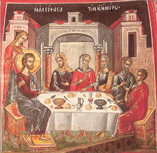
26 6When Jesus was in Bethany, in the house of Simon the leper, 7a woman came to Him having an alabaster flask of very costly perfumed ointment, and she poured it upon His head as He reclined at table. 8But His disciples, having seen it, became indignant, saying, “For what is this loss? 9“For it was possible for this perfumed ointment to have been sold for much and to have been given to the poor.” 10But Jesus, perceiving it, said to them, “Why do ye cause trouble to the woman? For she wrought a good work toward Me. 11“For ye have the poor among yourselves always, but Me ye have not always. 12“For in putting this perfumed ointment upon My body, she did it for My burial. 13“Verily I say to you, wheresoever this Gospel shall be proclaimed in all the world, also what she did shall be spoken of for a memorial of her.” 14Then one of the twelve, who was called Judas Iscariote, went to the chief priests, 15and said, “What are ye willing to give to me, and I will deliver Him up to you?” And they fixed by agreement with him for thirty pieces of silver. 16And from that time he sought an opportunity that he might deliver Him up.
Menaion — Fixed Calendar
The commemoration of our venerable Father Niketas the Confessor, Abbot of Medikion, and our holy Father Joseph the Hymnographer (commemorated on Sl. calendar on the 4th of April).
No readings given.
Lives of the Saints (Prologue)
April 16th – Civil Calendar
April 3rd – Church Calendar
1. St. Niketas the Confessor.
He was born in Bithynia, in the town of Caesarea. His father, Philaret, losing his wife, became a monk. Niketas remained with his paternal grandmother. After he had grown up and finished his schooling, he went to a monastery in Medikion, where Nikephoros, the abbot, tonsured him as a monk. After seven years of toil and asceticism, he was ordained hieromonk by Patriarch Tarasios. After the deaths of Nikephoros and Niketas’ great friend, Athanasius, the brethren chose Niketas as abbot, much against his will. St. Niketas was a holy example of life and asceticism to his brethren for many years. But when Leo V, the Armenian, came to the throne, following the devout Empress Irene and the pious Emperors Nikephoros and Michael, the iconoclast heresy sprang up again. The emperor deposed Patriarch Nikephoros and sent him into exile, and in his place put a heretic, Theodotus Kassiteras, a man of impure life. Niketas was imprisoned and tortured, but remained unwavering in his Orthodoxy. He was taken from prison to prison and tortured by hunger and thirst, by cold and heat and malice. But he remained utterly unwavering. A certain Nicholas pestered him particularly with his derision and malice. But one night the dead father of this Nicholas appeared to him in a dream and said: ‘Leave that servant of God alone!’ From that moment Nicholas repented, and not only refrained from pestering him but prevented others doing likewise. When the Emperor Leo the Armenian had made an evil end, the throne passed to the Orthodox Emperor Michael Balbus, who freed all the Orthodox sufferers. Niketas retired to a lonely place near Constantinople, where he spent the remaining days of his earthly life in prayer and thanksgiving to God. When he died, his body was taken to his monastery, and during that journey, many of the sick, on touching his body, were healed. His relics were placed close to the graves of his spiritual father, Nikephoros, and his friend Athanasius. This great hierarch entered into rest in 824.
2. St. Paul the Wretched.
A Russian by birth, he was enslaved by the Turks as a boy. Refusing to betray the Christian Faith and embrace Islam, he was tortured and beheaded in Constantinople in 1683.
3. The Holy Martyr Ulphianos.
A young man from the city of Tyre, he was tortured for Christ by the governor, Urban, the torturer of St. Amphianos (April 2nd). He was finally sewn into a sack, together with a dog and a snake, and thrown into the sea. He suffered and was glorified in 306.
FOR CONSIDERATION
‘I look to die a thousand deaths’—thus wrote St. Athanasius the Great to his flock in Egypt in the time of the terrible Arian heresy. Every spiritual man can say the same thing when he looks in spirit and sees the net in which the whole world is caught. The more spiritual the man, the thicker the net is seen to be. This is the will of God: that the most spiritual be saved by the narrowest path. And the psalmist himself said: ‘Many are the afflictions of the righteous.’ But, in the end, victory and glory fall to their lot. They only need to be armed with faith and patience. He who believes, understands his sufferings. He who arms himself with patience will see victory and glory. To those who love God, the narrowest way is sufficiently spacious, the greatest pains are the light yoke and the bitterest death is the joy of the wedding.
Daily Scripture Readings taken from The Orthodox New Testament, translated and published by Holy Apostles Convent, Buena Vista, Colorado, copyright © 2000, used with permission, all rights reserved.
Daily Prologue Readings taken from The Prologue of Ochrid, by Bishop Nikolai Velimirovic, translated by Mother Maria, published by Lazarica Press, Birmingham, England, copyright © 1985, all rights reserved. Edited by Dormition Skete.