

Daily Devotional
Sunday, April 13, 2025 (NS), March 31, 2025 (OS)
Fast Day, but Fish, Wine and Olive Oil Allowed.
Holy Week
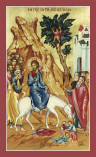
| Palm Sunday |
The commemoration of the appearance of the wonderworking image of the all-holy Theotokos, known as the Iveron Icon or Keeper of the Gate, and our venerable Father Hypatios the Wonder-worker, Bishop of Gangra, and our holy father among the saints, Innocent, Metropolitan of Moscow, Enlightener of Siberia and Alaska.
Scripture Readings
Paschalion — Movable Calendar
Palm Sunday
Epistle
The Reading is from the Epistle of Saint Paul to the Philippians [§ 247]. Brethren:
4 4Be rejoicing in the Lord always; again I will say, be rejoicing. 5Let your reasonableness be known to all men. The Lord is near: 6Cease being anxious about anything, but in everything by prayer and by entreaty, with giving of thanks, let your requests be made known to God. 7And the peace of God, which surpasseth all understanding, shall guard your hearts and your minds in Christ Jesus.
8For the rest, brethren, whatsoever things are true, whatsoever things are worthy of respect, whatsoever things are just, whatsoever things are pure, whatsoever things are pleasing, whatsoever things are of good report, if there is any virtue and if there is any praise, be considering these things. 9And what ye learned and received and heard and saw in me, these things be practising; and the God of peace shall be with you.
Gospel
In the Orthros
The Reading is from the Holy Gospel according to Saint Matthew [§ 83]. At that time:
21 1When Jesus drew near to Jerusalem, and came to Bethphage, toward the Mount of Olives, then Jesus sent forth two disciples, 2saying to them, “Go into the village, the one opposite you; and straightway ye shall find an ass which hath been tied, and a colt with her. Loose them and bring them to Me. 3“And if anyone should say anything to you, ye shall say, ‘The Lord hath need of them’; and straightway he will send them.” 4Now all this came to pass in order that it might be fulfilled that which was spoken by the prophet, saying, 5“Say to the daughter of Sion [Is. 62:11], ‘Behold thy King cometh to thee, meek, and mounted on an ass, and a colt, the foal of a beast of burden [cf. Zach. 9:9].’” 6And the disciples went and did even as Jesus commanded them, 7and brought the ass and the colt, and put their garments upon them, and He sat down upon them. 8And the greater part of the crowd spread their garments in the way; and others were cutting branches from the trees and were strewing them in the way. 9And the crowds, those going before and those following, were crying out, saying, “Hosanna, to the Son of David; blessed is He Who cometh in the name of the Lord [cf. Ps. 117(118):25(26)]; hosanna in the highest.” 10And after He entered into Jerusalem, all the city was shaken, saying, “Who is this?” 11And the crowds were saying, “This is Jesus the Prophet, the One from Nazareth of Galilee.”...
15But after the chief priests and the scribes saw the wonders which He did, and the children crying out in the temple and saying, “Hosanna, to the Son of David,” they were indignant, 16and said to Him, “Hearest Thou what these say?” And Jesus saith to them, “Yes; did ye never read, ‘Out of the mouth of babes and sucklings Thou hast perfected praise for Thyself [Ps. 8:2]’?” 17And He left them behind and went out of the city to Bethany, and He lodged there.
In the Liturgy
The Reading is from the Holy Gospel according to Saint John [§ 41].
12 1Six days before the passover, Jesus came to Bethany, where Lazarus was who had died, whom He raised from the dead. 2So they made a supper for Him there, and Martha was serving; but Lazarus was one of those reclining at table with Him. 3Then Mary, having taken a pound of very precious perfumed ointment of pure spikenard, anointed the feet of Jesus, and wiped His feet with her hair. And the house was filled with the odor of the perfumed ointment. 4Then one of His disciples, Judas Iscariote, Simon’s son, who was about to deliver Him up, saith, 5“Why was this perfumed ointment not sold for three hundred denarii and given to the poor?” 6But he said this, not that he was caring for the poor, but because he was a thief, and had the money box, and was taking away what was put in it. 7Then Jesus said, “Let her alone, for the day of My laying out for burial hath she kept it. 8“For ye have the poor among yourselves always, but Me ye have not always.” 9A great crowd of the Jews therefore knew that He was there, and they came not because of Jesus only, but also in order that they might see Lazarus, whom He raised from the dead. 10But the chief priests took counsel that they might put to death Lazarus also, 11because by reason of him many of the Jews were going away and were believing in Jesus.
12On the morrow a great crowd which came to the feast, after they heard that Jesus was coming into Jerusalem, 13took the palm branches of the palm trees, and went out to meet Him, and were crying, “Hosanna, blessed is He Who cometh in the name of the Lord, the King of Israel [cf. Ps. 117(118):25(26)].” 14And Jesus, having found a young ass, sat upon it, even as it is written: 15“Cease fearing, O daughter of Sion, behold, thy King cometh, sitting on a colt of an ass [cf. Zach. 9:9].” 16But the disciples knew not these things at the first; but when Jesus was glorified, then they remembered that these things were written in reference to Him, and that these things they did to Him. 17Then the crowd that was with Him when He called Lazarus out of the grave and raised him from the dead bore witness. 18On this account the crowd also went to meet Him, because it heard that He had done this sign.
Menaion — Fixed Calendar
The commemoration of the appearance of the wonderworking image of the all-holy Theotokos, known as the Iveron Icon or Keeper of the Gate, and our venerable Father Hypatios the Wonder-worker, Bishop of Gangra, and our holy father among the saints, Innocent, Metropolitan of Moscow, Enlightener of Siberia and Alaska.
Epistle
For the Icon:
The Reading is from the Epistle of Saint Paul to the Hebrews [§ 320]. Brethren:
9 1The first tabernacle also used to have both ordinances of worship and the sanctuary of this world. 2For a tabernacle was furnished: the first in which were both the lampstand and the table, and the laying forth of the loaves, which is called Holy; 3and after the second veil, a tabernacle which is called Holy of Holies, 4which hath a golden censer, and the ark of the covenant which hath been covered all around from every side with gold, in which was the golden jar having the manna, and the rod of Aaron that budded, and the tablets of the covenant; 5and above it were the cherubim of glory overshadowing the mercy seat, concerning which now is not the time to speak severally. 6Now after these things were thus furnished, the priests, on the one hand, enter into the first tabernacle, performing worship services; 7on the other hand, into the second, the high priest entereth alone once for all every year, not without blood, which he offereth on behalf of himself and the faults of ignorance of the people.
For the Hierarchs:
The Reading is from the Epistle of Saint Paul to the Hebrews [§ 318]. Brethren:
7 26Such a High Priest was fitting for us: holy, guileless, undefiled, Who hath been separated from the sinners and hath become higher than the heavens, 27Who hath no need daily, even as the high priests, to offer up sacrifices, first for his own sins, then for those of the people; for this He did once for all after He offered up Himself. 28For the law appointeth men high priests who have weakness; but the word of the oath, which is after the law, appointeth the Son, Who hath been perfected forever.
8 1Now in reference to the things being spoken of, the chief point is: We have such a High Priest, Who sat down on the right of the throne of the majesty in the heavens, 2a Liturgist of the holies and of the tabernacle, the true one, which the Lord pitched, and not man.
Gospel
For the Icon:
The Reading is from the Holy Gospel according to Saint Luke [§ 54]. At that time:
10 38 Jesus entered into a certain village. And a certain woman, by name Martha, received Him into her house. 39And she had a sister called Mary, who also sat down beside the feet of Jesus, and was listening to His word. 40But Martha was distracted about much serving, and she came up to Him and said, “Lord, is it no concern to Thee that my sister left me to serve alone? Speak to her therefore that she should help me.” 41And Jesus answered and said to her, “Martha, Martha, thou art anxious and troubled about many things. 42“But there is need of one thing, and Mary chose the good part, which shall not be taken away from her.”...
11 27And it came to pass, as He was speaking these things, a certain woman out of the crowd lifted up her voice and said to Him, “Blessed is the womb that bore Thee, and the breasts which Thou didst suck.” 28But He said, “Yea rather, blessed are they who hear the word of God and keep it.”
For the Hierarchs:
The Reading is from the Holy Gospel according to Saint Matthew [§ 11]. The Lord said to His disciples:
5 14“Ye are the light of the world. A city situated on the top of a mountain cannot be hid. 15“Nor do they light a lamp and put it under the bushel, but upon the lampstand, and it giveth light to all those in the house. 16“Thus, let your light shine before men, that they might see your good works, and might glorify your Father Who is in the heavens.
17“Do not begin to think that I came to abolish the law or the prophets; I came not to abolish, but to fulfill. 18“For verily I say to you, until the heaven and the earth shall have passed away, one iota or one tittle in no wise shall pass away from the law, until all shall have taken place. 19“Whosoever then shall break one of the least of these commandments, and shall teach men so, he shall be called least in the kingdom of the heavens; but whosoever shall do and teach them, this one shall be called great in the kingdom of the heavens.”
Lives of the Saints (Prologue)
April 13th – Civil Calendar
March 31st – Church Calendar
1. The Hieromartyr Hypatios, Bishop of Gangra.
Born in Cilicia, he was bishop in the town of Gangra. At the First Ecumenical Council, he was lauded on all sides for his devout life and miracles. The Emperor Constantius ordered a bust of Hypatios to be made in the saint’s lifetime, and he kept this bust in his palace as a weapon against every adverse power. Returning once from Constantinople, Hypatios was attacked in a gorge by a heretic, Novatian, and was pushed off the road into the mud. On top of that, a woman of that company threw a rock at his head, and the saint thus finished his earthly course. But this woman suddenly went insane, and taking the same rock, began to strike herself with it. When they brought her to the grave of St. Hypatios and prayed for her, she was healed by Hypatios’ compassionate spirit and spent the rest of her life in repentance and prayer. St. Hypatios suffered and went to the eternal kingdom of Christ our God in 326.
2. St. Jonah (Iona), Metropolitan of Moscow.
He was born in the province of Kostmor, becoming a monk at the age of twelve and as such living in the Simonov monastery near Moscow. He became Bishop of Ryazan in the time of Metropolitan Photius, and when Photius died, Jonah was chosen as metropolitan and sent to Constantinople for consecration and confirmation. But, at the same time, a man called Isidore, a Bulgarian by birth, outwitted Jonah, arrived in Constantinople before him and was consecrated as the Metropolitan for Russia. Jonah returned to his seat at Ryazan. But the malicious Isidore ended his reign as metropolitan in an evil way. He went to the Council of Florence, and only returned to Moscow three years later. He was condemned as an apostate from Orthodoxy and exiled. It is not known where he died. Jonah, the good and wise pastor, came to the Metropolitical throne. He was a great wonder-worker, a clairvoyant and a spiritual guide. When the Hagarenes besieged Moscow, Jonah sent them packing by his prayers. In old age, he desired to experience such illness that he would suffer greatly, and would by his sufferings be completely purified before his departure to the other world. At his prayer, God gave him wounds in his feet, which were foreseen in a vision by a priest, Iakov. The saint died of these wounds and went to join the citizens of heaven on March 31st, 1461. Many miracles were performed through his relics. A dumb man, John, was brought to the saint’s relics. John kissed Jonah’s hand, and as he related afterwards, the hand grabbed hold of his tongue and he felt a sharp pain. When it let his tongue go, he went back to his friends—and spoke as if he had never been dumb.
3. The Hieromartyr Audas, Bishop of the City of Suza.
He was beheaded for Christ in 418 in Persia by King Yazdgird. His deacon, St. Benjamin, was released by the torturers on condition that he preach the Gospel no more. He observed this condition for a time, but his heart could not bear it and he began again to spread the truth of Christ among the people. For this he was arrested and killed in 421, three years after St. Audas.
4. Our Holy Father Apollonius.
A famous Egyptian hermit, he renounced the world at the age of fifteen and withdrew to a mountain, where he lived for forty years eating only wild plants. After that, he founded a monastery in which he had 500 monks. He entered peacefully into rest in 395.
FOR CONSIDERATION
St. John of the Ladder says. ‘He who is inwardly proud of his own tears and condemns in his own mind those who do not weep, is like a man who begs weapons from the king against the enemy and kills himself with them.’ If your heart has been softened either by repentance before God or by learning the boundless love of God towards you, do not be proud towards those whose hearts are still hard. Remember how long your heart was hard. Seven brothers were ill in one hospital. One recovered from his illness and got up, and hastened to serve his other brothers with brotherly love, to speed their recovery. Be like this brother. Reckon all men as your brothers, and sick brothers at that. And if you come to feel that God has given something healthier to you than to them, know that that is given through mercy, that, as a healthy man, you may serve your frailer brethren. Who could take pride in that—as if health were all your own doing rather than God’s? As if a stagnant pool could clear of itself, and not be cleared by some spring, deeper and purer.
Daily Scripture Readings taken from The Orthodox New Testament, translated and published by Holy Apostles Convent, Buena Vista, Colorado, copyright © 2000, used with permission, all rights reserved.
Daily Prologue Readings taken from The Prologue of Ochrid, by Bishop Nikolai Velimirovic, translated by Mother Maria, published by Lazarica Press, Birmingham, England, copyright © 1985, all rights reserved. Edited by Dormition Skete.