

Daily Devotional
Sunday, March 23, 2025 (NS), March 10, 2025 (OS)
Fast Day, but Shellfish, Wine and Olive Oil Allowed.
Holy & Great Fast
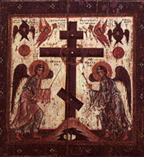
| The Sunday of the Third Week of the Great Fast or Sunday of the Veneration of the Cross. Mode Plagal Two — Sixth Eothinon |
The commemoration of the holy Martyr Quadratus of Corinth and those with him.
Scripture Readings
Paschalion — Movable Calendar
The Sunday of the Third Week of the Great Fast or Sunday of the Veneration of the Cross.
Mode Plagal Two — Sixth Eothinon
Epistle
The Reading is from the Epistle of Saint Paul to the Hebrews [§ 311]. Brethren:
4 14Having then a great High Priest Who hath passed through the heavens, Jesus the Son of God, let us be holding fast our confession. 15For we do not have a High Priest Who is not able to sympathize with our weaknesses, but One Who hath been tempted in all respects according to our likeness, without sin. 16Let us therefore be coming with boldness to the throne of grace, that we might receive mercy and find grace for help in due season.
5 1For every high priest being taken from among men is being appointed on behalf of men in things pertaining to God, that he may offer both gifts and sacrifices for sins, 2who is able to feel in due measure with those who are ignorant and led astray, since he himself also is compassed about with weakness. 3And by reason of this he ought, even for the people, so also for himself, to offer for sins. 4And no one taketh the honor to himself, but he who is called by God, even as also Aaron. 5Thus also the Christ glorified not Himself to become a high priest, but the One Who said to Him, “Thou art My Son, today I have begotten Thee [Ps. 2:7].” 6Even as He saith also in another place, “Thou art a priest forever according to the order of Melchisedek [Ps. 109(110):4].”
Gospel
The Reading is from the Holy Gospel according to Saint Mark [§ 37]. The Lord said:
8 34“Whosoever is willing to follow after Me, let him deny himself, and take up his cross, and keep on following Me. 35“For whosoever will save his life shall lose it; but whosoever will lose his life on account of Me and of the Gospel, this same one shall save it. 36“For what shall it profit a man, if he should gain the whole world, and lose his soul? 37“Or what shall a man give as an exchange for his soul? 38“For whosoever is ashamed of Me and My words in this generation, the adulterous and sinful one, also the Son of Man shall be ashamed of him, whenever He should come in the glory of His Father with the holy angels.”
9 1And He was saying to them, “Verily I say to you, that there are some of those standing here who in no wise shall taste of death, until they see the kingdom of God having come in power.”
Menaion — Fixed Calendar
The commemoration of the holy Martyr Quadratus of Corinth and those with him.
No readings given.
Synaxarion Readings
Synaxarion for the Third Sunday of Great Lent
Adoration of the Precious and Life-giving Cross
“Let all the earth venerate the Cross, through which it has learned to worship Thee, the Logos.”
On this third Sunday of the Great Fast we celebrate the veneration of the precious and life-giving Cross. Since during the forty days of the Fast we are also in a way crucified, mortified to the passions, contrite, abased, and sorrowful, the precious and life-giving Cross is offered to us as refreshment and confirmation, calling to mind the Passion of our Lord Jesus Christ and comforting us. If our God was crucified for our sake, how great should be our effort for His sake, since our afflictions have been assuaged through the Lord’s tribulations, and by the commemoration and the hope of the Cross of glory. For as our Savior in ascending the Cross was glorified through dishonor and grief, so should we also endure our sorrows, in order to be glorified with Him. Also, as those who have traveled a long hard road, weighed down by the labors of their journey, in finding a shady tree, take their ease for a moment and then continue their journey rejuvenated, so now in this time of the Fast, this sorrowful and laborious journey, the holy fathers have planted the life-giving Cross for our relief and refreshment, to encourage and make easier the labors that lie ahead. Or as when there is a royal procession, the king’s scepter and banners precede him, and then he himself appears, radiant and joyous in his victory, causing his subjects to rejoice with him. So then our Lord Jesus Christ, desiring to show His sure victory over death and His glory on the day of the Resurrection, sends His scepter before Himself, the sign of His kingship, the life-giving Cross, to gladden and refresh us, as it greatly fortifies and enables us to be prepared to receive the King with all possible strength and to praise Him in His radiant victory.
This week lies at the middle of the holy Forty Day Fast. The Fast is like a bitter source because of our contrition and the sadness and sorrow for sin that it brings. And as Moses plunged the branch in the bitter waters of Marah, making them sweet, so God, Who has led us through the spiritual Red Sea away from Pharaoh, through the life-giving wood of the precious and life-giving Cross, sweetens the bitterness of the Forty Day Fast and comforts us as those who were in the wilderness, until the time when by His Resurrection He will lead us to the spiritual Jerusalem. And since the Cross is called, and indeed is, the Tree of Life, it is fitting that the holy fathers have planted the Tree of the Cross in the middle of the Great Fast to commemorate both Adam’s tasting of its sweet fruit and of its being taken from us in favor of the Tree of the Cross, tasting of which we shall in no way die but will have even greater life.
Through the power of Thy Cross, O Christ our God, preserve us also from the temptations of the evil one. And make us worthy to venerate Thy divine Passion and life-bearing Resurrection, having radiantly traversed the great length of the Fast, and have mercy on us, as Thou art good and lovest mankind. Amen.
Translated from Triodion, siest ‘Tripesnets: Triod’ Postnaya, Moscow, 1904, by Robert Parent.
Lives of the Saints (Prologue)
March 23rd – Civil Calendar
March 10th – Church Calendar
1. The Holy Martyr Codratus (Kodratos) of Corinth, and others with him.
In a time of persecution of Christians, many of the faithful fled to the mountains and caves, as did Codratus’ mother. She was pregnant at the time, and gave birth to Codratus in a forest, dying almost at once. He was kept safe and fed by the providence of God and his guardian angel. Codratus grew up in solitude with nature. He Who gave manna from heaven to the Israelites in the wilderness released a sweet dew from a cloud onto the mouth of the child Codratus. When he was twelve years old, he went down to the town, and there some good people took a fancy to him and educated him. He studied medicine and then began to heal the sick, using both natural medicines, and more importantly, the spiritual power and prayer which had been with him from childhood. When a new persecution arose under Decius, Codratus was taken for trial and thrown into prison. Five of his friends stood beside him and confessed the name of Christ. They were: Cyprian, Dionysius, Anectus, Paul and Crescens. They were all dragged through the streets and struck with sticks and stones by the unbelievers, especially by the children, until they arrived at the scaffold. Here the martyrs prayed to God and were beheaded with the sword. A spring of water gushed out onto the earth at the spot, which to this day is called by Codratus’ name and commemorates the heroic death for Christ of the holy six. They suffered with honor for the truth in Corinth in the year 250, in the time of the Emperor Decius and his governor Jason.
2. The Holy Martyr Codratus of Nikomedia.
He was a rich nobleman and also a convinced and baptized Christian. In a time of persecution, when Valerian shut up many Christians in jail, Codratus bribed the warder and went into the prison to bring the captives food and uphold them in their faith. When they were brought before the judge and questioned about their names, place of origin and status, they were silent. Then Codratus appeared behind them and shouted at the top of his voice: ‘By name, we are Christians; servants of Jesus Christ the Lord by office and birth, and our city and place of origin is heaven.’ After this declaration he was brought to trial, and after long and harsh torture was beheaded along with the others.
3. Our Holy Mother Anastasia.
A patrician, she was a lady-in-waiting at the court of the Emperor Justinian. When she was widowed, and saw that the Empress Theodora could not abide her, she suddenly disappeared from Constantinople and took herself off to the Egyptian desert. A famous spiritual guide, Abba Daniel, tonsured her and presented her as the castrated monk Anastasius, by her wish, so that she might, as a woman under a man’s name, more easily evade the imperial searchers. Anastasia shut herself in a narrow cell, where she spent 28 years and where she entered into rest in the year 563. Before her death, the elder Daniel saw her face shining like the sun.
FOR CONSIDERATION
A tale by the elder Barlaam to Ioasaph: There was once a great and famous king; and it came to pass, when he was riding on a day in his golden chariot, with his royal guard, that there met him two men, clad in filthy rags, with fallen-in-faces, and pale as death. Now the king knew that it was by buffetings of the body and by the sweats of the monastic life that they had thus wasted their miserable flesh. So, seeing them, he leapt anon from his chariot, fell on the ground, and did obeisance. Then, rising, he embraced and greeted them tenderly. But his noblemen and counsellors took offence thereat, deeming that their sovereign had disgraced his kingly honor.... Then the king ordered four wooden caskets to be made. Two of these he covered over all with gold, and placing dead men’s moldering bones therein, secured them with golden clasps. The other two he smeared over with pitch and tar, but filled them with costly stones and precious pearls, and all manner of aromatic sweet perfume. The king set the four caskets before his noblemen, that they might appraise the value of these and those. Then he ordered the golden chests to be opened. And when they were thrown open, they gave out a loathsome smell and presented a hideous sight. Said the king, ‘Here is a figure of those who are clothed in glory and honor, and make great display of power and majesty, but within is the stink of dead men’s bones and works of iniquity.’ Next, he commanded the pitched and tarred caskets also to be opened, and delighted the company with the beauty and sweet savor of their stores. And he said unto them, ‘Know ye to whom these are like? They are like those lowly men, clad in vile apparel, whose outward form alone ye beheld, and deemed it outrageous that I bowed down to do them obeisance. But through the eyes of my mind I perceived the value and exceeding beauty of their souls, and was glorified by their touch, and I counted them more honorable than any chaplet or royal purple.’ Thus he shamed his courtiers, and taught them not to be deceived by outward appearances, but to give heed to the things of the soul.
Daily Scripture Readings taken from The Orthodox New Testament, translated and published by Holy Apostles Convent, Buena Vista, Colorado, copyright © 2000, used with permission, all rights reserved.
Daily Prologue Readings taken from The Prologue of Ochrid, by Bishop Nikolai Velimirovic, translated by Mother Maria, published by Lazarica Press, Birmingham, England, copyright © 1985, all rights reserved. Edited by Dormition Skete.