

Daily Devotional
Sunday, March 9, 2025 (NS), February 24, 2025 (OS)
Fast Day, but Shellfish, Wine and Olive Oil Allowed.
Holy & Great Fast
| The Sunday of the First Week of the Great Fast or Sunday of Orthodoxy. Mode Four — Fourth Eothinon |
24. The commemoration of the first and second finding of the honorable head of the Forerunner.
Scripture Readings
Paschalion — Movable Calendar
The Sunday of the First Week of the Great Fast or Sunday of Orthodoxy.
Mode Four — Fourth Eothinon
Epistle
The Reading is from the Epistle of Saint Paul to the Hebrews [§ mid 329]. Brethren:
Gk. usage, Heb. 11:24-26, 32-40; Sl. usage, Heb. 11:24-26, 32-12:2.
11 24By faith Moses, “having become full-grown [Ex. 2:11],” refused to be called the son of pharaoh’s daughter, 25having chosen rather to suffer affliction with the people of God, than to have the temporary enjoyment of sin, 26since he deemed the reproach of Christ greater wealth than the treasures in Egypt; for he kept on looking away from the treasures to the recompense.... 32And what more shall I say? For the time will fail me narrating about Gideon and Barak and also Samson and Jephthae, and about David and Samuel and the prophets, 33who through faith struggled against kingdoms, wrought righteousness, attained to promises, stopped mouths of lions, 34quenched the power of fire, escaped the edges of the sword, were empowered out of weakness, became strong in battle, turned back encampments of aliens. 35Women received their dead by resurrection. And others were tortured, not accepting release, that they might attain a better resurrection. 36And others received trial of mockings and of scourgings, and, moreover, of bonds and of imprisonment. 37They were stoned, they were sawn asunder, were tempted; they died, murdered by the sword. They went about in sheepskins, in goatskins, being in need, afflicted, ill-treated— 38of whom the world was not worthy. They were made to wander in deserts, and in mountains, and in caves, and in the holes of the earth. 39And these all, having been approved by testimony through faith, received not for themselves the promise, 40God having foreseen some better thing concerning us, that they should not be made perfect without us.
12 1Therefore we also, having so great a cloud of witnesses which is set around us, and having laid aside every weight and sin that is easily circumvented, let us by means of patience be running the course which is set before us, 2looking to Jesus, the originator and accomplisher of our faith.
Gospel
The Reading is from the Holy Gospel according to Saint John [§ 5]. At that time:
1 43Jesus intended to go forth into Galilee; and He findeth Philip, and saith to him, “Follow thou Me.” 44Now Philip was from Bethsaida, of the city of Andrew and Peter. 45Philip findeth Nathanael, and saith to him, “We have found the One of Whom Moses in the law, and the prophets, wrote—Jesus the son of Joseph, Who is from Nazareth.” 46And Nathanael said to him, “Out of Nazareth can there be any good thing?” Philip saith to him, “Come and see.” 47Jesus saw Nathanael coming toward Him, and saith concerning him, “Behold, truly an Israelite in whom is no guile.” 48Nathanael saith to Him, “From what place knowest Thou me?” Jesus answered and said to him, “Before Philip called thee, when thou wast under the fig tree, I saw thee.” 49Nathanael answered, and saith to Him, “Rabbi, Thou art the Son of God; Thou art the King of Israel.” 50Jesus answered and said to him, “Because I said to thee, ‘I saw thee underneath the fig tree,’ believest thou? Thou shalt see greater things than these.” 51And He saith to him, “Verily, verily, I say to thee, henceforth ye shall see the heaven having been opened, and the angels of God ascending and descending upon the Son of Man.”
Menaion — Fixed Calendar
24. The commemoration of the first and second finding of the honorable head of the Forerunner.
Epistle
For Gk. and some Sl. usages,
The Reading is from the Second Epistle of Saint Paul to the Corinthians [§§ 176, 177]. Brethren:
4 6It is God Who said, “Let there be light [cf. Gen. 1:3]” to shine out of darkness, Who shined in our hearts, for the illumination of the knowledge of the glory of God in the face of Jesus Christ.
7But we have this treasure in earthen vessels, that the preeminence of the power may be of God, and not from us. 8In every way we are afflicted, but not straitened; we are at a loss, but not utterly at a loss; 9persecuted, but not abandoned; cast down, but not destroyed— 10always bearing about in the body the dying of the Lord Jesus, that the life also of Jesus might be made manifest in our body. 11For we, the living, are always being delivered to death on account of Jesus, that also the life of Jesus might be made manifest in our mortal flesh. 12So that indeed death energizeth itself in us, but life in you. 13But having the same spirit of faith, according to that which hath been written: “I believed, wherefore I spoke [Ps. 115(116):1(10)],” we also believe, and therefore speak, 14knowing that the One Who raised up the Lord Jesus shall raise up us also through Jesus, and shall present us with you. 15For all things are for your sakes, that the grace, which abounded through the majority, might cause the giving of thanks to abound more to the glory of God.
for other Sl. usage, see [2 Cor. 4:6-12].
Gospel
The Reading is from the Holy Gospel according to Saint Matthew [§ 40]. At that time:
11 2After John heard in the prison the works of the Christ, he sent two of his disciples, 3and said to Him, “Art Thou the coming One, or do we look for another?” 4And Jesus answered and said to them, “Go and report to John what ye are hearing and seeing: 5“the blind are recovering their sight and the lame are walking; the lepers are being cleansed and the deaf are hearing; the dead are being raised and the poor are being preached the Gospel. 6“And happy is he, whosoever shall not be offended in Me.” 7And as these went their way, Jesus began to say to the crowds concerning John, “What went ye out into the wilderness to behold? A reed being shaken by the wind? 8“But what went ye out to see? A man who hath been clothed in soft garments? Behold, those wearing soft garments are in the houses of kings. 9“But what went ye out to see? A prophet? Yea, I say to you, and much more than a prophet. 10“For this is he about whom it hath been written: ‘Behold, I send forth My messenger before Thy face, who shall prepare Thy way before Thee [cf. Mal. 3:1].’ 11“Verily I say to you, there hath not arisen among those born of women a greater than John the Baptist; but the least in the kingdom of the heavens is greater than he. 12“And from the days of John the Baptist until now the kingdom of the heavens is being taken by force, and the forceful seize it. 13“For all the prophets and the law prophesied until John. 14“And if ye are willing to receive it, he is Elias, who is about to come. 15“The one who hath ears to hear, let him hear.”
Synaxarion Readings
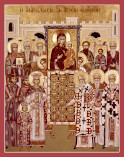
The Triumph of Orthodoxy Sunday
I rejoice when I see the veneration due the icons, once so shamefully rejected.
On this first Sunday of Great Lent, the Sunday of Orthodoxy, the Church of Christ celebrates the restoration of the holy and venerable icons by the Emperor Michael, the holy and blessed Empress Theodora, and the holy Methodius, patriarch of Constantinople.
Through God’s indulgence, Leo the Isaurian, a swineherd and keeper of donkeys, inherited the scepter of the kingdom in the 8th century. At that time Saint Germanos was at the helm of the Church. Leo sent for him and said, “Since it seems to me that there is no difference between the holy icons and idols, command that they be removed immediately from among us. Although if they are true likenesses of the saints, let them be hung higher on the walls so that we who are wallowing in sins do not defile them by venerating them.” But the patriarch responded thus to the emperor’s abomination, “O king, we have heard of someone who will come and raise his hand against the holy icons. He is called Conon. Could you be this man?” The emperor said, “I was so called as a child.” And since the patriarch refused to obey the emperor, the latter deposed him and installed Anastasios, who sympathized with him. And so at that time began the struggle against the holy icons.
After this Leo, Constantine Copronymos became heir to the kingdom as well as to the savage attacks against the holy icons. And what can be said about the number and kind of deeds that lawless man committed except that he came to a most shameful end. His son Leo, whose mother was a Khazar, inherited the kingdom after him, and he also came to a bad end. Irene and Constantine then ascended the throne. At the direction of the holy Patriarch Tarasius they assembled the Seventh Council, and the holy icons were once more accepted by Christ’s Church. After they relinquished the kingdom, Nicephoros ascended to the throne. After him there were Stavrakios and then Michael Rangabe, who did not persecute the Orthodox.
The beast-like Leo V the Armenian then seized the throne from Michael, and having been misled by an impious hermit, began the second iconoclasm. And once more the Church was bereft of her beauty. Michael Amorius succeeded him, whose son Theophilus then for the second time directed this madness against the icons. For it was this Theophilus who gave many of the holy fathers over to torments and tortures, not seeking the truth about the holy icons but believing whatever he would. “If there be anyone in the city intent on uprising, then he will be caught not long after,” he said. And after reigning for 12 years, he was stricken with an intestinal disorder so that he desired to relinquish his life. His mouth opened so wide that his internal organs were visible.
The empress was so upset at what had happened, that she could barely sleep. And in a dream she beheld the most pure Theotokos holding the pre-eternal Child, surrounded by most luminous angels. They were striking Theophilus her husband and humiliating him. Now when her dream had passed and Theophilus had come to his senses, he cried, “Woe is me in my wretchedness! I am struck for the sake of the holy icons.” And immediately the empress held an icon of the Theotokos above him and entreated her with tears. And Theophilus, so inclined, saw that one of the clergy surrounding him had an engolpion, which he grabbed and kissed. Now as soon as his lips touched the icon, he returned to normal and was relieved of the adversity and affliction and fell asleep, after confessing that it is good to venerate the holy icons. Then the empress, fetching the holy and precious images from her bedchamber, convinced Theophilus to kiss them and venerate them with all his heart. A short while afterwards Theophilus departed this life. Theodora then commanded that all who were in exile and in prison be freed. John Grammatikos was deposed from the patriarchal throne, since he was more a sorcerer and demon worshiper than a patriarch. Then Methodius, a confessor of Christ, ascended the throne, having suffered much through having been closed up in a tomb alive.
While he was there, Ioannikios the Great, who was practicing asceticism on Mount Olympus, received a divine visitation. The great faster Arsaakios came to him and said, “God has sent me to you, that we might go to the righteous Isaiah the recluse in Nicomedia and learn from him what God desires and what is fitting for His Church.” Now when they came to the venerable Isaiah, he said to them, “Thus saith the Lord: Behold, the end is approaching for the enemies of My image. Go to the empress Theodora and to the Patriarch Methodius and tell them: ‘Cease to do what is not holy, and offer sacrifice to Me with the angels by venerating the countenance of My image and of the Cross.’” Hearing this they immediately left for Constantinople and announced what had been said to Patriarch Methodius and all God’s assembled people. The assembly then went to the empress and found her agreeable in all things, since this was the pious and God-loving tradition of the fathers. The empress straightway brought out an icon of the Theotokos for all to see, and venerating it, she said, “Let all be condemned who do not venerate the holy icons, kissing them in love, not in worship as gods, but as images, for the sake of the love of their archetypes.” And they rejoiced with great joy. And in response she entreated them to pray for her husband Theophilus. Seeing her faith, they obeyed reluctantly. For Patriarch Methodius among the saints assembled all the people, priests and bishops and proceeded to God’s Great Church. Among the assembled were Ioannikios the Great from Olympus, Arsaakios, Pancratios, and the disciples of Theodore the Studite, and the confessors Theophanes and Theodore the Branded, Michael the synkellos of the Holy City and many others. And they prayed to God for Theophilus in tears all night long.
Now this took place throughout the first week of the Great Fast, with the Empress Theodora herself, the women, and all the people taking part. Having completed the prayers, the Empress Theodora retired at dawn on Friday, and dreamed that she was at the foot of the Cross, and there were several people passing by noisily, wearing various instruments of torture. As she recognized the Emperor Theophilus among those being led with his hands bound behind his back, she followed the group and its guards. When they reached the brass gates, she saw a supernatural vision, a man sitting in front of the image of Christ and Theophilus brought before him. Reaching to touch his feet, the empress prayed for the emperor. He opened his mouth and said, “Great is thy faith, O woman. Know that because of thy tears and thy faith, as well as the prayers and petitions of My servants and My priests, I grant forgiveness to thy husband Theophilus.” Then He said to the guards, “Loose him and give him to his wife.” And taking him, she departed rejoicing in gladness. And immediately the dream left her.
Now Patriarch Methodius, while the prayers and petitions were being offered for him, had taken a new parchment scroll and written the names of all the heretical emperors, including Theophilus, placing it under the holy altar table. But on Friday he saw a great and terrible angel entering the temple, coming to him and saying, “Thy petition has been heard, O bishop, and the Emperor Theophilus has received forgiveness. Trouble the Godhead about this no longer.” And desiring to ascertain the truth of his vision the patriarch descended from his place, and taking the parchment and unrolling it, he found—O the judgments of God!—that all reference to the name of Theophilus had been erased by God.
Upon hearing this, the empress rejoiced greatly and requested the patriarch to assemble all the people with the holy icons and crosses in Hagia Sophia so that it might be adorned with the holy icons and God’s new miracle could be known by all. And soon when all had gathered in the church holding candles, the empress arrived with her son. And a Litia was served there with the holy icons and the divine and precious wood of the Cross and with the sacred and divine Gospels. And leaving the church calling out, “Lord, have mercy,” they processed the agreed mile. Then they returned to the church, where Divine Liturgy was celebrated.
When the holy and precious icons were returned to their place, the holy men mentioned earlier and the pious Orthodox rulers were glorified, and those impious people who did not accept the honor of the holy icons were anathematized and condemned. And from that time these holy confessors appointed the annual commemoration of this solemnity, so that we might never again fall into a similar ignominy.
O unchanging Image of the Father, through the prayers of Thy holy confessors, have mercy on us. Amen.
Translated from Triodion, siest ‘Tripesnets: Triod’ Postnaya, Moscow, 1904, by Robert Parent.
Lives of the Saints (Prologue)
March 9th – Civil Calendar: Non-Leap Year
March 8th – Civil Calendar: Leap Year
February 24th – Church Calendar
1. The Finding of the Head of St. John the Baptist.
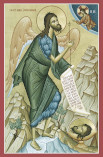 The great and glorious Forerunner was beheaded at the wish and request
of the wicked Herodias, wife of Herod. When John had been beheaded, Herodias ordered that his
head should not be buried with his body, for she feared that the terrible prophet would somehow
rise from the dead. So she took his head and buried it in some hidden and unworthy place, deep in
the earth. Her lady-in-waiting was Joanna the wife of Chuza, a courtier of Herod’s. This
good and God-fearing Joanna could not bear that the head of the godly man should remain in an
unworthy place, so she disinterred it secretly, took it to Jerusalem and buried it on the Mount
of Olives. Not knowing about all this, King Herod, when he heard about Christ and His great
miracles, was afraid and said: ‘It is John, whom I beheaded; he is risen from the
dead!’ (Mk. 6:16). After a considerable time, an eminent government official came to
believe in Christ, left his position in the world and became a monk. Under the name Innocent, he
settled on the Mount of Olives, in precisely the place where the Baptist’s head had been
buried. Deciding to build himself a cell, he dug deep and found an earthen pot containing a head
which, it was revealed to him secretly, was that of the Baptist. He venerated it and re-buried it
in the same place. By God’s providence, that wonder-working head went from hand to hand,
disappearing into the darkness of forgetfulness and then being once more revealed, until it was
finally taken to Constantinople in the middle of the 9th century, in the time of Patriarch
Ignatius and the God-fearing Empress Theodora, mother of Michael and wife of Theophilus. Many
miracles were performed by the head of the Forerunner. It is important and interesting to note
that, while he was alive, John did not work a single miracle (Jn. 10:41), but to his relics was
given the blessed power of working miracles.
The great and glorious Forerunner was beheaded at the wish and request
of the wicked Herodias, wife of Herod. When John had been beheaded, Herodias ordered that his
head should not be buried with his body, for she feared that the terrible prophet would somehow
rise from the dead. So she took his head and buried it in some hidden and unworthy place, deep in
the earth. Her lady-in-waiting was Joanna the wife of Chuza, a courtier of Herod’s. This
good and God-fearing Joanna could not bear that the head of the godly man should remain in an
unworthy place, so she disinterred it secretly, took it to Jerusalem and buried it on the Mount
of Olives. Not knowing about all this, King Herod, when he heard about Christ and His great
miracles, was afraid and said: ‘It is John, whom I beheaded; he is risen from the
dead!’ (Mk. 6:16). After a considerable time, an eminent government official came to
believe in Christ, left his position in the world and became a monk. Under the name Innocent, he
settled on the Mount of Olives, in precisely the place where the Baptist’s head had been
buried. Deciding to build himself a cell, he dug deep and found an earthen pot containing a head
which, it was revealed to him secretly, was that of the Baptist. He venerated it and re-buried it
in the same place. By God’s providence, that wonder-working head went from hand to hand,
disappearing into the darkness of forgetfulness and then being once more revealed, until it was
finally taken to Constantinople in the middle of the 9th century, in the time of Patriarch
Ignatius and the God-fearing Empress Theodora, mother of Michael and wife of Theophilus. Many
miracles were performed by the head of the Forerunner. It is important and interesting to note
that, while he was alive, John did not work a single miracle (Jn. 10:41), but to his relics was
given the blessed power of working miracles.
2. Our Holy Father Erasmus.
A monk of the Caves in Kiev, he inherited great wealth from his parents and spent it all on the beautifying of churches, especially on gold and silver covers for icons. When he had impoverished himself and left himself with nothing, he was despised by everyone. The devil suggested to him that he had squandered his goods in vain in using them for the beautifying of churches instead of giving them to the poor. Erasmus surrendered to this temptation and believed it, as a result of which he came to despise himself, fell into despair and began to live aimlessly and lawlessly. When the time of his death approached, the brothers gathered round him and began to speak of his sins, for he would not consider them for himself. But he suddenly sat up in bed and said: ‘My fathers and brethren, you have spoken thus and so, that I am a sinner and unrepentant, but lo, St. Anthony and St. Theodosius have appeared to me, and the most holy Mother of God, and have told me that the Lord has given me further time for repentance.’ The Mother of God also said these encouraging words to him: ‘The poor you have with you in every place, but my churches you have not.’ And he lived three days longer and repented and fell asleep in the Lord. This teaches us that zeal for the Church and for her beautification is a work pleasing to God. St. Erasmus entered into rest in 1160.
FOR CONSIDERATION
Those who let us do as we like are neither good teachers nor good friends. Blessed John Moschus writes about one eminent woman of senatorial family, who visited the Holy Land: ‘Arriving at Caesarea, she planned to remain there, and applied to the bishop with this request: “Find me a young woman to teach me the fear of God”. The bishop introduced her to a humble girl. After some time, he met this woman and asked her: “How is the girl that I introduced to you?” “She is all right”, replied the woman, “but she has been of little help to my soul because she lets me have my own way. It is because she is humble, but I need her to grumble at me and not let me do as I please”. The bishop found her someone else, a girl with a fairly rough character who grumbled at her, called her an ignorant rich woman and so forth. After some time, the bishop again asked the woman: “And how does this young woman get on with you?” “She is truly helpful to my soul”, replied the woman of senatorial family—and she thus became very humble.’ (‘The Spiritual Meadow’).
Daily Scripture Readings taken from The Orthodox New Testament, translated and published by Holy Apostles Convent, Buena Vista, Colorado, copyright © 2000, used with permission, all rights reserved.
Daily Prologue Readings taken from The Prologue of Ochrid, by Bishop Nikolai Velimirovic, translated by Mother Maria, published by Lazarica Press, Birmingham, England, copyright © 1985, all rights reserved. Edited by Dormition Skete.