

Daily Devotional
Sunday, March 2, 2025 (NS), February 17, 2025 (OS)
All Foods Allowed Except Meat.
Cheesefare Sunday - Forgiveness Sunday
Last day for Fish & Dairy until Pascha.
Sunday of the Cheesefare or Sunday of Forgiveness, the Sunday Before the Great Fast on Which We Commemorate the Casting Out of Adam From Paradise.
Mode Three — Third Eothinon
The commemoration of the holy Great-martyr Theodore the Recruit, and Hieromartyr Hermogenes, Patriarch of Moscow and All Russia.
Scripture Readings
Paschalion — Movable Calendar
Sunday of the Cheesefare or Sunday of Forgiveness, the Sunday Before the Great Fast on Which We Commemorate the Casting Out of Adam From Paradise.
Mode Three — Third Eothinon
Epistle
The Reading is from the Epistle of Saint Paul to the Romans [§ 112]. Brethren:
13 11Now our salvation is nearer than when we believed. 12The night is advanced, and the day hath drawn near. Let us therefore put away from ourselves the works of darkness, and let us put on the weapons of light. 13Let us walk becomingly, as in the day, not in revellings and drunkenness, not in acts of unlawful intercourse and licentiousness, not in strife and jealousy. 14But put on the Lord Jesus Christ, and cease taking forethought for the flesh, in regard to the lusts thereof.
14 1Now the one who is weak in the faith, be taking to yourselves, but not for passing judgments upon his opinions. 2One, on the one hand, hath faith to eat all things; but one, on the other hand, who is weak, eateth herbs. 3Let not the one who eateth despise him who eateth not, and let not the one who eateth not judge him who eateth; for God hath taken him to Himself. 4Who art thou who judgeth Another’s household slave? To his own Lord he standeth or falleth; but he shall be made to stand, for God is able to make him stand.
Gospel
The Reading is from the Holy Gospel according to Saint Matthew [§ 17]. The Lord said:
6 14“If ye forgive men their transgressions, your heavenly Father will also forgive you; 15“but if ye forgive not men their transgressions, neither will your Father forgive your transgressions.
16“And whenever ye are fasting, cease being as the hypocrites, of a sad countenance; for they artificially disfigure their faces, in such a manner that they might appear to men fasting. Verily I say to you that they have their reward. 17“But thou, when thou fastest, anoint thy head and wash thy face, 18“so that thou mightest not appear to men fasting, but to thy Father Who is in secret; and thy Father, Who seeth in secret, shall reward thee in the open.
19“Cease treasuring up for yourselves treasures upon the earth, where moth and rust doth destroy, and where thieves dig through and steal; 20“but be treasuring up for yourselves treasures in heaven, where neither moth nor rust doth spoil, and where thieves do not dig through nor steal. 21“For where your treasure is, there will your heart be also.”
Menaion — Fixed Calendar
The commemoration of the holy Great-martyr Theodore the Recruit, and Hieromartyr Hermogenes, Patriarch of Moscow and All Russia.
Epistle
For the Great-martyr:
The Reading is from the Second Epistle of Saint Paul to Saint Timothy [§ 292]. Child Timothy:
2 1Be thou empowered in the grace that is in Christ Jesus; 2and the things which thou heardest from me in the midst of many witnesses, commit thou these things to faithful men who shall be competent also to teach others. 3Thou therefore suffer hardship as a good soldier of Jesus Christ. 4No one serving as a soldier is entangled with the affairs of life, in order that he might please the one who enlisted him. 5And if anyone also contend as an athlete in the games, he is not crowned unless he contend lawfully. 6The farmer who laboreth must be first to partake of the fruits. 7Be considering what I say; O may the Lord give thee understanding in all things! 8Be remembering Jesus Christ, of the seed of David, Who hath been raised from the dead, according to my Gospel, 9in which I suffer hardship even to bonds as a malefactor, but the word of God hath not been bound. 10On this account I endure all things for the sake of the elect, that they might also attain salvation that is in Christ Jesus with eternal glory.
For the Hierarch:
The Reading is from the Epistle of Saint Paul to the Hebrews [§ 335]. Brethren:
13 17Be obedient to those who lead you, and keep on submitting, for they are watchful for your souls, as those about to render an account, that they may do this with joy, and not groaning; for this would be unprofitable for you. 18Keep on praying for us; for we trust that we have a good conscience, in all things wishing to conduct ourselves well. 19But I beseech you more abundantly to do this, that I might be restored more quickly to you.
20Now the God of peace Who brought up from the dead our Lord Jesus, the Shepherd of the sheep, the great One, in the blood of an everlasting covenant, 21may He render you perfect in every good work, in order to do His will, doing in you that which is well-pleasing before His face, through Jesus Christ, to Whom be glory to the ages of the ages. Amen.
Gospel
For the Great-martyr:
The Reading is from the Holy Gospel according to Saint Luke [§ 103]. The Lord said to His disciples:
20 46“Be on your guard against the scribes, who wish to walk about in full dress, and love salutations in the marketplaces, and chief seats in the synagogues, and chief places at the dinners, 47“who devour the houses of the widows, and for a pretense offer long prayers. They shall receive greater judgment.”
21 1And He looked up and saw the rich casting their gifts into the treasury. 2And He saw also a certain poor widow casting in that place two lepta. 3And He said, “Truly I say to you that this poor widow cast in more than all; 4“for all these did cast into the gifts of God out of that which is superfluous to them, but she, out of her need, cast in her whole means of living which she had.”
for Sl. usage, see [Jn. 15:17-16:2].
For the Hierarch:
The Reading is from the Holy Gospel according to Saint John [§ 36]. The Lord said to the Jews who had come to Him:
10 9“I am the door; by Me if anyone should enter, he shall be saved, and shall go in and go out and find pasture. 10“The thief cometh not, except that he might steal, and slay, and destroy. I came that they may have life, and may have it abundantly. 11“I am the good shepherd. The good shepherd layeth down his life for the sheep. 12“But the hireling, who indeed is not a shepherd, whose own the sheep are not, seeth the wolf coming, and leaveth the sheep and fleeth; and the wolf seizeth them and scattereth the sheep. 13“Now the hireling fleeth, because he is a hireling and careth not about the sheep. 14“I am the good shepherd; and I know those that are Mine, and am known of those that are Mine. 15“Even as the Father knoweth Me, I also know the Father; and I lay down My life for the sheep. 16“And I have other sheep which are not of this fold; them also it is needful for Me to bring, and they shall hear My voice; and there shall be one flock and one Shepherd.”
Synaxarion Readings
Cheesefare Sunday
Let all the earth weep bitterly with the fathers of our race, for it is fallen with those who tasted the sweet fruit of the tree.
On this day we commemorate the fall of Adam the first-created from partaking of the fruit of Paradise, which our holy and divine fathers have appointed for the Sunday before Great Lent in order to demonstrate the great healing effect of the fast upon human nature and the great harm of intemperance and disobedience. Setting aside the countless instances of these vices in the world, the fathers have put forth a vivid example in first-created Adam, who suffered great harm in his total failure to fast and brought this harm upon our nature. He did not keep the first commandment of a beneficial fast which God had required of mankind, but yielding to the desires of his belly and of the serpent through Eve, he not only did not become godlike, but he gave rise to death, bringing perdition upon all our race. For the sake of Adam’s intemperance the Lord fasted for forty days and was obedient. It was for this reason that the holy apostles conceived this present forty-day fast, so that as Adam forfeited incorruption through his intemperance, we may regain it through abstinence. Also, as was stated earlier, it was the intent of the holy fathers through the Triodion to relate in a condensed form all of God’s acts from the beginning to the end of the world. Since Adam’s transgression and fall through the eating of the fruit of the tree is the principal cause of the state of mankind, the fathers exhort us who are observing this commemoration to avoid Adam’s sin and to shun intemperance in all things.
Now it was on the sixth day that Adam was created by the hand of God after His own image and through His life-giving breath. Receiving God’s commandment, he lived in Paradise up until the sixth hour, when he disobeyed God’s command and was driven out. And as he stretched out his hand at the sixth hour to touch the fruit, so the new Adam, Christ, at the sixth day and hour stretched out his hands upon the Cross, annulling the sentence of perdition brought about by the former Adam. For he was created in the midst of corruption and incorruption through providence, with the freedom of choice. God could have made Adam sinless, yet His providence was to provide for reparation. For this cause He gave His commandment that Adam might partake of all in the garden, save the one tree. Does this not mean that Adam was meant to understand the essence of all created things by the divine power but was not to attempt to understand the essence of the Godhead? That is to say, God commanded Adam to concern himself with all other elements and qualities, reasoning with his mind to the glory of God; for this is true nourishment. But he was not to search for the divine essence: God, Who He is, where He is, and how He brought all things into being out of nothingness. Yet to his own harm Adam, having no care for the other things, sought to examine God and to determine His essence; and since he was not perfect but still a simple child, he failed in his undertaking, when through Eve Satan planted in him the desire of becoming like God.
Some say that the tree of disobedience was a fig tree, and becoming aware of their nakedness, Adam and Eve used its leaves to cover themselves. For this reason Christ cursed the fig tree as the cause of that disobedience, attributing to it a sort of resemblance to sin. For having transgressed becoming clothed in mortal flesh and receiving the curse, Adam was driven from Paradise. And at God’s command a flaming sword guarded its gates. Adam sat before the gates of Paradise and lamented the many blessings he had lost in his failure to observe a timely fast. And through him the entire race shared in that sentence, until our Creator, taking pity on our nature which because of Satan was perishing, was born of the holy Virgin and lived an exceptional life, showing us the path away from the devil, that is abstinence and humility, and valiantly gaining the victory over the deceiver, returned us to our former state.
In their desire to lay all these events before us, the God-bearing fathers have begun with the Old Testament: the creation of the world, the fall of Adam through the eating of the fruit, which we commemorate today, and later on the words of Moses and the prophets and the poetry of David, which impart grace. Afterwards in order, the events of the New Testament, of which the first is the Annunciation, which always occurs during the Great Fast through God’s ineffable providence, the raising of Lazarus, Palm Sunday, the reading of the sacred Gospels during Holy Week, and the profound texts of the holy and saving Passion of Christ. After this the Resurrection and the rest up to the descent of the Holy Spirit read in the Book of Acts, how this event became a proclamation that assembled all the saints together, for in the Book of Acts the Resurrection is confirmed through signs and wonders.
Since we have so suffered from Adam’s failure to keep the fast, this event is commemorated today at the beginning of Great Lent, so that keeping in mind the enormous evil brought about by Adam’s intemperance, we may make joyful haste to accept and keep the fast. And as Adam sinned in his desire to become godlike, we may thereby receive godliness through fasting, tears, and humility until God visits us; for without these it is impossible to regain that which we have lost. It should be also noted that the holy forty-day fast is the tenth part of the entire year. Since out of indolence we are not willing to fast constantly or to rid ourselves of evil habits, the apostles and divine fathers have passed down the Fast to us as a sort of first offering of the harvest of our lives. And as we have acted inappropriately for the entire year, we may now cleanse our souls through fasting, contrition, and humility. We should keep the Great Fast with the utmost care. For as there are four seasons in the year, so there are four fasts. Yet the divine apostles have entrusted Lent to us as the greatest of the fasts, since it honors the Holy Passion of Christ, His fast, and His glorification. Moses also fasted forty days before he received the Law, also Elias, Daniel, and all who found favor in God’s sight. Adam illustrates for us the benefit of the fast as opposed to intemperance. For this reason Adam’s banishment from Paradise was appointed by the holy fathers to be commemorated on this day.
In Thine ineffable compassion, O Christ our God, make us worthy of the nourishment of Paradise, and have mercy on us, as Thou alone lovest mankind. Amen.
Translated from Triodion, siest ‘Tripesnets: Triod’ Postnaya, Moscow, 1904, by Robert Parent.
Lives of the Saints (Prologue)
March 2nd – Civil Calendar: Non-Leap Year
March 1st – Civil Calendar: Leap Year
February 17th – Church Calendar
1. The Holy and Great Martyr Theodore the Tyro.
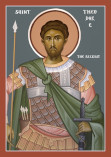 ‘Tyro’
means ‘Recruit’. No sooner had St. Theodore entered the Marmarite regiment of the
army in the town of Amaseia than a persecution of Christians broke out under the Emperors
Maximian and Maximinus. Theodore did not attempt to conceal that he was a Christian, and was
brought to trial and imprisoned in a prison that was then locked and sealed. The wicked judge
intended him to die of hunger, but the Lord Christ Himself appeared to Theodore in the prison and
encouraged His martyr with these words: ‘Fear not, Theodore; I am with thee. Take no more
earthly food and drink, for thou shalt be in the other life, eternal and unending, with Me in
heaven.’ Then a multitude of angels appeared in the prison, and the whole place shone with
light. The warders on duty saw the angels in white apparel and were filled with fear. Then St.
Theodore was taken out, tortured and condemned to death. He was thrown into fire, and gave his
soul to the most high God. He suffered in 306.
‘Tyro’
means ‘Recruit’. No sooner had St. Theodore entered the Marmarite regiment of the
army in the town of Amaseia than a persecution of Christians broke out under the Emperors
Maximian and Maximinus. Theodore did not attempt to conceal that he was a Christian, and was
brought to trial and imprisoned in a prison that was then locked and sealed. The wicked judge
intended him to die of hunger, but the Lord Christ Himself appeared to Theodore in the prison and
encouraged His martyr with these words: ‘Fear not, Theodore; I am with thee. Take no more
earthly food and drink, for thou shalt be in the other life, eternal and unending, with Me in
heaven.’ Then a multitude of angels appeared in the prison, and the whole place shone with
light. The warders on duty saw the angels in white apparel and were filled with fear. Then St.
Theodore was taken out, tortured and condemned to death. He was thrown into fire, and gave his
soul to the most high God. He suffered in 306.
2. Our Holy Fathers Theodosius (Teodosy) the Bulgarian and Roman his pupil.
As a monk, Theodosius settled not far from the town of Trnovo, where he founded a community which became known as ‘Theodosius’ after him. He was prominent in the council in Bulgaria against the Bogomils in 1360. Upholding the Orthodox Faith at that council, he put the Bogomils to shame by his reasoning. He finished his earthly course in Constantinople in 1362. His disciple, Roman, continued in asceticism in Theodosius’ community until his death.
3. St. Mariamna (Maria).
The sister of the apostle Philip, she traveled with her brother, and with him preached the Gospel in Hierapolis and in other places. After Philip had died a martyr’s death, Mariamna continued her missionary work in Lykaonia, where she died.
FOR CONSIDERATION
He is an artist who draws out and carves the shapes of living creatures from rough and formless stone. He is an artist who weaves many-colored carpets from the wool of sheep. He is an artist who builds a magnificent palace of clay bricks. But what artist in the world can equal Christ the Artist—Who makes the illiterate into wise men, fishermen into apostles, turns old men into heroes and the dissolute into saints? But everything must be given into the hand of the artist, that he may bring into being that which he is capable of creating. And all sorts of things are, in fact, committed to the hand of the artist. And men must be given into the hand of Christ, that He may draw out from them and build that which He alone knows and is able to create. Nineteen past centuries witness to us that all they who, far from standing against Christ the Artist, gave themselves to Him, were changed from brutish and ignorant beings into angelic sons of God.
Daily Scripture Readings taken from The Orthodox New Testament, translated and published by Holy Apostles Convent, Buena Vista, Colorado, copyright © 2000, used with permission, all rights reserved.
Daily Prologue Readings taken from The Prologue of Ochrid, by Bishop Nikolai Velimirovic, translated by Mother Maria, published by Lazarica Press, Birmingham, England, copyright © 1985, all rights reserved. Edited by Dormition Skete.