

Daily Devotional
Sunday, February 16, 2025 (NS), February 3, 2025 (OS)
No Fasting.
| Fifth Period Mode One — First Eothinon |
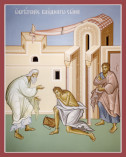
The commemoration of the Afterfeast of the Meeting of the Lord, and the holy and Righteous Symeon the God-receiver, and the holy Prophetess Anna.
Scripture Readings
Paschalion — Movable Calendar
Fifth Period
Sunday of the Thirty-Fourth Week or Sunday of the Prodigal Son
Mode One — First Eothinon
Epistle
The Reading is from the First Epistle of Saint Paul to the Corinthians [§ 135]. Brethren:
6 12All things are lawful to me, but all things are not expedient; all things are lawful to me, but I will not be brought under the power of any. 13Foods for the belly, and the belly for foods; but God shall bring to nought both this and these. Now the body is not for fornication, but for the Lord; and the Lord for the body. 14And God both raised up the Lord, and will raise up us by His own power. 15Ye know that your bodies are members of Christ, do ye not? Having taken up then the members of Christ, shall I make them members of a harlot? May it not be! 16Or know ye not that he that is joined to the harlot is one body? For, “The two,” saith He, “shall be into one flesh [Gen. 2:24].” 17But he who is joined to the Lord is one spirit. 18Keep on fleeing fornication. Every sin whatsoever a man might do is outside the body, but he who committeth fornication sinneth against his own body. 19Or know ye not that your body is a temple of the Holy Spirit Who is in you, Whom ye have from God, and ye are not your own? 20For ye were bought with a price; glorify then God in your body and in your spirit, which are God’s.
Gospel
The Reading is from the Holy Gospel according to Saint Luke [§ 79]. The Lord said this parable:
15 11“A certain man had two sons. 12“And the younger of them said to the father, ‘Father, give to me the portion of the property which falleth to me.’ And he divided to them his means of living. 13“And not many days after, the younger son, having gathered all together, went abroad into a distant land, and there scattered his property, living profligately. 14“But after he spent all, there arose a severe famine throughout that land, and he began to be in want. 15“And he went and joined himself to one of the citizens of that land; and he sent him into his fields to feed swine. 16“And he was longing to fill his belly from the husks, which the swine were eating; and no one was giving to him. 17“But having come to himself, he said, ‘How many hired servants of my father abound in loaves, and I am perishing with hunger! 18“‘I will arise and go to my father, and will say to him, “Father, I sinned against heaven and before thee, 19“‘“and am no longer worthy to be called thy son; make me as one of thy hired servants.”’ 20“And he rose up and went to his father. But when he was yet far away, his father saw him and was moved with compassion, and ran, and fell upon his neck, and ardently kissed him. 21“And the son said to him, ‘Father, I sinned against heaven and before thee, and am no longer worthy to be called thy son.’ 22“But the father said to his slaves, ‘Bring forth the robe, the chief one, and clothe him, and provide a ring for his hand and sandals for the feet. 23“‘And bring the calf, the fattened one, and slay it; and let us eat and be merry; 24“‘for this my son was dead and is alive again; and he was lost and is found.’ And they began to be merry. 25“Now his son, the elder one, was in a field; and as he came and drew near to the house, he heard music and dancing. 26“And he summoned one of his servants, and began inquiring what these things may be. 27“And he said to him, ‘Thy brother is come, and thy father slew the calf, the fattened one, because he received him back safe and sound.’ 28“But he was angry and not willing to go in. Then his father went out and besought him. 29“And he answered and said to his father, ‘Behold, so many years I am serving thee, and never did I transgress thy commandment, and never didst thou give a kid to me, in order that I might make merry with my friends; 30“‘but when this thy son came, the one who devoured thy means of living with harlots, thou didst slay for him the calf, the fattened one.’ 31“And he said to him, ‘Child, thou art always with me, and all that is mine is thine. 32“‘But to make merry and to rejoice was fitting, because this thy brother was dead and is alive again, and was lost and is found.’”
Menaion — Fixed Calendar
The commemoration of the Afterfeast of the Meeting of the Lord, and the holy and Righteous Symeon the God-receiver, and the holy Prophetess Anna.
Epistle
The Reading is from the Epistle of Saint Paul to the Hebrews [§ mid 321]. Brethren:
9 11Christ, Who came as High Priest of the coming good things, by means of the greater and more perfect tabernacle—not made by hand, that is, not of this creation, 12nor by blood of goats and of calves, but by His own blood—entered once for all into the Holies, having Himself obtained eternal redemption. 13For if the blood of bulls and of goats and ashes of a heifer, sprinkling those who have been defiled, sanctifieth to the purity of the flesh, 14how much more shall the blood of the Christ, Who through the eternal Spirit offered Himself without blemish to God, purify your conscience from dead works in order to worship the living God?
Gospel
For the God-receiver:
The Reading is from the Holy Gospel according to Saint Luke [§ 8]. At that time:
2 25There was a man in Jerusalem whose name was Symeon, and this man was just and pious, waiting for the consolation of Israel, and the Holy Spirit was upon him. 26And it had been divinely revealed to him by the Holy Spirit that he should not see death before he should see the Christ of the Lord. 27And he came in the Spirit into the temple. And when the parents were bringing in the little Child Jesus, in order to do for Him according to the custom of the law, 28he also received Him into his arms and blessed God and said, 29“Now lettest Thy slave depart in peace, O Master, according to Thy word; 30“for mine eyes have seen Thy salvation, 31“which Thou didst prepare before the face of all the peoples, 32“a light for revelation to the nations and the glory of Thy people Israel.” 33And Joseph and His Mother were marvelling at the things which were spoken concerning Him. 34And Symeon blessed them, and said to Mariam His Mother, “Behold, this One is set for the fall and rising up of many in Israel, and for a sign which is contradicted— 35“and as to thee a sword shall go through thine own soul also—in order that the reckonings of many hearts might be revealed.” 36And there was Anna, a prophetess, a daughter of Phanuel, of the tribe of Aser. She was advanced in many days, having lived with a husband seven years from her virginity. 37And she was a widow about eighty-four years, who departed not from the temple, and worshipped God with fastings and entreaties night and day. 38And she, having stood by, at the same hour, was giving thanks to the Lord and kept on speaking about Him to all those waiting for redemption in Jerusalem.
39And when they performed all things according to the law of the Lord, they returned to Galilee, to their city Nazareth.
40And the little Child was growing and showing Himself strong in spirit, being filled with wisdom; and the grace of God was upon Him.
Synaxarion Readings
Sunday of the Prodigal Son
If anyone be a prodigal as I, take courage and turn back; for the gates of God’s mercies are opened to all.
On this day we celebrate the Sunday of the Prodigal Son, dedicated as the second service of the Triodion by the divine fathers for the following reason. There are some who recognize much in themselves that is unbecoming, who live a life of great dissipation from their youth, whose lives are full of drunkenness and immorality, who having fallen thus into the depths of evil, become despondent, giving birth to pride, from whence they have no desire to advance to any of the virtues, preferring their bondage to evil and falling ever deeper into evil. Having a fatherly love for even these individuals, and desiring to lead them out of their despair, the holy fathers prescribed this parable for the second preparatory Sunday in order to tear up the passion of despair by the roots, to lead them to acceptance of the virtues, and to demonstrate to sinners the abundance of God’s compassion upon sinners and prodigals in His great goodness and love for mankind. For there is no sin which cannot be overcome by the knowledge of His love for mankind, and this is what is presented in this parable of Christ.
Now the sons of man—that is, of the Logos, God and Man—are two: the righteous and the sinful. It is the eldest who abides ever in God’s blessings, following His commandments and remaining always by Him. But the younger son, having become attached to sin and renouncing his closeness to God through shameful deeds, has wasted God’s love for mankind and for him and has lived as a prodigal. For having completely rejected Him after Whose image he was created, and having followed an evil demon, willingly enslaving himself to this demon’s pleasure, he was unable to fulfill his desire. For sin is an unsatisfying thing that becomes a habitual source of only temporary pleasure. It may be compared to the husks that are fed to swine. At first it seems that they might be something tasty, but they turn out to be very dry and are much like weeds, which is how sin takes possession. For the prodigal son had hardly come to his senses when, perishing from hunger for virtue, he comes to his father, saying, “Father, I have sinned before heaven and before thee, and I am not worthy to be called thy son.” Yet the father receives him in repentance, not reproaching him but embracing him and kissing him in a display of divine and fatherly love. And he clothes him, a symbol of Baptism, putting a ring on his finger, a symbol of the grace of the All-Holy Spirit. He also puts sandals on his feet, not so much as a protection from some serpent or scorpion that might sting him on his path to God, but rather as a means of crushing the heads of those creatures. And then in a tremendous display of joy he slaughters the fatted calf for him, his only-begotten Son, and the Father grants him communion of His body and blood. Now the elder son expresses his amazement at his father’s limitless mercy. But the lover of mankind exhorts him to silence with loving and kind words of humility, saying, “Thou art ever with me, and it was meet that we should make merry and be glad, for my son was formerly dead in his sin and is alive again, having repented of the foolish things he has done. He was lost, since he was far from me in his licentious habits, and he was found by me, suffering in my compassion and calling him back in my mercy.” This parable may be applied to us as well, which is why the holy fathers have prescribed it for today. We who have sinned as the prodigal are encouraged to weed out despair and fear through repentance, confession, and good works. For this is a great aid and a powerful weapon against the assaults of the adversary.
In Thine ineffable love for mankind, O Christ our God, have mercy upon us. Amen.
Translated from Triodion, siest ‘Tripesnets: Triod’ Postnaya, Moscow, 1904, by Robert Parent.
Lives of the Saints (Prologue)
February 16th – Civil Calendar
February 3rd – Church Calendar
1. St. Simeon the God-Receiver.
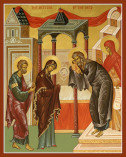 This Simeon was chosen, in the time of the
Egyptian Pharaoh Ptolemy Philadelphus (285-246 B.C.), as one of the famous Seventy to whom was
committed the task of translating the Old Testament from the Hebrew into Greek. Simeon worked
conscientiously, but when translating the Prophet Isaias, he came to the prophecy: ‘Behold,
the virgin shall conceive and bear a son’. He was puzzled and took a knife to scratch out
the word ‘virgin’ and substitute ‘young woman,’ and thus translate it
into Greek. But at that moment an angel of God appeared to him and held him back from his
intention, explaining to him that the prophecy was true and rightly-expressed. And to confirm its
veracity, the messenger from God said that he, Simeon, by the will of God, would not die until he
had seen the Messiah born of a virgin. The righteous Simeon rejoiced at these heavenly tidings,
left the prophecy unchanged and thanked God that He had found him worthy to live to see the
Promised One. When the Christ Child was brought to the temple in Jerusalem by the Virgin Mary,
the Spirit of God revealed this to Simeon, who was now a very old man with snow-white hair. He
went quickly to the temple and found there both the Virgin and the Child, bathed in a light that
shone round their heads like a halo. The joyful elder took Christ in his arms and prayed to God
to let him leave this world: ‘Now lettest Thy slave depart in peace, O Master, according to
Thy word; for mine eyes have seen Thy salvation.’ Thither came also Anna the prophetess,
the daughter of Phanuel, who recognized the Messiah and made Him known to the people. Anna was
then 84 years old. Soon after that, St. Simeon departed this life. This righteous elder is
venerated as the protector of young children.
This Simeon was chosen, in the time of the
Egyptian Pharaoh Ptolemy Philadelphus (285-246 B.C.), as one of the famous Seventy to whom was
committed the task of translating the Old Testament from the Hebrew into Greek. Simeon worked
conscientiously, but when translating the Prophet Isaias, he came to the prophecy: ‘Behold,
the virgin shall conceive and bear a son’. He was puzzled and took a knife to scratch out
the word ‘virgin’ and substitute ‘young woman,’ and thus translate it
into Greek. But at that moment an angel of God appeared to him and held him back from his
intention, explaining to him that the prophecy was true and rightly-expressed. And to confirm its
veracity, the messenger from God said that he, Simeon, by the will of God, would not die until he
had seen the Messiah born of a virgin. The righteous Simeon rejoiced at these heavenly tidings,
left the prophecy unchanged and thanked God that He had found him worthy to live to see the
Promised One. When the Christ Child was brought to the temple in Jerusalem by the Virgin Mary,
the Spirit of God revealed this to Simeon, who was now a very old man with snow-white hair. He
went quickly to the temple and found there both the Virgin and the Child, bathed in a light that
shone round their heads like a halo. The joyful elder took Christ in his arms and prayed to God
to let him leave this world: ‘Now lettest Thy slave depart in peace, O Master, according to
Thy word; for mine eyes have seen Thy salvation.’ Thither came also Anna the prophetess,
the daughter of Phanuel, who recognized the Messiah and made Him known to the people. Anna was
then 84 years old. Soon after that, St. Simeon departed this life. This righteous elder is
venerated as the protector of young children.
2. The Holy Martyrs Adrian and Evoulos (Eubulus).
These two holy souls came from their home town, Baneas, in Caesarea of Cappadocia, to visit imprisoned Christians and to uphold and encourage them. They themselves were taken and condemned to death. Adrian was slain with the sword and Evoulos was thrown to the wild beasts in the year 309. Thus with no trace of lament for this life, they entered with joy and honor into eternal life.
FOR CONSIDERATION
The great heavenly glory attained by St. Simeon, who held the holy Savior in his arms, is clearly attested in this incident taken from the life of St. Peter the Athonite (June 12th). As a military commander, Peter was taken captive in some battle, bound and cast into prison in the town of Samara on the banks of the Euphrates. Lying long in prison, Peter begged St. Nicholas with tears to pray to God for him, that he might be freed from prison, vowing that he would consecrate himself wholly to God. St. Nicholas appeared to him in a dream and said that he had prayed for him, but that God was delaying his deliverance because he, Peter, had earlier made a similar vow and had not fulfilled it. St. Nicholas then advised him to pray to St. Simeon, ‘who has great power before God, and stands near His throne with the most holy Mother of God and St. John the Forerunner’. Peter followed this advice and began to pray to St. Simeon. St. Nicholas appeared to him again—this time with St. Simeon—in a vision, not a dream. Peter saw Simeon, wonderful in appearance with light streaming from his countenance. He was clad in the robes of a priest of the Old Covenant and bore a golden scepter in his hand. St. Simeon said to Peter: ‘Do you wish to fulfill your vow and become a monk?’ Peter replied: ‘Yes, lord, with the help of God.’ Then Simeon touched Peter’s fetters lightly with his scepter and they melted as if made of wax. And he opened the door of the prison and led Peter out.
Daily Scripture Readings taken from The Orthodox New Testament, translated and published by Holy Apostles Convent, Buena Vista, Colorado, copyright © 2000, used with permission, all rights reserved.
Daily Prologue Readings taken from The Prologue of Ochrid, by Bishop Nikolai Velimirovic, translated by Mother Maria, published by Lazarica Press, Birmingham, England, copyright © 1985, all rights reserved. Edited by Dormition Skete.