

Daily Devotional
Thursday, February 13, 2025 (NS), January 31, 2025 (OS)
No Fasting.
Thursday of the Thirty-Fourth Week
The commemoration of the holy Wonder-workers and Unmercenaries Kyros (Cyrus) and John.
Scripture Readings
Paschalion — Movable Calendar
Thursday of the Thirty-Fourth Week
Epistle
The Reading is from the First General Epistle of Saint John [§ 69]. Brethren:
1 8If we should say that we have no sin, we deceive ourselves, and the truth is not in us. 9If we be confessing our sins, faithful is He and righteous to forgive us our sins and cleanse us from all unrighteousness. 10If we should say that we have not sinned, we make Him a liar, and His word is not in us.
2 1My little children, these things I write to you, in order that ye might not sin. And if anyone should sin, we have a Paraclete with the Father, Jesus Christ the righteous. 2And He Himself is the expiation for our sins, and not for ours only, but also for the whole world. 3And in this we know that we have come to know Him, if we be keeping His commandments. 4The one who saith, “I have come to know Him,” and keepeth not His commandments, is a liar, and the truth is not in this one. 5But whosoever may keep His word, truly in this one the love of God hath been perfected. In this we know that we are in Him. 6The one who saith he abideth in Him ought himself also so to walk, even as that One walked.
Gospel
The Reading is from the Holy Gospel according to Saint Mark [§ 62]. The Lord said to His disciples:
13 31“The heaven and the earth shall pass away, but My words in no wise shall pass away.
32“But concerning that day or the hour, no one knoweth, not even the angels in heaven, nor the Son, except the Father. 33“Be taking heed, be vigilant, and be praying; for ye know not when the time is. 34“It is as a man who went abroad, and left his house, and gave authority to his slaves, and to each one his work, and he commanded the porter that he should watch. 35“Be watching then; for ye know not when the lord of the house cometh—at evening, or at midnight, or at cockcrowing, or in the morning— 36“lest coming suddenly he should find you sleeping. 37“Now what I say to you, I say to all: Be watching.”
14 1Now after two days it was the passover and the feast of unleavened bread. And the chief priests and the scribes were seeking how they might lay hold of Him by guile and put Him to death. 2But they were saying, “Not during the feast, lest there be an uproar of the people.”
Menaion — Fixed Calendar
The commemoration of the holy Wonder-workers and Unmercenaries Kyros (Cyrus) and John.
Epistle
The Reading is from the First Epistle of Saint Paul to the Corinthians [§ 153]. Brethren:
12 27Ye are the body of Christ, and members severally.
28And God set for Himself some in the Church: first apostles, second prophets, third teachers, then works of power, then free gifts of healings, helps, governments, kinds of tongues. 29All are not apostles, are they? All are not prophets, are they? All are not teachers, are they? All do not have works of power, do they? 30All do not have free gifts of healings, do they? All do not speak with tongues, do they? 31All do not interpret, do they? But keep on desiring earnestly the better gifts of grace. And yet I show you a more surpassing way.
13 1If I speak with the tongues of men and of angels, but I have not love, I have become as sounding brass or a clanging cymbal. 2And if I have prophecy, and know all the mysteries and all the knowledge, and if I have all the faith, so as to remove mountains from one place to another, but I have not love, I am nothing. 3And if I dole out all of my goods, and if I deliver up my body that I may be burned, but I have not love, I am being profited nothing. 4Love is long-suffering, is kind; love is not jealous; love vaunteth not itself, is not puffed up; 5doth not behave unseemly, seeketh not its own, is not provoked, thinketh no evil; 6rejoiceth not in unrighteousness, but rejoiceth with the truth; 7covereth all things, believeth all things, hopeth all things, endureth all things. 8Love never falleth away.
Gospel
The Reading is from the Holy Gospel according to Saint Matthew [§ mid 34]. At that time:
10 1After Jesus called to Himself His twelve disciples, He gave to them authority over unclean spirits, so as to cast them out, and to cure every disease and every weakness.... 5These twelve Jesus sent forth, and commanded them, saying, “Do not begin to go into the way of the nations, and do not begin to enter into a city of the Samaritans. 6“But go rather to the sheep, the lost of the house of Israel. 7“And as ye go, be preaching, saying, ‘The kingdom of the heavens hath drawn near.’ 8“Be healing the sick, cleansing lepers, raising the dead, casting out demons; freely ye received, freely give.”
Lives of the Saints (Prologue)
February 13th – Civil Calendar
January 31st – Church Calendar
1. The Holy Unmercenaries and Wonder-workers Cyrus and John.
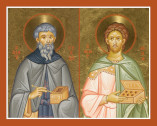 These compassionate and wonderful saints
were not blood brothers, but were brothers in spirit. Cyrus (Kyros) lived at first in Alexandria,
and working as a doctor, healed people by the power of Christ together with medicine for the
body. Discovering that illness came upon people mainly through sin, he always told them to
cleanse their souls from sin by repentance and prayer, that they might be restored and
strengthened in body. When Diocletian began his persecution of Christians, Cyrus went off to
Arabia, where he received the monastic schema. But, as he had become known in Alexandria, so he
became known also in Arabia, and people went to him for help. John, hearing of him and being at
that time a Roman officer in Edessa, came to Arabia to see Cyrus. On seeing each other, they
loved each other as brothers and remained together to live in asceticism. At that time, a
Christian woman called Athanasia was tortured together with her three daughters in the town of
Canopus. Cyrus and John heard of this and came to Canopus to encourage the mother and daughters
not to fall back from the Faith. And, grateful indeed for the counsel of these saints, Athanasia
endured all the tortures, and with her daughters, was slain for Christ. The daughters were:
Theoctista, age 15; Theodota, age 13; and Evdokia, age 11. Then the torturers took Cyrus and
John, and after torture and imprisonment, slew them with the sword in the year 311. These holy
martyrs performed innumerable miracles, both during their lives and after their death. Their
relics were translated to Rome in the time of the Emperor Arkadios. They are invoked for help
especially for the sleepless and for the blessing of water and food.
These compassionate and wonderful saints
were not blood brothers, but were brothers in spirit. Cyrus (Kyros) lived at first in Alexandria,
and working as a doctor, healed people by the power of Christ together with medicine for the
body. Discovering that illness came upon people mainly through sin, he always told them to
cleanse their souls from sin by repentance and prayer, that they might be restored and
strengthened in body. When Diocletian began his persecution of Christians, Cyrus went off to
Arabia, where he received the monastic schema. But, as he had become known in Alexandria, so he
became known also in Arabia, and people went to him for help. John, hearing of him and being at
that time a Roman officer in Edessa, came to Arabia to see Cyrus. On seeing each other, they
loved each other as brothers and remained together to live in asceticism. At that time, a
Christian woman called Athanasia was tortured together with her three daughters in the town of
Canopus. Cyrus and John heard of this and came to Canopus to encourage the mother and daughters
not to fall back from the Faith. And, grateful indeed for the counsel of these saints, Athanasia
endured all the tortures, and with her daughters, was slain for Christ. The daughters were:
Theoctista, age 15; Theodota, age 13; and Evdokia, age 11. Then the torturers took Cyrus and
John, and after torture and imprisonment, slew them with the sword in the year 311. These holy
martyrs performed innumerable miracles, both during their lives and after their death. Their
relics were translated to Rome in the time of the Emperor Arkadios. They are invoked for help
especially for the sleepless and for the blessing of water and food.
2. The Holy Martyr Tryphaena.
She voluntarily and courageously underwent harsh torture for Christ. Then, because she would not repudiate her faith, a mad ox was released which gored and killed her. This came to pass in the first century. She is invoked to help mothers who are unable to nurse their babies.
3. Our Holy Father Nikita of the Kiev Caves.
As a monk, in disobedience to his abbot, he went off and lived as a recluse in a solitary cell. For his disobedience, God sent great temptations upon him. Once when Nikita was at prayer, the devil appeared to him as an angel of light and said to him: ‘Do not pray any more, but rather read books, and I will pray in your place.’ Nikita obeyed, stopped praying and began to read books. He read only the Old Testament and was totally unable to open the New, being prevented by some diabolical strength. He also prophesied with the help of the devil—about crimes, kidnappings, fires and other evil works which were known to the devil and thence made known to him. The holy fathers of the monastery finally realized that Nikita had fallen into demonic delusion and began to pray for him. Nikita returned to himself, realized the abyss into which he had fallen, repented bitterly of his disobedience and pride and directed himself onto the right path. After long penance and many tears, God forgave him and gave him the gift of wonder-working. He entered into rest in 1108.
FOR CONSIDERATION
Although the holy fathers praised monasticism as the angelic state, and although many of the greatest saints spent their lives and achieved perfection in the silent and lifeless desert, nevertheless the Orthodox Church does not recommend monasticism to all the faithful. ‘Neither will all those in the desert be saved, nor all those in the world be lost,’ said one saint. To one city-dweller who, without any inclination to monasticism, had made up his mind to go to a monastery, St. Niphon said: ‘My son, a man is neither saved nor lost by the place he is in, but is saved or lost by his deeds. Neither a holy place nor a holy state is of use to him who does not fulfill the commandments of the Lord. Saul lived in regal luxury and perished. David lived in like luxury and received the wreath. Lot lived among the lawless Sodomites and was saved. Judas was among the apostles and went to hell. Whoever says that it is impossible to be saved with a wife and children is a deceiver. Abraham had a wife and children and three hundred and eighteen servants, and also much gold and silver, and he was called the friend of God! Many servants of the Church have been saved, and many lovers of the desert; many aristocrats, and many soldiers; many craftsmen, and many farm laborers. Be devout towards God [by loving the truth of Orthodoxy] and loving towards men, and you will be saved.’
Daily Scripture Readings taken from The Orthodox New Testament, translated and published by Holy Apostles Convent, Buena Vista, Colorado, copyright © 2000, used with permission, all rights reserved.
Daily Prologue Readings taken from The Prologue of Ochrid, by Bishop Nikolai Velimirovic, translated by Mother Maria, published by Lazarica Press, Birmingham, England, copyright © 1985, all rights reserved. Edited by Dormition Skete.