

Daily Devotional
Sunday, February 9, 2025 (NS), January 27, 2025 (OS)
No Fasting.
The commemoration of the holy New-martyrs and Confessors of the Russian Land.
If the 25th of January falls on Monday, Tuesday, or Wednesday, chant the service of the New-martyrs on the preceding Sunday. If the 25th of January falls on Thursday, Friday, or Saturday, chant the service on the following Sunday. If the 25th of January falls on Sunday, chant the service for the New-martyrs that day, and the service to St. Gregory the Theologian on the 27th of January, in conjunction with that of St. John Chrysostom; in which case the hymns to St. Gregory precede those of St. John's. Thus the service can occur as early as the 22nd of January or as late as the 28th of that month.
If the service coincides with the Sunday of the Publican and the Pharisee, or with that of the Sunday of the Prodigal Son, or with Meatfare Sunday, the service of the New-martyrs is then chanted in conjunction with the Triodion and its Prokeimenon.
If a service to a major saint should fall on the same Sunday, we chant the service to the major saint on the closest Saturday, or on some other day.
If the church's feast day should fall on such a Sunday, chant the church's feast day in conjunction with the Triodion, with no further alteration. The service of the New-martyrs is then moved to the following Sunday.
| Sunday of the Thirty-Third Week or Sunday of the Publican and the Pharisee Mode Plagal Four — Eleventh Eothinon |
The commemoration of the translation of the relics of our father among the saints, John Chrysostom, Archbishop of Constantinople.
Scripture Readings
Special Commemorations
The commemoration of the holy New-martyrs and Confessors of the Russian Land.
If the 25th of January falls on Monday, Tuesday, or Wednesday, chant the service of the New-martyrs on the preceding Sunday. If the 25th of January falls on Thursday, Friday, or Saturday, chant the service on the following Sunday. If the 25th of January falls on Sunday, chant the service for the New-martyrs that day, and the service to St. Gregory the Theologian on the 27th of January, in conjunction with that of St. John Chrysostom; in which case the hymns to St. Gregory precede those of St. John's. Thus the service can occur as early as the 22nd of January or as late as the 28th of that month.
If the service coincides with the Sunday of the Publican and the Pharisee, or with that of the Sunday of the Prodigal Son, or with Meatfare Sunday, the service of the New-martyrs is then chanted in conjunction with the Triodion and its Prokeimenon.
If a service to a major saint should fall on the same Sunday, we chant the service to the major saint on the closest Saturday, or on some other day.
If the church's feast day should fall on such a Sunday, chant the church's feast day in conjunction with the Triodion, with no further alteration. The service of the New-martyrs is then moved to the following Sunday.
Epistle
The Reading is from the Epistle of Saint Paul to the Romans [§ 99]. Brethren:
8 28We know that to those who love God all things work together for good, to those who are called according to purpose. 29For whom He foreknew, He also foreordained to be conformable to the image of His Son, in order for Him to be the firstborn among many brethren. 30But whom He foreordained, these also He called; and whom He called, these also He justified; and whom He justified, these also He glorified. 31What then shall we say to these things? If God is for us, who can be against us? 32He Who indeed spared not His own Son, but delivered Him up for us all, how shall He not with Him also graciously give us all things? 33Who shall bring an accusation against the elect of God? God is the One Who justifieth. 34Who is the one who condemneth? Christ is the One Who died, but much more is He the One also Who was raised, Who also is at the right of God, Who also intercedeth for us. 35Who shall separate us from the love of Christ? Shall affliction, or distress, or persecution, or famine, or nakedness, or danger, or sword? 36Even as it hath been written: “For on account of Thee, we are being put to death the whole day; we were counted as sheep of slaughter [Ps. 43(44):23(22)].” 37But in all these things we more than conquer through the One Who loved us. 38For I have been persuaded that neither death, nor life, nor angels, nor principalities, nor powers, nor things present, nor things coming, 39nor height, nor depth, nor any other created thing, shall be able to separate us from the love of God, which is in Christ Jesus our Lord.
Gospel
The Reading is from the Holy Gospel according to Saint Luke [§ 106]. The Lord said to His disciples, “Be taking heed of men:
21 12“For they shall lay their hands upon you and persecute you, delivering you up to synagogues and prisons, bringing you before kings and governors on account of My name; 13“but it shall prove to be a testimony for you. 14“Therefore settle it for yourselves in your hearts not to premeditate to make a defense; 15“for I will give you a mouth and wisdom, which all those who oppose you shall not be able to contradict nor withstand. 16“And ye shall be delivered up also by parents, and kinfolk, and friends, and brethren; and they shall put some of you to death. 17“And ye shall be hated by all for My name’s sake. 18“But a hair of your head in no wise shall perish. 19“In your patience win your souls.”
Paschalion — Movable Calendar
Sunday of the Thirty-Third Week or Sunday of the Publican and the Pharisee
Mode Plagal Four — Eleventh Eothinon
Epistle
The Reading is from the Second Epistle of Saint Paul to Saint Timothy [§ 296]. Child Timothy:
3 10Thou hast closely followed my teaching, conduct, purpose, faith, long-suffering, love, patience, 11persecutions, sufferings, such as happened to me in Antioch, in Iconium, in Lystra—what persecutions I endured! And out of them all the Lord delivered me. 12Yes, and all those who wish to live piously in Christ Jesus shall be persecuted. 13But evil men and cheats shall advance to the worse, leading astray and being led astray. 14But thou, keep on abiding in what thou didst learn and wast assured of, knowing from whom thou didst learn, 15and that from a babe thou hast known the sacred writings, which are able to make thee wise in regard to salvation through faith which is in Christ Jesus.
Gospel
The Reading is from the Holy Gospel according to Saint Luke [§ 89]. The Lord said this parable:
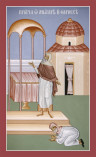
18 10“Two men went up into the temple to pray, the one a Pharisee and the other a tax collector. 11“The Pharisee, having assumed a stance, was praying these things to himself, ‘God, I thank Thee that I am not as the rest of men—rapacious, unjust, adulterers, or even as this one, the tax collector. 12“‘I fast twice a week; I tithe all things, as much as I acquire.’ 13“And the tax collector, having stood afar off, was not willing even to lift up his eyes to the heaven, but kept beating upon his breast, saying, ‘God, be gracious to me the sinner.’ 14“I say to you, this one went down to his house having been justified rather than that one; for everyone who exalteth himself shall be humbled, and the one who humbleth himself shall be exalted.”
Menaion — Fixed Calendar
The commemoration of the translation of the relics of our father among the saints, John Chrysostom, Archbishop of Constantinople.
Epistle
The Reading is from the Epistle of Saint Paul to the Hebrews [§ 318]. Brethren:
7 26Such a High Priest was fitting for us: holy, guileless, undefiled, Who hath been separated from the sinners and hath become higher than the heavens, 27Who hath no need daily, even as the high priests, to offer up sacrifices, first for his own sins, then for those of the people; for this He did once for all after He offered up Himself. 28For the law appointeth men high priests who have weakness; but the word of the oath, which is after the law, appointeth the Son, Who hath been perfected forever.
8 1Now in reference to the things being spoken of, the chief point is: We have such a High Priest, Who sat down on the right of the throne of the majesty in the heavens, 2a Liturgist of the holies and of the tabernacle, the true one, which the Lord pitched, and not man.
Gospel
The Reading is from the Holy Gospel according to Saint John [§ 36]. The Lord said to the Jews who had come to Him:
10 9“I am the door; by Me if anyone should enter, he shall be saved, and shall go in and go out and find pasture. 10“The thief cometh not, except that he might steal, and slay, and destroy. I came that they may have life, and may have it abundantly. 11“I am the good shepherd. The good shepherd layeth down his life for the sheep. 12“But the hireling, who indeed is not a shepherd, whose own the sheep are not, seeth the wolf coming, and leaveth the sheep and fleeth; and the wolf seizeth them and scattereth the sheep. 13“Now the hireling fleeth, because he is a hireling and careth not about the sheep. 14“I am the good shepherd; and I know those that are Mine, and am known of those that are Mine. 15“Even as the Father knoweth Me, I also know the Father; and I lay down My life for the sheep. 16“And I have other sheep which are not of this fold; them also it is needful for Me to bring, and they shall hear My voice; and there shall be one flock and one Shepherd.”
Synaxarion Readings
Sunday of the Publican and the Pharisee
O Creator of all above and below, as Thou receivest the thrice-holy hymn from the angels, so also from mankind receive the Triodion. He who lives like a Pharisee is far from the Church, for Christ is received within, O ye humble of heart.
With God on this present day we begin the Triodion, the hymns of which were composed by many of our holy and God-bearing fathers, inspired by the Holy Spirit according to their worthiness. The first of all was the great author St. Cosmas of Maiuma, who composed the three odes (symbolic of the Holy and life-creating Trinity) for the Great and Holy Week of the Passion of our Lord and God and Savior Jesus Christ. After him, others of the fathers, including Saints Theodore and Joseph of the Studite Monastery, following his zealous example, arranged the services of the other weeks of the Holy and Great Forty-day Fast, reserving them at first for the use of the Studite Monastery. Furthermore they composed and arranged hymns, seeking them and collecting them from other books of the fathers. Since, according to the Triodion, Sunday, the celebration of the Resurrection, is the first day of the week as well as the last or eighth day, they prescribed the first ode (canticle) of the canon to be sung on the second day of the week, i.e. Monday. The second ode was prescribed for Tuesday, the third day of the week, the third ode for Wednesday, the fourth ode for Thursday, the fifth ode for Friday, and the sixth and seventh odes for Saturday. The rest, the eighth and ninth odes, are prescribed for every day.
It must be known, however, that although it is called the Triodion, it does have services with other than three-ode canons. It is so named because the majority of the services have three-ode canons, especially during Holy Week. For it was our holy fathers’ idea that through the entire Triodion would be commemorated in a concise form all God’s benefits to us from the beginning, using it as a reminder for all of us that we were created by Him, and were exiled from Paradise through the tasting of the fruit, rejecting the commandment that was given to us for our knowledge, and we were cast out through the envy of the arch villain serpent and enemy, who was made to crawl for his arrogance; that we remained cut off from the benefits of Paradise and were led by the devil; that the Son and Logos of God, having suffered in His mercy, bowing the heavens, descended and made His abode in the Virgin and became man for our sake, showing us through His life the ascent into the heavens, through humility first of all, then by fasting and the rejection of evil, and through His other deeds; that He suffered and rose from the dead and ascended once more into heaven, and He sent down the Holy Spirit upon His holy disciples and apostles, who all proclaimed Him to be the Son of God and the most perfect God. And that once more the divine apostles acted through the grace of the most Holy Spirit and gathered all the saints from the ends of the earth through their preaching, filling the world on high, which was the intention of the Creator from the beginning.
Now the purpose of the Triodion intended by the holy fathers on these three present feasts of the Publican and the Pharisee, the Prodigal Son, and the Second Coming is a kind of preparatory lesson and stimulation to prepare ourselves for the spiritual labors of the Fast, having put aside our usual corrupt habits. First of all they present to us the parable of the Publican and the Pharisee, and they call the week following precursory. For those who desire to go off to do military battle first ascertain the time of the battle from the leaders, so that having cleaned and polished their weapons, and preparing well all their other matters, and having removed all obstacles from their path, they earnestly go forth to their labors, taking the necessary supplies. Often before battle they tell anecdotes and tales and parables to incite their hearts to zeal, driving off idleness, fear, despair, and other unworthy feelings. So the divine fathers herald the coming fast against the armies of demons as a struggle which constrains our souls to cleanse ourselves of the poison accumulated over a long period of time. Not yet possessing those benefits, let us strive to obtain them, and arming ourselves properly, so let us embark on the labors of the Fast.
Now the first weapon among the virtues is repentance and humility. And the adversary of attaining the greatest humility is pride and arrogance. So they place before us first of all this present trustworthy parable from the divine Gospel. It encourages us to shun the desire for the pride and arrogance of the Pharisee and to cultivate the opposite desire of the Publican for humility and repentance. For the greatest and most grievous passion is pride and arrogance, since this is how the devil fell from the heavens before the morning star and was cast into darkness. Because of this Adam, the father of our race, was driven from Paradise through partaking of the fruit. Through this example the holy fathers encourage all not to be proud of their successes, but to always be humble. For the Lord sets Himself against the proud, but He gives grace to the humble. Better a man who has sinned, if he knows that he has sinned and repents, than a man who has not sinned and thinks of himself as righteous. For Christ said, “I say to you that the publican went down to his house justified rather than the Pharisee.” This parable reveals that no one should exalt himself, even though he has done good deeds, but rather should always be humble and pray from his heart to God, for even if he should fall into the most serious sin, salvation is not far off.
Through the prayers of all Thy holy hymnographers, O Christ our God, have mercy on us. Amen.
Translated from Triodion, siest ‘Tripesnets: Triod’ Postnaya, Moscow, 1904, by Robert Parent.
Lives of the Saints (Prologue)
February 9th – Civil Calendar
January 27th – Church Calendar
1. St. John Chrysostom, the Golden Mouth of Orthodoxy.
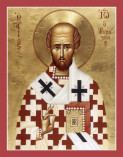 The Church celebrates the memory of this saint on November 13th and
January 30th, but on this day is celebrated the translation of his honored relics from the
Armenian village of Comana, where he died in exile in 407, to Constantinople where earlier, as
patriarch, he had governed the Church. Thirty years after his death, Patriarch Proklos made a
speech in memory of his spiritual father and mentor, and by this speech so roused the love of the
people and the emperor, Theodosios the Younger, towards the great saint that they all wanted the
relics of St. Chrysostom to be translated to Constantinople. It is related that the coffin
containing the relics could not be shifted from its place until the emperor had written a letter
to St. Chrysostom, begging his forgiveness (for Theodosios’ mother, Evdoxia, was guilty of
having persecuted the saint) and appealing to him to return to Constantinople, his former
residence. When this repentant letter was placed on the coffin, the latter became light in
weight. Before the translation, many of the sick, on touching the coffin, were healed. When the
relics arrived at the capital, the emperor again begged forgiveness over them in his
mother’s name, as though it were she herself speaking: ‘While I lived in this
temporal life, I acted in malice towards thee; but now that thou livest in eternal life, be thou
of help to my soul. My glory passes and there is nought to help me; help me, father, in thy
glory; help me before I come to be condemned before the judgment of Christ.’ When the saint
was carried into the Church of the Holy Apostles and placed on the patriarchal throne, the
assembled throng heard these words from his mouth: ‘Peace be unto all!’ The
translation of the relics of St. John Chrysostom was carried out in the year 438.
The Church celebrates the memory of this saint on November 13th and
January 30th, but on this day is celebrated the translation of his honored relics from the
Armenian village of Comana, where he died in exile in 407, to Constantinople where earlier, as
patriarch, he had governed the Church. Thirty years after his death, Patriarch Proklos made a
speech in memory of his spiritual father and mentor, and by this speech so roused the love of the
people and the emperor, Theodosios the Younger, towards the great saint that they all wanted the
relics of St. Chrysostom to be translated to Constantinople. It is related that the coffin
containing the relics could not be shifted from its place until the emperor had written a letter
to St. Chrysostom, begging his forgiveness (for Theodosios’ mother, Evdoxia, was guilty of
having persecuted the saint) and appealing to him to return to Constantinople, his former
residence. When this repentant letter was placed on the coffin, the latter became light in
weight. Before the translation, many of the sick, on touching the coffin, were healed. When the
relics arrived at the capital, the emperor again begged forgiveness over them in his
mother’s name, as though it were she herself speaking: ‘While I lived in this
temporal life, I acted in malice towards thee; but now that thou livest in eternal life, be thou
of help to my soul. My glory passes and there is nought to help me; help me, father, in thy
glory; help me before I come to be condemned before the judgment of Christ.’ When the saint
was carried into the Church of the Holy Apostles and placed on the patriarchal throne, the
assembled throng heard these words from his mouth: ‘Peace be unto all!’ The
translation of the relics of St. John Chrysostom was carried out in the year 438.
2. Our Holy Father Titus of the Kiev Caves.
He was at first a soldier, but receiving a wound in the head in battle, he retired from the world to the monastery of the Caves in Kiev, there to be healed and to receive the monastic schema. He spent his time in ceaseless mourning over his former sins. Before his death he was shown by a heavenly vision that all his sins had been forgiven. His relics lie in the caves of Theodosius.
FOR CONSIDERATION
Fasting is a great thing, but love is greater. If it is by fasting that devils are driven out, passions tamed, the body calmed, the spirit steadied, it is by love that God makes His abode with men. The Lord Himself emphasized fasting as necessary, but proclaimed love as the greatest commandment. In the first half of last century, Jeladin Bey, a Turk, ruled over Ochrid. He was a rebel against the sultan and an independent governor. At that time the Church was ruled by Metropolitan Kalinik. Jeladin and Kalinik, although of different faiths, were very good friends and often visited each other. It happened that Jeladin Bey condemned twenty-five Christians to death by hanging, and the execution was to take place on Great Friday. The metropolitan, deeply distressed by this event, went to Jeladin and besought him to mitigate the sentence. While they were talking, the hour of the midday meal arrived, and the bey invited the metropolitan to eat with him. A dish of lamb had been prepared for the meal. The metropolitan excused himself, as the fast (of the monastic rule, as well as of Holy Friday) prevented him from remaining to eat, and prepared to leave. The bey was angered and said to him: ‘Choose; either you eat with me and free twenty-five people from hanging, or you refrain and they hang.’ The metropolitan crossed himself and sat down to lunch, and Jeladin freed the people from the death sentence.
Daily Scripture Readings taken from The Orthodox New Testament, translated and published by Holy Apostles Convent, Buena Vista, Colorado, copyright © 2000, used with permission, all rights reserved.
Daily Prologue Readings taken from The Prologue of Ochrid, by Bishop Nikolai Velimirovic, translated by Mother Maria, published by Lazarica Press, Birmingham, England, copyright © 1985, all rights reserved. Edited by Dormition Skete.