

Daily Devotional
Thursday, January 9, 2025 (NS), December 27, 2024 (OS)
No Fasting.
Thursday of the Twenty-Ninth Week
The commemoration of the Afterfeast of Nativity, and the First-martyr and Archdeacon Stephen.
Scripture Readings
Paschalion — Movable Calendar
Thursday of the Twenty-Ninth Week
Epistle
The Reading is from the Epistle of Saint Paul to the Hebrews [§ 315]. Brethren:
7 1Melchisedek, king of Salem, priest of God the Most High—who met Abraham returning from the slaughter of the kings and blessed him, 2to whom also Abraham divided a tenth of all—which indeed is first interpreted “king of righteousness,” and then also “king of Salem,” which is, “king of peace,” 3without father, without mother, without genealogy, having neither beginning of days nor end of life, but having been made like the Son of God, remaineth a priest in perpetuity. 4Now be considering how great this one was, to whom even the Patriarch Abraham gave a tenth of the spoils. 5And indeed those of the sons of Levi, who receive the priesthood, have a commandment to take tithe of the people according to the law, that is, from their brethren, though they came forth out of the loins of Abraham; 6but he who hath no genealogy traced from them hath taken tithe of Abraham and hath blessed him who hath the promises.
Gospel
The Reading is from the Holy Gospel according to Saint Mark [§ 52]. At that time:
11 27Jesus came again to Jerusalem. And as He was walking about in the temple, the chief priests, and the scribes, and the elders come to Him, 28and say to Him, “By what authority doest Thou these things? And who gave Thee this authority that Thou mayest be doing these things?” 29And Jesus answered and said to them, “I also will question you for one word; and answer Me, and I will tell you by what authority I am doing these things: 30“The baptism of John, was it from heaven or from men? Answer Me.” 31And they were reasoning with themselves, saying, “If we should say, ‘From heaven,’ He will say, ‘Why then did ye not believe him?’ 32“But if we should say, ‘From men’?”—they were fearing the people; for all held that John was a prophet. 33And answering, they say to Jesus, “We know not.” And Jesus answered, saying to them, “Neither do I tell you by what authority I am doing these things.”
Menaion — Fixed Calendar
The commemoration of the Afterfeast of Nativity, and the First-martyr and Archdeacon Stephen.
Epistle
The Reading is from the Acts of the Apostles [§ 17]. In those days:
6 8Stephen, full of faith and of power, was doing great wonders and signs among the people. 9But there rose up some of those from the synagogue which is called that of the Libertines, and Cyrenians, and Alexandrians, and of those from Cilicia and Asia, disputing with Stephen. 10And they were not able to stand against the wisdom and the spirit by which he was speaking. 11Then they suborned men, who said, “We have heard him speaking blasphemous words against Moses and God.” 12And they stirred up the people, and the elders, and the scribes. And having set upon him, they seized him, and brought him to the sanhedrin. 13And they set up false witnesses, saying, “This man ceaseth not speaking blasphemous words against this holy place and the law; 14“for we have heard him saying that this Jesus the Nazaræan shall destroy this place and shall change the customs which Moses delivered to us.” 15And having looked intently upon him, all those sitting in the sanhedrin saw his face as though it were a face of an angel.
7 1Then the high priest said, “Are then these things so?” 2And he began saying, “Men, brethren, and fathers, hearken: The God of glory appeared to our father Abraham when he was in Mesopotamia, before he dwelt in Haran, 3“and said to him, ‘Get thee out from thy land and from thy kindred, and come here into a land which I shall show thee [cf. Gen. 12:1].’ 4“Then after he went out from the land of the Chaldæans, he dwelt in Haran. And from that place, after his father died, He removed him into this land in which ye now dwell. 5“And He did not give him an inheritance in it, not even the breadth of a footstep. And yet He promised to give it to him for a possession, and his seed after him, though he had no child.... 47“But Solomon built Him a house. 48“But the Most High dwelleth not in temples made by hand, even as the prophet saith, 49“‘The heaven is a throne to Me, and the earth a footstool of My feet; what manner of house will ye build Me,’ saith the Lord, ‘or what is the place of My rest [cf. Is. 66:1]? 50“‘My hand did make all these things, did it not [cf. Is. 66:2]?’ 51“O stiff-necked and uncircumcised in the heart and in the ears, ye always fall in a direction contrary to the Holy Spirit; as your fathers did, also do ye. 52“Which of the prophets have your fathers not persecuted? And they slew those who announced beforehand about the coming of the righteous One, of Whom now ye have become betrayers and murderers, 53“ye who received the law by the disposition of angels, and guarded it not.” 54And when they heard these things their hearts were sawn asunder, and they were gnashing their teeth at him. 55But he, being full of the Holy Spirit, gazed intently into the heaven, and saw the glory of God, and Jesus standing on the right of God; 56and he said, “Behold, I see the heavens having been opened and the Son of Man standing on the right of God.” 57And they cried out with a loud voice, and they held their ears together, and rushed upon him with one accord. 58And they cast him outside of the city and began stoning him. And the witnesses themselves laid aside their garments at the feet of a young man who was called Saul. 59And they kept on stoning Stephen as he called upon the Lord and said, “Lord Jesus, receive my spirit.” 60And having knelt down, he cried with a loud voice, “Lord, do not make this sin stand against them.” And having said this, he fell asleep.
Gospel
The Reading is from the Holy Gospel according to Saint Matthew [§ 87]. The Lord said this parable:
21 33“There was a certain man, a master of a house, who planted a vineyard, and put a hedge around it, and dug a wine-vat in it in which to press grapes, and built a tower. And he let it out to vinedressers, and went abroad. 34“And when the season of the fruits drew near, he sent forth his slaves to the vinedressers to receive his fruits. 35“And the vinedressers took his slaves, and indeed beat one, and killed another, and stoned another. 36“Again he sent forth other slaves, more than the first; and they did to them in like manner. 37“But afterwards he sent his son to them, saying, ‘They will respect my son.’ 38“But after the vinedressers saw the son, they said among themselves, ‘This is the heir. Come, let us kill him, and let us gain possession of his inheritance.’ 39“And they took him, and cast him out of the vineyard, and slew him. 40“Whenever the lord, therefore, of the vineyard should come, what shall he do to those vinedressers?” 41They say to Him, “He will evilly destroy those evil men, and will let out the vineyard to other vinedressers who shall render to him the fruits in their seasons.” 42Jesus saith to them, “Did ye never read in the Scriptures, ‘The stone which the builders rejected, this became the head of the corner; this came to be from the Lord, and it is marvellous in our eyes [Ps. 117(118):22, 23; cf. Is. 28:16]’?”
Lives of the Saints (Prologue)
January 9th – Civil Calendar
December 27th – Church Calendar
1. The Holy Protomartyr Stephen the Archdeacon.
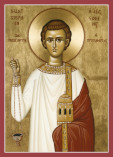 He was a kinsman of the Apostle Paul and one
of those Jews who lived in a Hellenic milieu. Stephen was the first of the seven deacons whom the
holy apostles ordained for the service of the poor in Jerusalem. This is why he is called the
Archdeacon—the first, or chief, of them. By the power of his faith, Stephen worked many wonders
among the people. The wicked Jews disputed with him, but were always confounded by his wisdom and
the power of the Spirit Who acted through him. Then the shameful Jews, adept at calumny and
slander, stirred up the people and leaders against this innocent man. They slandered Stephen,
saying that he had blasphemed against God and against Moses, and quickly found false witnesses
who supported their assertion. Then Stephen stood before the people, and all saw his face
‘like the face of an angel’: that is, his face was illumined by the light of grace as
was the face of Moses when he talked with God. Stephen opened his mouth and spoke of God’s
manifold works and marvels, performed in the past for the people of Israel, and of the
people’s manifold transgressions and opposition to God. He especially denounced them for
the slaying of Christ the Lord, calling them ‘betrayers and murderers’ (Acts 7:52).
While they ground their teeth, Stephen looked and saw the heavens open and the glory of God, and
spoke to the Jews of what he saw: ‘Behold, I see the heavens opened, and the Son of Man
standing on the right of God’ (Acts 7:56). Then the malicious men took him out of the city
and stoned him to death. Among his murderers was his kinsman Saul, later the Apostle Paul. At
that time, the most holy Mother of God was standing on a rock at a distance with St. John the
Theologian, and witnessed the martyrdom of this first martyr for the truth of her Son and God,
and she prayed for Stephen. This happened exactly a year after the descent of the Holy Spirit
upon the apostles. St. Stephen’s body was taken secretly and buried by Gamaliel in his own
ground. He was a Jewish prince and a secret Christian. Thus this first of Christ’s martyrs
made a glorious end and entered into the kingdom of Christ our God.
He was a kinsman of the Apostle Paul and one
of those Jews who lived in a Hellenic milieu. Stephen was the first of the seven deacons whom the
holy apostles ordained for the service of the poor in Jerusalem. This is why he is called the
Archdeacon—the first, or chief, of them. By the power of his faith, Stephen worked many wonders
among the people. The wicked Jews disputed with him, but were always confounded by his wisdom and
the power of the Spirit Who acted through him. Then the shameful Jews, adept at calumny and
slander, stirred up the people and leaders against this innocent man. They slandered Stephen,
saying that he had blasphemed against God and against Moses, and quickly found false witnesses
who supported their assertion. Then Stephen stood before the people, and all saw his face
‘like the face of an angel’: that is, his face was illumined by the light of grace as
was the face of Moses when he talked with God. Stephen opened his mouth and spoke of God’s
manifold works and marvels, performed in the past for the people of Israel, and of the
people’s manifold transgressions and opposition to God. He especially denounced them for
the slaying of Christ the Lord, calling them ‘betrayers and murderers’ (Acts 7:52).
While they ground their teeth, Stephen looked and saw the heavens open and the glory of God, and
spoke to the Jews of what he saw: ‘Behold, I see the heavens opened, and the Son of Man
standing on the right of God’ (Acts 7:56). Then the malicious men took him out of the city
and stoned him to death. Among his murderers was his kinsman Saul, later the Apostle Paul. At
that time, the most holy Mother of God was standing on a rock at a distance with St. John the
Theologian, and witnessed the martyrdom of this first martyr for the truth of her Son and God,
and she prayed for Stephen. This happened exactly a year after the descent of the Holy Spirit
upon the apostles. St. Stephen’s body was taken secretly and buried by Gamaliel in his own
ground. He was a Jewish prince and a secret Christian. Thus this first of Christ’s martyrs
made a glorious end and entered into the kingdom of Christ our God.
2. Our Holy Father Theodore the Branded.
Theodore and his brother Theophanes were born in Palestine and were skilled in both worldly and spiritual learning. They were monks in the community of St. Sava the Sanctified, and were there ordained priests. They suffered harsh persecution for their defense of the icons under three emperors: Leo the Armenian, Michael Balbus and Theophilus. The demented Theophilus beat them with his own hands, and ordered that they have mocking verses branded on their faces, from which they became known as ‘the Branded’. They were thrown into prison in the town of Apameia in Bithynia, and Theodore died there of his wounds. Theophanes was freed in the time of the Emperors Theodore and Michael, and was made Metropolitan of Nicaea by Patriarch Methodius. He died in 845. These two wonderful brothers suffered for Christ, and received a glorious reward from Christ in the deathless kingdom of light.
FOR CONSIDERATION
A story of the divine Christ-Child: Both great prophets, Isaias and Jeremias, prophesied that the Lord would come to Egypt, and that His presence would shake the temples and destroy the idols. Isaias wrote: ‘Behold, the Lord shall come into Egypt, and the idols of Egypt shall be moved at His presence’ (Is. 19:l; cf. Jer. 43:12,13). When the divine refugees came to the city of Hermopolis (Cairo), and came near to an idolatrous temple, all the idols in the temple suddenly fell down and were broken to pieces. Palladius writes about this: ‘We saw the idolatrous temple there, in which, at the presence of the Savior, all the idols fell to the ground’. In some place there were three hundred and sixty-five idols. When the most holy Virgin went into that temple with the divine Child in her arms, all these idols fell down and were smashed, and idols all over the land of Egypt fell in the same way.
The holy Prophet Jeremias, who had lived in Egypt in old age, had foretold to the Egyptian pagan priests that the idols would fall and all the graven images would be destroyed at the time when a Virgin Mother with a Child born in a manger would come to Egypt. The priests remembered this prophecy, and in accordance with it, depicted in their temples a virgin resting in bed with a child in a manger beside her, wrapped in swaddling bands, and they venerated this picture. Pharaoh Ptolemy asked the priests what the picture meant, and they replied that it was a mystery, foretold by a prophet to their forefathers, and that they were awaiting its fulfillment. And this mystery was indeed fulfilled, and revealed not only in Egypt, but in the whole world.
Daily Scripture Readings taken from The Orthodox New Testament, translated and published by Holy Apostles Convent, Buena Vista, Colorado, copyright © 2000, used with permission, all rights reserved.
Daily Prologue Readings taken from The Prologue of Ochrid, by Bishop Nikolai Velimirovic, translated by Mother Maria, published by Lazarica Press, Birmingham, England, copyright © 1985, all rights reserved. Edited by Dormition Skete.